‘Advocates of proportional representation need to manage their expectations – just look at New Zealand’, politics.co.uk, 6 October 2023.

Unless the Conservatives pull off the mother of all comebacks between now and next year, it looks increasingly likely that Keir Starmer will be Britain’s next prime minister.  Whether he’ll move into Number Ten with a working majority, however, is a tricky question.

If an election were called tomorrow, then Labour could feel pretty confident of winning well in excess of 350 seats.  Trouble is it won’t be.  Turkeys, especially Tory turkeys don’t vote for Christmas and Sunak, if he follows the example of most of his predecessors, will hang on for as long as he can, hoping something will turn up.

There’s no guarantee, then, that the double-figures lead over the Tories which Labour currently enjoys will last until autumn 2024.  And don’t forget, either, that it’ll take an unprecedented 13-14 point swing to deliver it even the barest of bare majorities.

True, Starmer is now seen as a better bet by more voters than Sunak.  But his star-power doesn’t come close to matching Tony Blair’s in 1997.  Nor has the party’s recent performance in local elections so far matched what New Labour achieved in the run-up to its landslide victory back then.  So a horribly-narrow win, or even a hung parliament, is still a distinct possibility.

In that case, Labour’s ability to govern confidently may end up resting on some sort of deal with one or more of the UK’s smaller parties – whether it be simply for “confidence and supply” à la Theresa May and the DUP in 2017, or else involves a full-blown coalition à la David Cameron and the Lib Dems back in 2010.

And if those smaller parties have got any sense, then the price Starmer may have to pay for whichever arrangement he plumps for is a promise to, at the very least, look into the possibility of introducing a more proportional voting system for elections to Westminster.  

Cue speculation about the consequences of PR for the UK’s party system and in particular how it might lock in a supposed progressive majority and lock the Conservatives out of power – which is clearly the aim of some of those keenest on the idea.

Re-engineering the voting system in order to do down your opponent is, of course, by no means unusual. But it rarely works out quite as well as those who do the tinkering hope it will. Certainly, as others have noted, anyone who thinks PR will put an end to right-wing government in the UK should be careful what they wish for.

Indeed, anyone who, like me, favours a move to a fairer voting system should probably dial down their expectations of how much things would change.

PR would doubtless boost the number of MPs from Britain’s so-called “minor parties” and would very probably usher in a handful of new ones to boot, one or two of whom might last long-term.  But it is less likely than some of its advocates think to blow up parliament as we know it: rather than rendering the UK’s party system unrecognisable, it will reconfigure it.

To appreciate this, just look at what happened when another Westminster-style democracy – New Zealand – switched to proportional representation in the mid-nineties.

That switch did not, in the end, completely upend the country’s politics.  Yes, there were a few new entrants, and they were of precisely the kind we’d expect to see in the UK – not least from the populist NZ First and the neoliberal ACT on the right and the Greens and a left party (the Alliance) on the left.  But Kiwi politics fairly soon settled into a familiar pattern: essentially bipolar blocs led by Labour and by National (NZ’s Tories) alternating in office, with the prime minister in each and every case being supplied by one or other of them. The election to be held on the 14 October – the tenth under New Zealand’s PR system – shows little sign of breaking that mould.

In short, to imagine PR bringing about no change in the UK would be an exaggeration. But a complete implosion of politics as we know it? Unlikely. Long-established parties have an infrastructure and a degree of brand loyalty that mean many voters will stick with the devils they know.

That said, New Zealand should serve as a warning to the smaller party that’s most likely to pressure Labour on PR in a hung parliament or tiny majority scenario – the Lib Dems. In the end, there turned out to be no place in the new eco-system for a centrist party. Like I said, be careful what you wish for.

Originally published at https://www.politics.co.uk/comment/2023/10/06/advocates-of-proportional-representation-need-to-manage-their-expectations-just-look-at-new-zealand/
Posted in Uncategorized | Leave a comment

‘State of the Conservative Party’, The House Magazine, 30 August 2023

According to Enoch Powell, “There is one thing you can be sure of with the Conservative Party, before anything else – they have a grand sense of where the votes are.”

Given the government’s evident determination to double down on policies which appeal to particular demographics – most obviously older, whiter, less well-educated and often less well-heeled voters – this is still the case. However, that strategy – divide in order to rule, if you like – proving sufficient to secure Rishi Sunak re-election next year looks increasingly unlikely.

After getting on for fifteen long and often chaotic years in office, and with virtually all the economic fundamentals currently pointing in the wrong direction, the mid-2020s looks odds-on to produce the fourth of those heavy, albeit only occasional, defeats the party has suffered since 1945.

Odds-on, of course, isn’t the same as certainty. After all, Labour needs a huge swing simply to win the narrowest of narrow majorities at Westminster. Knowing this, and knowing that Keir Starmer is no Tony Blair, Tory politicians haven’t necessarily given up the ghost – not yet at least.

And there are still factors working in their favour. The most obvious fact (and one that explains why Sunak and Hunt are content to oversee an increase in pension rates that would be regarded as ‘inflation-busting’ in any other context) is that older voters are not only more likely to vote Conservative, but far more likely to vote per se.

There’s also the nailed-on support of ‘the party in the media’ – papers like the Mail, the Telegraph, the Sun, and the Express. While they don’t directly determine the way people vote, they nevertheless contribute heavily to a climate of opinion that helps the Tories and hinders their opponents, not least by setting the agenda for broadcast news. Admittedly, promises to ‘stop the boats’ and slow progress toward net-zero have their downsides, alienating some voters at the same time as appealing to others. But make no mistake, we’ll be hearing about them endlessly between now and polling day.

Nor should we forget the way both broadcast and print outlets tend to reinforce the idea that the nation’s economy is essentially like a household’s. This persuades many people that, when times are tough, the government should be even tougher – misleading, maybe, but still an undoubted boon for what is still an essentially Thatcherite party.

Thatcher’s belief that public spending should be kept as low as possible will continue to animate the Tories, win or lose – though expect an increasingly fraught fight (both before and after the election) between Sunak-style ‘fiscal conservatives’ and Trussite tax cutters.

Whether a similarly bitter battle will take place between self-styled ‘liberal conservatives’ and the party’s anti-woke warriors is another matter, however. Even if election defeat removes a fair few of the party’s ‘Fuck off back to Francers’, Rishi Sunak, his tech-bro technocratic vibe notwithstanding, has done little or nothing to halt the party’s shift toward the populist radical right. It’s a shift that may have been initially inspired by the need to counter Nigel Farage, but it has since taken on a momentum of its own, supercharged by celebrity Brexiteers like Boris Johnson and their media cheerleaders and parliamentary stooges.

The chances, then, of anyone winning a post-election leadership contest without doubling down on that Eurosceptic, climate-sceptic, national-populist approach, while also calling for a smaller state that will supposedly “do less better” (all the while offering comfort to the country’s elderly and, indeed, its NIMBYs), seem vanishingly small.

Powell may be best known for the infamously racist and ultimately career-ending ‘Rivers of Blood speech’, but he was, first and foremost, the Conservatives’ first neoliberal populist. This is very much his party now. 

Originally published at https://www.politicshome.com/thehouse/article/state-conservative-party

Posted in Uncategorized | Leave a comment

‘Republicans seem to think their time is coming – they will be disappointed’, The i, 7 July 2023.

Ardent fans of the British monarchy needn’t lose any sleep at the sight of a few republican protesters making their feelings known during the King’s recent progress through the streets of Scotland’s capital city, Edinburgh. Even the fact that the Scottish National Party’s new leader and First Minister, Humza Yousaf, would like to see an independent country choose an elected rather than a hereditary head of state should not cause them too much concern.

What will worry them, though, is the fact that rejection of the institution to which they themselves remain unwaveringly loyal seems to be rising, albeit only very gradually: according to this year’s British Social Attitudes survey, it now stands at 25 per cent, compared to 15 per cent 30 years ago.

Clearly, that hardly represents a clear and present danger to Charles and Camilla. The monarchy still commands majority assent and residual affection. And if public approval looks rather more lukewarm than it used to, that might well be due to people drawing a predictable (if not necessarily fair) comparison between the late Queen Elizabeth and her less popular son. If so, when the crown eventually passes to Prince William, support may tick up once again. Royal births, marriages and deaths, it seems, routinely do the monarchy a favour.

But even if that does happen, the rise of republicanism looks likely to continue. That’s because there is a marked contrast between the views of older and younger generations.

YouGov polling from last autumn, for instance, makes this very clear. When asked “Do you think Britain should continue to have a monarchy in the future, or should it be replaced with an elected head of state?” only 15 per cent of those aged 65 and over opted for a republic. But support for that option grew as the pollster travelled down the age gradient, finding favour with 20 per cent of 50-64 year-olds, 31 per cent of 25-49 year-olds, and a striking 40 per cent of 18-24 year olds.

True, the latter were the only group where support for a president exceeded that for a king or queen – and even then, the gap was a mere four percentage points. True, too, that the gap not only ran in the opposite direction when it came to their elders but was also much wider – 23 for 25-49-year-olds, 52 for 50-64 year olds and a whopping 64 points for those aged 65 plus respectively. Moreover, older Brits said they felt more strongly about the issue than did their younger counterparts.

But a closer look reveals that the “Don’t know” figure for those in their late teens and early twenties was 24 points. Even if only half of that age group break for republicanism in the future, that option stands at least a chance of eventually commanding majority support.

Yet nothing is set in stone. Whether that scenario ultimately comes to pass will depend in no small part on whether a cohort effect trumps a life-cycle effect – in other words, on whether young Brits retain their scepticism towards the monarchy as they age or whether, instead, they gradually grow more attached to the institution, either as a source of comfort and continuity in troubled times or simply as a celebrity soap opera.

What happens could also depend on shifts in party political loyalties. Predictably, perhaps, support for a hereditary rather than an elected head of state increases as you move from the left to the right of the political spectrum. In YouGov’s poll only half of Labour voters opted for a monarch, compared to just under seven out of 10 Lib Dems, and between eight and nine out of 10 Tories.

We don’t know for sure, of course, whether it’s love of king (as well as country) that makes one a Conservative, or whether it’s becoming a Conservative that inclines one towards the monarchy. But if there’s any truth at all in the latter, then any eventual swing of the pendulum back to the Tories would presumably bode well for Buckingham Palace.

Republicans, then, can’t afford to simply sit back, safe in the knowledge that their time will come. Fascinatingly, for all that those at or nearing retirement age feel so positively towards the monarchy, it is they who turn out to be most pessimistic about its continuation. When asked by YouGov whether we’d still have a monarchy in a hundred years’ time, only those aged 65 and over believed on balance (by 37 for yes to 39 for no points) that we wouldn’t. Every other age group, notwithstanding the fact that more of them were republicans, thought that we would – and by an 11 or 12 point margin.

Enthusiasm for a hereditary head of state may be waning, and enmity may even be on the rise. But this is Britain, after all: acceptance and apathy will probably win the day come what may.

Originally published at https://inews.co.uk/opinion/republicans-seem-think-time-coming-they-disappointed-2462420

Posted in Uncategorized | Leave a comment

‘Will the election be another ’92 or ’97 for the Tories?’, Evening Standard, 7 July 2023.

July 20 is shaping up to be something of a Super Thursday — unless you’re Rishi Sunak. Although nothing’s certain in politics these days, there’s a serious possibility that the Tories could lose all three by-elections scheduled to take place before the summer recess.

The pain looks set to continue into the autumn when (presuming she does eventually quit) Nadine Dorries’s belated departure from the Commons will trigger another potentially tricky contest — one that may end up taking place alongside what might well prove a defeat for another beleaguered leader, the SNP’s Humza Yousaf.


If things do go badly, expect the Prime Minister (or if he goes into hiding, his party chairman Greg Hands) to play down the results as reinforcing the need for the Government to hold its nerve while the harsh economic medicine the country’s being forced to swallow supposedly works its magic. Anyway, by-elections aren’t an accurate guide to the outcome of the next election, right?

Wrong. The Tories are hoping that 2024 will turn out to be another 1992, when they snatched victory from the jaws of defeat, rather than a 1997, when they were buried by a Labour landslide. So expect them to point to the fact that, between taking over from Margaret Thatcher in 1990 and going to the country a couple of years later, John Major lost four Tory-held seats on the trot — two in by-elections to the Lib Dems and two to Labour.

But, long-term, the stats tell a different story. As Lib Dem president and big-time polling nerd, Mark Pack, pointed out, research suggests that by-election defeats — especially if a bunch of them involve big swings — tend to bode badly for incumbent governments.

Even worse, history suggests that they can create panic in the ranks: it was the loss of the Conservatives’ 17,000 majority in Eastbourne on a 20-point swing to the Lib Dems in October 1990, for instance, that finally persuaded her MPs that Mrs Thatcher had to go.


It’s unlikely, though, that these by-elections will do for Sunak. Most Tory MPs have decided it’s Rishi or bust. But if they’re lost badly, morale will hit rock-bottom — especially if it looks as if people vote tactically.

It’s worth recalling on that score that there are precious few seats where Labour and the Lib Dems are in direct competition with each other. So if they get their act together and make it obvious to voters (albeit informally) who stands the best chance in each constituency, then the Conservatives are in even greater trouble.

Although the two main opposition parties don’t quite seem to have decided who takes precedence in Dorries’ Mid-Beds seat (even if a recent poll there brought better news for Sir Keir Starmer than for Sir Ed Davey), it’s already pretty clear they’ve made up their minds in Uxbridge and in Selby (Labour) and in Somerton (Lib Dem).

These contests will also afford parties a chance to road-test their election messages. Watch (and listen) carefully.

Originally published at https://www.standard.co.uk/news/politics/super-thursday-byelections-poll-results-rishi-sunak-professor-tim-bale-analysis-b1092911.html

Posted in Uncategorized | Leave a comment

‘Why the Conservative Party is broken’, New Statesman, 21 June 2023.

George Orwell’s memorable take on Dickens, “rotten architecture, but wonderful gargoyles”, didn’t really fit the Conservatives – until recently, that is.

For most of its history, the party – run by relatively pragmatic leaders unconstrained by rank-and-file members and fuelled by no-questions-asked donations from business backers – might as well have been precision-engineered to win elections. Meanwhile, very few of the Tories we used to love to hate ever proved sufficiently nasty (or sufficiently comical) for us to call them to mind decades after they’d departed the scene.

But all that has changed. The architectural rot set in when, at the turn of the century, the then-leader William Hague persuaded his colleagues to award the final say in leadership contests to the grassroots. And it spread when some of the Tories’ biggest donors – instead of contenting themselves with simply paying an insurance policy against a Labour government and letting the politicians get on with it – began to demand a little more for their money: access, influence on the direction of the party (particularly over Europe), and honours, however controversial. The party in the media, too – proprietors, editors and columnists – became ever more ideologically vociferous. 

As a result, any MP hoping to lead the Tories will need to please not only their Commons colleagues but the Conservative crowd too – often by appealing, in an increasingly 24/7 and polarised public sphere, to its most atavistic opinions. And that – along with the need to stem any bleeding of support to its Faragiste flank – has shifted the party’s centre of gravity firmly to the nationalistic and authoritarian right.

At the same time, the gargoyles have grown wonderfully grotesque – none more so, perhaps, than the ultras of the European Research Group and the so-called Red Wall: step forward Jacob Rees-MoggSuella Braverman, Lee Anderson and Nadine Dorries.

But the greatest gargoyle of all, of course, is Boris Johnson – a populist politician so morally ugly that, in the end, not even his ardent fans in parliament, in the press and among the grassroots were able to save him from himself. 

Johnson’s early exit from the Commons, however, has arguably come too late to save the party he seemed to see as little more than a vehicle for his own all-consuming ambition. Rishi Sunak – too spineless to come to parliament and endorse the Privileges Committee’s excoriating judgement on his predecessor – shows no sign, for all his tech-bro bonhomie, of wanting to move beyond the culture wars. If anything, he looks increasingly likely to double down on the anti-woke, anti-migrant rhetoric as his promises to “deliver” on the economy look less and less likely to produce results.

Defeat at next year’s general election may, of course, be the moment the Tories are mugged by reality. But don’t assume as much. That rotten architecture and those wonderful gargoyles will likely push Sunak’s successor even further away from the mainstream. How long will it take the party get back there?

Originally published at https://www.newstatesman.com/quickfire/2023/06/conservative-party-broken

Posted in Uncategorized | Leave a comment

‘Johnson’s resignation not likely to lead to “Tory Civil War”‘, UK in a Changing Europe, 15 June 2023.

Ever since Boris Johnson announced he would be resigning his seat in the House of Commons, national newspapers have been full of stories about a ‘Tory civil war’. Indeed, that phrase has cropped up nearly as often in the week following his announcement as in the first six months of this year.

But is the Conservative Party really at war with itself right now – and from top to bottom? Or is what we are seeing simply a dramatic but essentially temporary reaction to its having decided, finally, to bin Boris Johnson?

Inevitably, the former prime minister’s enduring appeal to the party in the media (the columnists, editors and proprietors who are integral to the party and not just an external force acting upon it), as well as to some Tory members and MPs, is going to make getting shot of him completely very tricky.

But to suggest that their outrage at the way their hero has been treated amounts to civil war sets the bar for internecine conflict far too low.

Cast your mind back for a moment, to the dog days of 2018/19. Theresa May was desperately trying to garner support for her Brexit deal with the EU. The ERG (along with one B. Johnson Esq. of the parish of Uxbridge and South Ruislip) were equally desperately trying to destroy it – and her. Recall the confidence vote of December 2018 when some 117 Tory MPs – well over a third of the parliamentary Conservative Party – voted against their leader. Recall, too, the first ‘Meaningful Vote’ on her deal, which saw 118 of them troop into the No Lobby.

Now that’s what I call a civil war, certainly when you compare it to this last week when, by my reckoning, we’ve so far seen only around fifteen Tory MPs go into bat for Boris. Moreover, all of them are familiar to Tory-watchers – men and women who remain loyal to Johnson that some commentators have likened them to the ‘disciplined and deluded collection of stooges’ he once suggested were vital to anyone campaigning, as he once had, to become President of the Oxford Union.

The difference between now and then, however, isn’t just numerical. Three or four years ago there was a genuine battle of ideas – even ideals – going on: how hard a Brexit should the government be aiming for and what precisely did regaining sovereignty mean and entail? Boris Johnson, in his resignation statement, might have made passing mention of trade deals, tax cuts, EU directives, housing and animal welfare. But, in reality, it boiled down to him, him, him – and his failure to come to terms both with his ousting from Number Ten and his finally having to face the consequences of his actions, in spite of his supposedly self-evident claim (one all too often inflated by his diehard fans) to be the only Tory election-winner in town.

True, the really big splits in the Conservative Party have always seen fights over an issue conflated with competition for the crown – or, at the very least, competition for a place in ‘the court’ of whoever wears (or aspires to wear) it. As a result, arguments over what passes for high principle always take on an additional edge by being bound up with high (and therefore also low) politics. All the more so because Britain’s highly stratified class, educational and media systems mean that the characters involved have often been playing the same game with the same people for what can seem like forever.

Yet even if all politics inevitably involves not just ideas, interests and institutions, but also individuals. But hyperbolic loyalty to Johnson qua Johnson, seems to have trumped any commitment to ideology and to the preservation of party unity and to the electoral success that, in part depends on it – at least as far as some Tory newspapers, some Conservative MPs and some grassroots members are concerned.

The self-styled Conservative Democratic Organisation, for example, likes to claim that its main aim is to make the party more responsive to its rank and file. In reality, however, it is arguably little more than an extra-parliamentary fan-club for Boris Johnson – and one that, bankrolled and organised from the top-down rather than the bottom up, risks looking more astroturf than grassroots. Meanwhile, at Westminster itself, there are former colleagues of Johnson whose expressions of support and sympathy for him after in the immediate wake of his resignation hovered somewhere between outright idolatry and familiar conspiracy theory.

The idea, however, that either the CDO or the small bunch of MPs who publicly came out to support Johnson in the immediate aftermath of his resignation could possibly prosecute some kind of civil war is laughable.

The former’s conference down in Bournemouth in mid-May was far from an impressive affair, and it still has fewer than 3500 followers on twitter and only half as many on Facebook and just 141 on Instagram.

As for the MPs, we may, of course, see any vote on the Privileges Committee’s report flush out more faithful followers of Boris Johnson at Westminster – particularly if a rumoured plan to have the Commons ‘note’ rather than ‘accept’ it fails to come to fruition. But unless any rebellion even approaches the level Mrs May had to contend with before he managed to bring her down, then, can we – should we – really talk about a government and a party at war with itself? Sadly, however, I expect that we will: sometimes, whatever the truth of the matter, the headlines write themselves.

Originally published at https://ukandeu.ac.uk/johnsons-resignation-not-likely-to-lead-to-civil-war/

Posted in Uncategorized | Leave a comment

‘If the Tories lose the next election, Boris Johnson won’t be the man they turn to’, Observer, 4 June 2023.

Judging by the polls and by May’s local elections, things aren’t looking too clever for the Conservatives. No surprise, then, that talk is already turning to what will happen to them should they go down to nationwide defeat in 2024, with speculation centred on who might take over from Rishi Sunak.

But the direction the party will take if it loses next year, and who it will pick to lead it in opposition, is ultimately going to depend on just how many Tory MPs hang on to their seats in the wake of such a defeat – and who they are. And that, in turn, might depend on quite how heavy that defeat turns out to be.

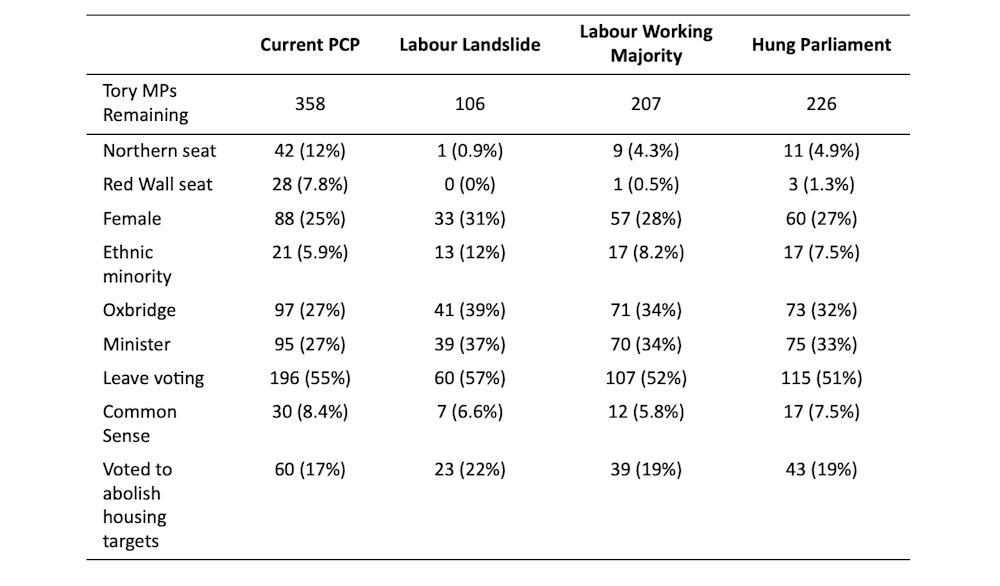
To try to get at all this, Liverpool University’s David Jeffery and I decided to model three scenarios – a Labour landslide; a relatively comfortable Labour overall majority; and a hung parliament with Labour as the largest party.

The biggest change that defeat would bring would be the exodus from the Commons of most of those Tory MPs representing constituencies in the north of England. A Labour landslide might leave just one or two northern Tories sitting at Westminster, while only about 10 to 15 would survive in the event of a comfortable Labour victory or a hung parliament. Even then, that would represent only a third of those Conservatives currently holding a northern seat.

If that does come to pass, then the party’s increasingly desperate attempt to hold on to the “red wall” by upping the ante on small boats and its anti-woke agenda – an effort that may well cost it seats in the southern “blue wall” – will have been in vain.

Defeat would also bring about demographic change. In all three scenarios women would probably make up a greater proportion of the parliamentary Conservative party, although the impact would be slightly greater in the event of a Labour landslide, with women then making up almost a third of all Tory MPs. And because many of the party’s ethnic minority incumbents sit in some of its safest seats, a really bad defeat would also see them make up a greater proportion of Conservatives in the Commons. The same incidentally goes for Oxbridge-educated Tory MPs and for current ministers.

Depressingly for pro-European progressives, Brexit true-believers would make up the majority in all three scenarios, and while the proportion of MPs associated with the anti-woke Common Sense Group would fall, the fall wouldn’t be that significant. As for the nimbys – backbenchers dedicated to opposing measures to encourage housebuilding – their strength would increase slightly, especially if there were a landslide.

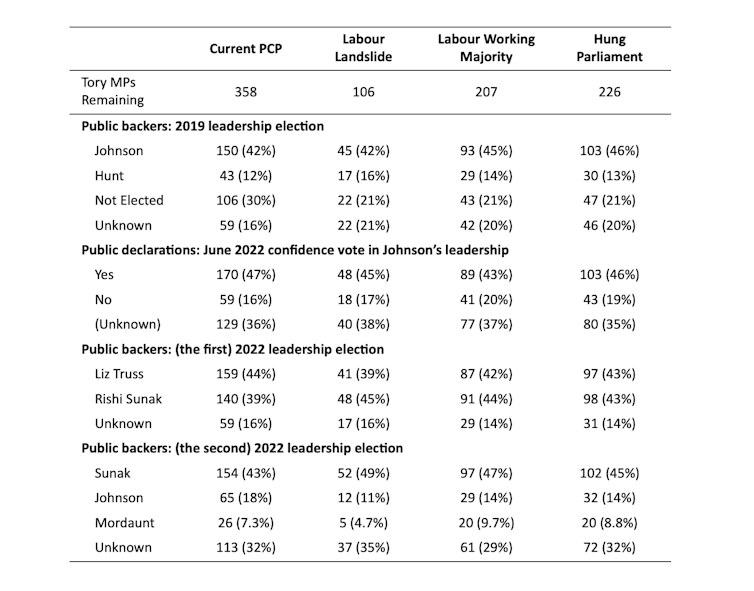
On a brighter note, there is no evidence that a post-defeat parliamentary Conservative party would turn again to Boris Johnson. Indeed, the share of MPs who publicly backed him in last year’s second, abortive, leadership contest falls from nearly one in five now to nearer one in 10 in a Labour landslide and isn’t much more significant even in a hung parliament. In any case, unless he finds himself a safer seat fairly soon, Johnson’s relatively small majority means he might not be there to take up the reins again anyway.

That said, Penny Mordaunt would be in an even weaker position to snatch the crown, even if it’s a sword rather than a dagger she decides to wield. Using public declarations in last year’s leadership contest as a baseline, her support at Westminster would fall a very long way short of what she would need to make it into the final two. And she would lose her seat in a landslide defeat in any case.

Culture warrior Kemi Badenoch, on the other hand, sitting as she does for rock-solid Saffron Walden, would still be around, and so in with a shout. The same goes for Sunak himself. Indeed, his supporters would, in our landslide scenario, comprise about half of the parliamentary party. Whether that might tempt him to stay on rather than skedaddle straight to Santa Monica, who knows?

Whoever is in charge, though, our modelling suggests that, in defeat, the Tories – no less Brexity, as well as more southern, more nimbyish, more Oxbridge than they already are – will find it more difficult than ever to argue that they truly are a one-nation party.

Originally published at https://www.theguardian.com/politics/2023/jun/04/if-the-tories-lose-the-next-election-boris-johnson-wont-be-the-man-they-turn-to

Posted in Uncategorized | Leave a comment

‘Annihilation in the red wall, an exit for a top leadership contender and a parliamentary party stuffed with southerners and Oxbridgers – how losing the next election could shape the Conservatives’, 31 May 2023 (with David Jeffery).

The Conservative party is clearly in trouble. Admittedly, opinion polls are snapshots, not predictions, but few pundits would argue Rishi Sunak will find it easy to overturn Labour’s double digit lead in the next election, especially after the Tories’ poor showing in the recent local elections. Even more worrying for Sunak, the severity of this trouncing appears to have been down, at least in part, to the willingness of those determined to eject the Tories from office to vote tactically.

It is hardly surprising that we’re beginning to see speculation about what will happen to the Conservatives in the event of a defeat at a general election, which seems most likely to take place in the autumn of 2024. Almost inevitably that has sparked debate about who might take over from Sunak should he decide to step down as leader – talk which home secretary Suella Braverman’s barnstorming speech to the recent National Conservatism conference in London has done nothing to quell.

The previous week, business secretary Kemi Badenoch’s decision to face down Brexit hardliners over the Retained EU Law (Revocation and Reform) Bill was discussed through the prism of her leadership ambitions. Even leader of the House of Commons Penny Mordaunt’s impressive ability to hold up a really, really heavy ceremonial sword for a really, really long time during the King’s coronation provoked renewed chatter about her chances for the top job.

But the direction the party will take if it loses next year, and who it will pick to lead it in opposition, is actually going to depend both on how many Tory MPs hang on to their seats in the wake of such a defeat – and on who they are. And that, in turn, might depend on quite how heavy defeat turns out to be.

Three scenarios

Here we look at three scenarios in an attempt to tease out the differences we’d expect to see in the parliamentary Conservative party. We’ve not included the seats in which MPs have announced they are resigning, because we don’t yet know who would fill these vacancies.

The first scenario is a Labour landslide that would leave just 106 of the current parliamentary Conservative party in Westminster. The second is a relatively comfortable Labour win, giving Keir Starmer a majority of around 60 over all other parties, including 207 current Conservative MPs. And the third is a result which means Labour is the largest party, and able to govern with the help of, say, the Lib Dems, either in the form of a confidence-and-supply agreement with a minority government or in full-blown coalition.

The most obvious change that any kind of defeat would bring would be the exodus from the Commons of most of those Tory MPs representing constituencies in the north of England, although this would nonetheless vary considerably according to the size of Labour’s victory. Only one northern MP would be left were Labour to win a landslide and around ten would survive in the event of a comfortable Labour victory or our hung parliament scenario. Even then, however, that would represent only a third of those Conservatives currently sitting for a northern seat. And as for holding onto the much discussed red wall, forget about it.

How election defeat would shape party demographics

A table showing how the demographics of the parliamentary Conservative party would be changed if three different election scenarios play out.
How parliament would look ideologically. T Bale/D Jeffery

Defeat would also bring about some demographic change. In all three scenarios women would make up a greater proportion of the parliamentary Conservative party, although the impact would be slightly greater in the event of a Labour landslide, with women making up almost a third of all Tory MPs. And because many of the party’s ethnic minority incumbents sit in some of its safest seats, a really bad defeat would also see them make up a greater proportion of Conservatives sitting in the House of Commons. The same incidentally goes for Oxbridge-educated Tory MPs and for current ministers.

Leavers would make up the majority in all three scenarios, and while the proportion of MPs associated with the anti-woke Common Sense Group (never as great as many imagine) would fall, the fall wouldn’t be that significant. As for the NIMBYs – the backbenchers who dedicate immense energy to opposing measures to encourage house building – their strength would increase slightly, especially if there were a landslide.

Who would lead after election defeat?

There is certainly no evidence that a post-defeat parliamentary Conservative party would flock back to Boris Johnson, regardless of the metric used. Indeed, the share of MPs who publicly backed him in last year’s second, abortive, leadership contest falls from 18% now to 11% in a Labour landslide. Even in a hung parliament the figure only rises to 14%. And in any case, unless he finds himself a safer seat fairly soon, Johnson’s relatively small majority means he might not be there to take up the reins again anyway.

The post-defeat leadership contenders: who’s in with a shout?

A chart showing how many MPs who supported various leadership contenders in the past would be left after an election defeat.
Could past leadership contenders lose supportive MPs? T Bale/D Jeffery, CC BY-ND

That said, the party’s swordbearer-in-chief, Mordaunt, would be in an even weaker position: not only would her paltry 7.3% of public supporters fall to just 4.7% of the PCP, she would also lose her seat in a landslide defeat. Badenoch, on the other hand, in rock-solid Saffron Walden would still be around and is already being tipped to do better than the creditable fourth-place finish she achieved last time around. The same goes for Sunak himself. Indeed, his supporters would, in our landslide scenario, comprise nearly half of the parliamentary party. Whether that might tempt him to stay on rather than skedaddle to Santa Monica, who knows?

Whoever is in charge, our numbers suggest that, in the event of a heavy defeat, the Tories – represented as they would be by MPs who would be still more southern, more NIMBYish, more Oxbridge than they already are – could find it more difficult than ever to argue that they truly are a One Nation party.

Originally published at https://theconversation.com/annihilation-in-the-red-wall-an-exit-for-a-top-leadership-contender-and-a-parliamentary-party-stuffed-with-southerners-and-oxbridgers-how-losing-the-next-election-could-shape-the-conservatives-206652

Posted in Uncategorized | Leave a comment

‘Essex pub dispute: do people really still think golliwogs are OK? I conducted a snap survey’, The Conversation, 12 April 2023.

The landlady of a pub in Essex has been expressing bemusement about the complaints of “snowflakes” after her display of golliwog dolls attracted the attention of the county’s police – only for them to be told, reportedly by the home secretary Suella Braverman, that they shouldn’t be wasting their time on such “nonsense”.

Six years ago, a not dissimilar incident unfolded in a cafe at the foot of the South Downs in Sussex, where the proprietors’ insistence on displaying a golliwog behind the counter prompted a complaint from a dismayed member of what Braverman terms the tofu-eating wokerati (namely me). On that occasion, however, it was the proprietor who called the police on the snowflake – even if, much to my disappointment, they never turned up in the end.

That incident prompted me, with the help of the polling organisation YouGov, to do a spot of survey research on public attitudes to golliwogs in England, Scotland and Wales. Was I a hopelessly politically correct outlier? Could I possibly be entirely alone in feeling more than a little uncomfortable about them?

The results were, to use a cliche, shocking but not surprising, at least to me. It turned out that some 63% of the public didn’t think it was racist to sell or display a golliwog doll – although, interestingly, slightly fewer people (53%) thought it “acceptable” to do so. Those who thought it was racist made up just 20% of the sample, and those who thought it unacceptable 27%. The rest said they didn’t know.

But that was then, this is now. The Black Lives Matter movement and the support given to it by prominent celebrities (not least some English footballers) has since loomed large in the national debate. Its advocates might reasonably expect attitudes to have shifted in their direction. And given there were pretty big differences between the attitudes of younger and older people in 2017, as well as between graduates and non-graduates, they might expect demographic change and the expansion in higher education to have helped too – if only at the margins.

YouGov was kind enough to repeat the exercise this week to see whether such a shift had indeed occurred. And lo and behold, it had – although not for everyone.

Six years ago, a majority said selling or displaying a golliwog doll wasn’t racist. Now it’s a minority. True, that minority still makes up nearly half the population, but a 15-point drop from 63% to 48% in a little over half a decade seems pretty significant. Meanwhile, the proportion of people who think it is racist has gone up from a fifth to just over a quarter (from 20% to 27%), with another 25% (up from 17% in 2017) opting for “don’t know”.

There’s been a similar “progressive” shift when it comes to whether selling or displaying golliwogs is or isn’t acceptable. The proportion of people who think it is acceptable has dropped 14 points from 53% to just 39% since 2017, with the proportion who think it isn’t rising from 27% to 34%. There’s been an identical increase (from 20% to 27%) in those saying “don’t know”.

The enduring divisions

Age continues to play a huge part in all this: a stunning 74% of those aged 65 and over continue to insist that selling or displaying a golliwog isn’t racist – a view confined to a mere 13% of 18- to 24-year-olds.

Among the older group, 64% say it’s acceptable to display one. Only 10% of the younger group agree. Education also continues to matter: twice as many graduates (42% – up 11% on 2017) as non-graduates (21%) say it’s racist.

There are, too, significant differences on both counts between those living in an ethnically diverse city like London and other parts of the country, and between middle- and working-class people, with those living in the capital and middle-class people more likely to brand the selling or display of golliwogs as racist and unacceptable.

What’s most striking, though, is the difference partisanship still plays in people’s attitudes. Only 13% of Conservative supporters and people who voted leave in the 2016 Brexit referendum think selling or displaying golliwogs is racist.

That figure (more or less depressingly, depending on your point of view) represents an insignificant change on six years ago. It is also dwarfed by the 47% of Labour supporters and 42% of remain voters who think the same about displaying these dolls.

Essentially, when it comes to golliwogs at least, the times are changing. Unless, that is, you’re old, less-educated, a Tory, a “leaver”, or a certain pub owner in Essex – in which case you’re more likely to be heard singing the same old song, and will probably continue to do so until, eventually and inevitably, your voice falls silent.

Originally published at https://theconversation.com/essex-pub-dispute-do-people-really-still-think-golliwogs-are-ok-i-conducted-a-snap-survey-203632

Posted in Uncategorized | Leave a comment

‘Can the Tories hold off a Labour landslide at the next election?’, Politics Home/The House, 5 April 2023.

Ginger Rogers may be better known as a movie star than as a political strategist, but since Liz Truss trashed its already badly-tarnished brand last autumn, the Conservative Party has had little choice but to follow her advice.

“Nothing’s impossible I have found,” sang Rogers in the appositely-named Swing Time, “For when my chin is on the ground, I pick myself up, dust myself off, start all over again.”

Sure, by the time they fight the next general election the Tories will have spent 14 years in power. And sure, they’re currently miles behind Labour in the opinion polls. But they’ve got a new leader, and they’re not giving up hope just yet. So are they right to think nothing’s impossible?

The precedents, we should remember, aren’t entirely discouraging. In 1992 and 2015, most pundits were predicting defeat for John Major and David Cameron respectively. Yet both men pulled off unexpected victories.

Moreover, Labour has a massive mountain to climb if it’s to win a majority in 2024. True, it might not need the 13-point swing that some claim, but – as the polls begin to narrow as we approach the election itself – even the seven or eight point lead some analysts calculate is required could begin to look like a big ask.

Then there’s the way that Rishi Sunak is busy “scraping the barnacles off the boat”. With Jeremy Hunt’s help, he’s undone at least some of the damage done to the government’s reputation by Liz Truss and Kwasi Kwarteng. High-profile industrial disputes look as if they might be on the way to being resolved, too. And with the signing of the Windsor Framework, Sunak has improved relations with the EU at the same time as inflicting a humiliating parliamentary defeat on the self-styled Spartans of the ERG, as well as on Boris Johnson and assorted has-beens on the back benches. Meanwhile, Johnson’s woeful performance in front of the Privileges Committee seems to have finally put paid to damaging leadership speculation.

As a result, Sunak’s personal ratings are on rise – not spectacularly so but enough to put him in touching distance of Keir Starmer, whose own ratings, remember, are hardly stellar. Voters’ evaluation of party leaders aren’t the be-all and end-all but still count for something.

So, of course, do their evaluations of the economy, and these are likely to improve as the government hits its laughably modest targets on growth and inflation and then doles out a few tax cuts next year. Meanwhile, Sunak’s “Stop the Boats” pledge might bring back a few proverbial Red Wall voters into the fold – particularly if broadcasters can be encouraged to follow the Tory press which still does so much (too much, some say) to set their agenda.

For all that, however, the fundamentals don’t auger well for the Tories. The Budget ensured that most of us will find ourselves paying far more tax this year, while polling suggests that voters didn’t think it did much to help them with what, for all-too-many, really is a cost of living crisis brought on by stagnant, if not falling, real wages. Throw in the fact that people know full well that the NHS is struggling badly, and you have a ready-made recipe for a Labour landslide – especially if the SNP begins to lose its hold over Scotland and the Lib Dems can pick up 15 or so Tory seats in the so-called Blue Wall.

Finally, anyone expecting the Tories tough talk on asylum to save their bacon might need to think again. For one thing, it’s unlikely to trump voters’ concerns about the economy and public services. For another, there’s a serious risk that Sunak ends up overpromising and under-delivering – something which could even tempt Nigel Farage back into frontline politics. If that happens, and he decides to contest Tory as well as Labour seats this time around, it really will be game over for the government.

Originally published at https://www.politicshome.com/thehouse/article/tories-hold-off-labour-landslide-next-election

Posted in Uncategorized | Leave a comment