‘Europe is marching to the right. Can Keir Starmer carry the centre-left torch?’, Observer, 14 January 2024.

If Keir Starmer’s Labour party wins power this year, it will be bucking a trend. In many European countries, it’s not the centre left but the right – and all too often the far right – that seems to be on a roll.

In France, Marine Le Pen’s Rassemblement National is leading in the polls. In the Netherlands, Geert Wilders’ equally extreme Freedom party (PVV) scooped nearly a quarter of the vote at last November’s general election and has increased its support as coalition negotiations drag on.

In Italy, Giorgia Meloni, leader of the supposedly “post-fascist” Fratelli d’Italia (Brothers of Italy), is already running the country. And, although Rishi Sunak’s new best friend is playing nice with foreign leaders, at home she’s attempting to make yet another change to the country’s electoral system. If she gets her way, not only will Italy get a directly elected prime minister but whichever party emerges as the largest at the next election (as Fratelli did in 2022 with just 26%) will win a majority of parliamentary seats irrespective of its vote share.

The situation in Germany is not much rosier. In 2021, the Social Democrats (SPD), led by the defiantly uncharismatic centrist, Olaf Scholz, won a narrow victory, enabling them to form a “traffic light” coalition with the Free Democrats and the Greens.

Sadly, things have gone downhill ever since. With the country mired in a so-called winter of discontent, the SPD is now polling at just 15%, down 10 points on its 2021 showing, putting it in third place behind not only the Christian Democratic CDU/CSU (on 32%) but also the worryingly extreme Alternative for Germany (AfD), which now has the support of over one in five Germans.

A “black-blue” (CDU/CSU and AfD) coalition after 2025’s general election remains unlikely but it can’t be ruled out. Indeed, talking up the possibility may actually be the SPD’s only hope of a last-gasp recovery.

After all, framing last year’s election in Spain as “a showdown between the forces of progress and the forces of reactionary conservatism” represented by a putative government of the centre-right Partido Popular and the far-right Vox saw the socialist prime minister, Pedro Sánchez, of the Spanish Socialist Workers’ party (PSOE), snatch victory from the jaws of defeat. Whether his subsequent decision to cling on to office via a controversial deal with Catalan separatists is such a wise move, however, remains to be seen.

Sánchez’s dramatic escape and Vox’s disappointing performance serve as a useful caveat to anyone overly inclined to see the far right triumphing and the centre left losing everywhere they look. So, too, at least for the moment, do Denmark and Norway. That said, it is impossible to deny that the 21st century has seen the far right thrive and the centre left descend into long-term decline throughout western Europe.

The reasons are myriad and complex, and they vary between countries. We do need, though, to avoid falling into the trap of assuming that, simply because populist radical right parties have increased their support at the same time as social democratic parties have lost theirs, the change is due to working-class voters moving en masse from one to the other.

Indeed, the latest research suggests that this is far from the case, with most of those flocking to the far right coming either from more mainstream rightwing parties or from the ranks of the serially disillusioned. Meanwhile, many of those fleeing the centre left are going either to the Greens and the radical left or (and this should never be underestimated) switching to the centre right rather than the far right.

In fact, the loss of traditional working-class voters experienced by Europe’s centre left is mainly due to the disappearance of many of the industrial, often heavily unionised, jobs that they used to do, and the concomitant rise in more diverse, fragmented and, frankly, more middle-class, service-sector employment.

Yet there’s an extent to which centre-left parties only have themselves to blame. And that includes Labour, even if, so far, it has got off relatively lightly compared with its continental counterparts – thanks mainly to first-past-the-post discouraging Britain’s progressive voters from supposedly “wasting” their vote on more radical alternatives.

By insisting for years that we should all embrace (or at least learn to live with) a more marketised, less welfarist economy, the centre left has sacrificed its ability to offer voters the safety net against insecurity that many, not unreasonably, still crave.

At the same time, with politics becoming an overwhelmingly graduate profession, centre-left politicians look and sound less and less like the people they claim to represent.

All this has played (and continues to play) into the hands of charismatic political entrepreneurs on the populist radical right who draw a rhetorically powerful distinction between an apparently out-of-touch establishment elite and “the people” they’ve arguably let down and ignored.

It’s a distinction that populist politicians have found particularly easy to dramatise, too, as their more mainstream counterparts, in their desperation to prove they are “listening to voters”, have consistently overpromised and underdelivered – most obviously on controlling immigration.

Those same mainstream politicians – on the centre left as well as the centre right – have also done the far right a favour by adopting many of its populist tropes and hardline policies. Rather than stealing their thunder, that strategy has served only to make them look to more and more voters like an increasingly viable and legitimate option.

Starmer, then, may be bucking the trend if he makes it into No 10. But, once he gets there, he also needs be careful. By overdoing the fiscal orthodoxy and the tough talk on migration, he could easily end up reinforcing Europe’s big shift to the right instead of becoming a beacon of hope for the continent’s battered progressives. Sometimes it’s good to be the odd one out.

Originally published at https://www.theguardian.com/commentisfree/2024/jan/14/europe-marches-right-keir-starmer-carry-centre-left-torch

Posted in Uncategorized | Tagged , , , , , | Leave a comment

‘The Conservative Party’, UK in a Changing Europe, 5 December 2023.

British voters have fallen out of love with the Conservative Party – and hopes that Rishi Sunak might persuade them otherwise are fading fast. On almost any measure, the Conservatives have fallen behind Labour. And while the Leader of the Opposition, Keir Starmer, may not be that popular, he is generally seen as a better bet than Sunak. According to Savanta, back in November 2022 some 38% of the public believed that Sunak would make the better prime minister, compared to 35% who said the same about Starmer. A year later Sunak’s score had dropped by six points to 32%, while Starmer’s had risen by the same amount to 41%.

The last general election delivered a comfortable 11.5point win for the Conservatives, giving Boris Johnson a substantial Commons majority. Now, however, average headline voting intention figures put Labour ahead by between 15 and 20 percentage points. Yet it wasn’t immediately downhill from that election. Indeed, the Conservatives widened their lead in the early weeks of the pandemic in 2020, only to see it shrink to virtually zero in the chaos that followed and then bounce back to around ten points with the vaccine roll-out in the New Year of 2021.

By the late autumn of 2021, however, Labour had drawn level, and the Conservatives have been in trouble ever since. The Partygate revelations and atmosphere of crisis around Number Ten were bad enough. But the premiership of Liz Truss proved even more disastrous, widening what had been a Labour lead of around 10% to an incredible 30 points in a few short weeks.

True, Truss’ replacement by Sunak saw a recovery from the nadir, with the gap between the parties halving in the spring of 2023 to some 15 points. However, since then, any recovery has stalled, with Politico’s latest poll of polls putting Labour on 46% and the Conservatives on 26%.

This should come as no surprise in view of the economic difficulties facing the country and the state of public services, particularly the NHS. It also chimes with Sunak’s own poll ratings. He became PM on 25 October 2022 with an average net prime ministerial approval rating of +4, which briefly rose to +8. Since then, however, his ratings have declined, and since January 2023 have essentially flatlined for months, with approval running at under 40 % and disapproval over 60%.

Even this may flatter to deceive. On a different measure – namely when voters are asked whether they have a favourable or unfavourable view of a politician or a party – Sunak’s rating fell to a new low of minus 41% at the end of August 2023, even though the Conservatives ‘recovered’ slightly to -48. A mere 8% said they had a favourable view of Sunak but an unfavourable view of the Conservatives – not many more than the 5% who said the opposite – suggesting Sunak is no longer much of an asset. Some 60% of those asked had an unfavourable view of both leader and party. This compares with the 45% who said the same of Starmer’s Labour.

While Labour’s rating is hardly stellar, it can take some comfort not only from Conservative scores but also from some polling which suggests that voters see Starmer and Labour as ideologically closer to them than Sunak and the Conservatives. Asked to place themselves on a left-right scale running from zero to ten, the (mean) average self-placement was 4.6, with Starmer placed at 3.9 and Labour at 3.3. However, voters placed the Conservatives further away at 7.6 and Sunak at 7.3.

The Conservatives have also fallen behind Labour when it comes to handling the issues voters name as priorities – most worryingly, on handling the economy, where, according to YouGov polling over the summer, only one in five people thought they were the best party compared to one in four who named Labour. Eight out of ten voters thought the government was handling the economy badly.

The same was true of the NHS, where the Conservatives trailed Labour by 12 points to 40 as best party, and of immigration – long seen by Conservative MPs as one of their electoral trump cards – where the party trailed Labour by 17 to 22 points. Indeed, practically the only good news for the Conservatives was that they continued to outperform Labour as the best party to handle Brexit. Yet even there the gap between the two parties was a mere four points, and with two-thirds of voters saying the government was handling that issue badly.

It will come as no surprise if numbers like these provoke further disquiet in Conservative ranks over the coming months. Such division itself, however, risks doing further damage – some 66 % of voters were telling YouGov in mid-August 2023 that they thought the Conservatives were divided, compared to just 35% who thought the same of Labour.

Whether or not ‘divided parties lose elections’, it is almost certainly the case that governments that look exhausted and no longer in control of events are in severe danger. Unfortunately for the Conservatives, voters seem to have made up their minds: 84% of voters told YouGov in mid-August that they thought the government looked ‘tired’ and 88% reckoned it was led by, rather than leading, events.

By the beginning of September 75% of people told pollsters More in Common that it was time for a change of government – a figure that included a striking 47% of those who voted Conservative in 2019. Two devastating by-election losses to Labour towards the end of October suggested such polls painted an accurate picture of public opinion.

As the general election draws nearer, then, there may be little Sunak and his colleagues can do other than to focus on his five priorities and hope that something will turn up. Stranger things have happened, of course – but not as often as he would like.

Originally published at https://ukandeu.ac.uk/wp-content/uploads/2023/12/UKICE-The-State-of-Public-Opinion-2023-2-.pdf

Posted in Uncategorized | Tagged , , , , , | Leave a comment

‘The Tories have changed direction – but they may not be headed where you think’, Daily Telegraph, 18 November 2023.

With only a year or less to go before a general election, one would have thought the Conservative Party’s historic will to power would by now have begun to reassert itself, ensuring that its members set aside their differences in order to take the fight to Labour. 

No such luck. Rather than subsiding, what’s now routinely described as “the Tory civil war” seems to have entered a new, even more vicious phase. The Prime Minister’s decision to sack Suella Braverman and bring back David Cameron has been widely interpreted as Rishi Sunak finally deciding to align himself and his party with the supposedly “moderate” centre-Right. Frozen out, in this take, is the populist radical Right personified by the now former home secretary and another ex-PM, Red Wall-winning Boris Johnson. The inevitable conclusion is that the two camps are now set for a tooth-and-nail fight to the death. 

But is the reality as simple as that?

The ‘zealots’

No sooner had news of the reshuffle emerged than supporters of “Suella” – who like Johnson now goes by her first name in politics – were rushing to declare their dismay. Writing for The Telegraph, Miriam Cates and Danny Kruger, founders of the New Conservatives – a collection of 20 or so MPs who mostly represent seats in the North and the Midlands – claimed that, “instead of returning us to the promises of 2019, this reshuffle looks more like an attempt to reconvene the class of 2015”.

Theirs is only the latest of a long line of Tory backbench ginger groups inspired by the success of the European Research Group, which stiffened the Government’s stance on Brexit. The aims of this latest ‘party within a party’, are threefold: It aims to “support legislation that delivers on the priorities of the people”; “to develop ideas for the 2024 Conservative Party Manifesto”; and to “campaign and raise funds for New Conservative candidates in marginal seats”. The fact that the New Conservatives have John Hayes as their honorary president is also significant. In both policy and personnel there is considerable overlap with Hayes’ very own Common Sense Group, which has been around since the summer of 2020 and operates in essentially the same ideological space.

Its 2021, occasionally hyperbolic collection of essays, Common Sense: Conservative Thinking for a Post-Liberal Age, sets out clearly what that space is: “‘Common sense’ is deemed to be the preserve of ‘the people’ and/or ‘ordinary people’ – the ‘mainstream majority’ at permanent risk of betrayal by an overly-progressive, insufficiently patriotic ‘elite’, which sneers and sniggers at their salt-of-the-earth attitudes to everything from what’s on the telly to the British empire, sex education in schools, ‘cancel culture’ in universities, and – above all – curbing immigration.”

Indeed, the latter – along with a (presumably related) concern about British women being discouraged from having all the children that they would ideally like and that the country badly needs – is something of an obsession for the Cates and Kruger group. A raft of recommendations on how to reduce the numbers coming to the UK from abroad was the subject of the New Conservatives’ first-ever report, produced in July. So it is hardly surprising that its members have been all over the media this week, urging Sunak to show the Supreme Court who’s boss.

One of them (the man he appointed Deputy Party Chairman, Lee Anderson) argued that the court’s judgment on the Rwanda plan was “a dark day for British people”: asylum-seekers, he claimed, were “intruders” and “we should ignore the law and send them back the same day.”

Its movers and shakers were just as put out by Monday’s reshuffle as they were by the Rwanda decision on Wednesday. To them the Cabinet changes signalled, as Kruger and Cates put it in an open letter published on Tuesday, “a major change in the policy direction of the Government” to the extent that “the Conservative Party now looks like it is deliberately walking away from the coalition of voters who brought us into power with a large majority in 2019” – an election which, in their words, “represented the realignment of our politics”.

Whether this “realignment” was a permanent watershed, or a more contingent, never-to-be-repeated confluence of Brexit, Boris and Corbyn, is now at the heart of the Tory in-fighting. Tory opponents of the New Conservatives point to mounting polling evidence suggesting the latter, and hint darkly that talk of realignment is actually just self-interest on the part of new Red Wall Conservative MPs, who were swept into Parliament by the unique circumstances of 2019, and who now fear being swept out of it again in 2024. Understanding which side of the “realignment” Conservative MPs are on is crucial to understanding the divide within the Party now being painted as between ‘soft’ and ‘hard’ Right; between ‘moderate’ and ‘zealot’.

The ‘moderates’

Conservatives who see themselves as not only more moderate but more realistic – the centre-Right, if you like – may have appreciated the way that Johnson pulled the party out of the nosedive it was in during the last days of Theresa May. They may also have admired the way that Johnson crushed Corbyn and, every bit as importantly, brushed aside Nigel Farage by building upon the culturally conservative coalition that May (for all the good it did her) managed to forge between affluent voters in the party’s southern heartlands and somewhat less affluent (but hardly destitute) voters in the more or less post-industrial North and Midlands.

However, they (and here at least, “they” includes Boris Johnson himself) never ran away with the idea, unlike their “faith, flag and family” colleagues, that this was somehow forever. 

Obviously, the centre-Right hoped, along with Johnson, that the party might be able to hold 2019’s winning coalition together for another election or two. Hence a combination of targeted regional and infrastructure spending (“levelling up”); some much-trumpeted bungs to the NHS (40 “new” hospitals and tens of thousands of “new” nurses); and a promise to reverse May’s police cuts. Hence, too, a limited, largely rhetorical, “war on woke”, along with a tough line on “illegal” asylum-seekers to distract from the embarrassingly liberal post-Brexit immigration regime necessitated by the UK labour market’s chronic skills shortages.

But, ultimately, as far as the centre-Right was concerned anyway, this was still an essentially Conservative government. None of the above (nor, indeed, the irritating but sadly necessary transition to net zero) should be allowed to cost the Government and its taxpayers too much money, nor do anything to reduce UK capital’s access to world markets and vice versa.

For centre-Right Tories, after all, Brexit (which most had cautioned and voted against in 2016) was risk enough. Fingers crossed it might work out well enough in the end, even if, in their view, there was little hope of pushing through the deregulation and welfare-state slashing that some of their more neo-liberal colleagues were advocating. 

As for colleagues arguing the opposite, namely that the referendum result represented a mandate and an opportunity to return to a quasi-mercantilist, even protectionist regime, they were barking – and not just up the wrong tree.

But does the reshuffle mean that the centre-Right has at last put those colleagues back in their respective boxes and that Sunak has finally outed himself as one of them all along? And does it represent not only the return of Cameron but of the Cameroons?

Back to the future?

Apparently – and unsurprisingly given how much he relied on him when he was prime minister – Cameron (who was apparently recommended for the job by his own former foreign secretary, William Hague) is still pretty thick with his former chancellor, George Osborne. Meanwhile, the latter’s one-time chief of staff (and now prospective parliamentary candidate) Rupert Harrison is on the Economic Advisory Council appointed by Jeremy Hunt, two-time secretary of state under Cameron. Moreover Danny Finkelstein, Conservative peer and author of the appositely-titled Everything in Moderation and a must-read piece in David Gauke’s recently published essay collection The Case for the Centre Right, is said to be helping Sunak prep for PMQs, as well as, along with Hague, offering him sage advice in his weekly newspaper column.

Meanwhile, front of house, there’s the trio of former Cameron-era Number 10 and CCHQ staffers – Deputy PM and Cabinet Office Minister Oliver Dowden; Laura Trott, just promoted to Chief Secretary of the Treasury; and Richard Holden, Sunak’s new Party Chairman. And then there are those, like the media-friendly scions of Conservative families, Victoria Atkins (now doing Hunt’s old job at Health and Social Care) and Laura Farris (given her first junior ministerial role in the reshuffle), who, like Energy Secretary Claire Coutinho, would surely have fitted in perfectly had they been in SW1 a decade ago.

But does one Cameron, and a handful of Cameroons, a centre-Right Tory government, let alone a centre-Right Tory Party, make? Have they really taken back control? Are they suddenly the future once again? And if there is such a thing as “the soul” of the Conservative Party, will they emerge victorious in a battle for it with the New Conservatives, or indeed with the “Trussites” of the Conservative Growth Group who are also itching to get into the fight?

The answer to all these questions is a resounding no.

The return of cakeism

The most obvious reason why not is that Sunak is clearly as determined as his predecessors (and especially, of course, Johnson) to have his cake and eat it. Yes, he’s hoping to project the supposedly moderate (but in reality broadly Thatcherite) managerial competence trumpeted (not always with good reason) by the centre-Right. But at the same time he’s keen to remind “the people” that he’s on their side when it comes to resisting the attempts of “foreign courts” to prevent him stopping the boats, to beating back “woke” and (to coin a phrase), to getting rid of at least some of the more immediately costly “green crap” (copyright D Cameron) associated with the transition to net zero.

That, after all, was what motivated some of the culture-war clichés Sunak spouted during his (failed) first leadership bid. It was what motivated his surprise appointment of another Cameron-era (albeit non-Cameroon) blast-from-the-past politician, Esther McVey (founder of the self-appointed Blue Collar Conservatives and sometime GBNews co-host), as his so-called “Minister for Common Sense”. It was what motivated his press conference promise on Wednesday to do whatever it takes to get planes taking off to Rwanda. And it was what motivated him not to sack Anderson for suggesting that those planes should leave that same day, arguing instead that “Lee’s comments reflect the strength of feeling on this issue”.

The other reason why the Cameroons – “the establishment”, “the patricians”, the “Blue-Wallers”, whatever you want to call them – won’t permanently win the day is also the reason why the Red Wall’s “send-them-backers” and Truss’s “Singapore on Thames” tendency won’t win it either.

The UK’s first past the post electoral system practically guarantees that our two main parties are essentially coalitions. In the Conservatives’ case, that coalition runs from the Reform-adjacent populist radical Right to those who like to think of themselves as “one-nation Tories”. There is, then, no such thing as what Braverman in her poison-pen letter to Sunak referred to as “an authentic Conservative agenda” – only a series of sometimes cross-cutting, sometimes complementary Conservative tendencies. And their relative strength rises and falls depending in part on which wannabe and existing MPs happen to win or lose their seats whenever a general election rolls around. A bunch of defeats in the Red Wall in 2024, for instance, will severely (if only temporarily) weaken the populist radical Right – one reason why Braverman is unlikely to win any post-election leadership contest.

Moreover, the likelihood of any of these tendencies becoming hegemonic in the party is made all the smaller by the fact that British public opinion is wide-ranging but also thermostatic. Like the central heating kicking in when it gets too cold, Tory governments that don’t spend enough to prevent public services visibly crumbling sooner or later get replaced by a Labour government that does. And just as the heating ticks off at a certain threshold, that Labour government, having done its best to restore those services, eventually gets booted out in favour of a Tory government responding to voters grumbling about high taxes.  

Arguments about cultural issues (mainly immigration), as well as questions of leadership and competence, can disrupt and delay that turn-taking – just as they did in 2019. And that can provoke in-fighting both between and within the parties, with ginger groups within each claiming to possess the secret of electoral success. They may be right – in which case they gain the upper hand for a while. But they’re never right every time – and so they lose it again.

True blue? Who?

Because the Conservative Party’s primary goal has traditionally been to keep the other lot out of power rather than to implement a self-consciously ideological programme, it has, on balance, adapted more rapidly and more successfully than its Labour opponent. It has always been helped, too, by its historic willingness to espouse an unflinching patriotism, and by the desire shared widely on its benches to keep government spending and intervention to a minimum. This means that, contrary to appearances, there is often actually far more that unites than divides its adherents, wherever they happen to sit (or claim to sit) on the Conservatives’ ideological continuum. 

Johnson sometimes challenged that unity. While he is vaunted on the Right for Brexit and trouncing Corbyn, he was far happier than Cameron to allow both spending and immigration figures to soar. For all his electoral achievements, Johnson’s opportunism on these two critical issues tugged at the social and economic threads binding the party’s disparate wings. This week’s irony is that, just as he is being derided as the embodiment of a regressive move to the soft centre, Cameron’s traditional views on spending and immigration may help glue the shards of a fractured parliamentary party together.

None of this means, of course, that Sunak will be able to turn things around electorally by next year. Nor does it mean that, should he fail to do so, the party will necessarily make a quick return to office. After all, it took 13 years (and a global financial crash) after 1997, and even then Cameron failed to win a majority. 

Moreover, flirting with populist Right-wing politics is one thing. Swallowing it whole – even if only for a while – is quite another, especially in a country that statistics show, to the frustration and fury of some, is becoming more multicultural and more socially liberal with each passing year. That is a warning to ambitious leadership hopefuls on the Tory Right like Braverman and Kemi Badenoch: it is dangerous to pull faces when the wind is changing; you don’t want to get stuck in the wrong pose.

Originally published at https://www.telegraph.co.uk/politics/2023/11/18/tories-change-direction-david-cameron-conservatives-sunak

Posted in Uncategorized | Tagged , , , | Leave a comment

‘Brexit and the “Merkel Myth”‘ (with Karl Pike), UK in a Changing Europe, 27 October 2023

Criticising prime minister Theresa May’s approach to Brexit, Nick Clegg confessed that he’d always assumed May

would jump on a plane in the dead of night without telling the press, go to Berlin, have a nice, quiet sauerkraut dinner with Angela Merkel, and say to her ‘listen this is a nightmare for us, I don’t want this, you don’t want this, Europe’s got many bigger fish to fry… let’s try and reach quickly an accommodation’.

A few months later, and just ahead of the 2017 general election, veteran Sun columnist Trevor Kavanagh encouraged the tabloid’s readers to ‘give Theresa May the landslide majority she says she needs to take on German Chancellor Angela Merkel’. And writing in its aftermath, the paper remained convinced that it was still all about the German Chancellor, noting ‘It would be ideal if Ms Merkel realised the damage a “punishment” Brexit will do to German car giants and saw reason’. If she didn’t, it continued, May should ‘get serious about walking away’.

This was all too typical: as ‘Brexit’ began to dominate British political discourse, Remainers and Leavers were united in believing that the key to limiting the damage EU withdrawal might do or, alternatively, to exploiting the opportunities on offer, lay with Angela Merkel. But nor was it anything new. Indeed, from the moment David Cameron committed in early 2013 to holding an in-out referendum should he be re-elected as Prime Minister, right through to the moment Merkel stepped down as Germany’s Chancellor nearly a decade later, many British politicians and commentators – particularly (but not exclusively) if they were Conservatives –assumed that the path to whichever outcome they were bent on ran through Berlin.

The consequences of attributing this near-miraculous power to Germany’s Chancellor were serious, not to say deleterious.  The ‘Merkel myth’ skewed the British political class’s understanding of the EU’s priorities, its objectives, and the likely outcomes of leaving.

Boiled down to its essential components, the Merkel myth was based on four widespread but ultimately false assumptions, namely

(i) that the German Chancellor (and certainly not the EU’s appointed negotiator, once the UK had voted to leave, Michel Barnier) was the ultimate decision-maker on the EU side;

(ii) that in the wake of the Eurozone and refugee crises (both of which had supposedly proved this decision-making power) Merkel would deliver on her inclination to compromise in order to preserve good relations with the UK;

(iii) that German industrial interests would push Merkel in that direction; and

(iv)  that Merkel was essentially a pragmatist and one temperamentally inclined both towards the UK and to delay deciding until late on in any process.

The third of those assumptions has probably generated the most attention – in part because it has generated the most comedy, much of it occasioned by May’s future Brexit Secretary David Davis’s assurance prior to the referendum that ‘Within minutes of a vote for Brexit the CEO’s of Mercedes, BMW, VW and Audi will be knocking down Chancellor Merkel’s door demanding that there be no barriers to German access to the British market.’ This became, as Barnier’s senior adviser Stefaan De Rynck has noted in his book, ‘a recurring meme in London during three and a half years of negotiations’.

However, the other assumptions were every bit as important, reinforced as they were not just by misreadings of Merkel’s modus operandi and her underlying motivations but by an equally misplaced faith in the importance of supposed personal chemistry.

Cameron, in particular, learned far too late that, inasmuch as he had a good relationship with ‘Angela’, it did not mean that she would help him get what he wanted and needed in his renegotiation, especially when it came to constraining free movement. Yet it was hoped – early on anyway and likewise to little eventual effect – that the apparent similarities between the two women (unflashy, clergyman’s daughters, who had worked hard to rise to the top in a man’s world) might prove useful.

All four assumptions were also underpinned by a widespread tendency among the British political class to see the EU as an essentially intergovernmental organisation often overtaken by supranational pretensions. A powerful ally like Germany, then, would allow Britain to sidestep the ‘bureaucracy’ of the Commission.

France, on the other hand, was continually seen as an antagonist – and one intent on ‘punishing’ the UK for wanting to leave the EU. This made it all the more tempting to see Germany, along with the Netherlands, ‘the Nordics’ and ‘the Baltics’, as a counterweight, thereby underestimating the ultimately unwavering commitment on its part (and on the part of its Chancellor) to what one British minister regretfully called ‘the extraordinary grip’ exerted by Europe’s ‘political project’.

Ironically, the risk that this might occur was never lost on Merkel herself. In an address to Parliament during a visit to London back in 2014, she had noted

I have been told many times during the last few days that there are very special expectations of my speech here today. Supposedly, or so I have heard, some expect my speech to pave the way for a fundamental reform of the European architecture which will satisfy all kinds of alleged or actual British wishes. I am afraid they are in for a disappointment. I have also heard that others are expecting the exact opposite… I am afraid these hopes will be dashed, too.

She wasn’t wrong. Clearly, it is one thing to listen to a speech but quite another to actually hear it.

[Tim Bale and Karl Pike’s full-length article, ‘Hopes will be dashed: Brexit and the “Merkel myth”’ is free to read in the Journal of European Integration.]

Originally published at https://ukandeu.ac.uk/brexit-and-the-merkel-myth/

Posted in Uncategorized | Leave a comment

‘Cricket fan Rishi should shun Right and hold out for a Geoff Boycott route to unlikely victory’, Evening Standard, 25 October 2023

Rishi Sunak is no magician.

Only a preternaturally talented politician could persuade voters that, after 13 long and not particularly successful years in office, his party represents the change they’re crying out for. That was the trick the Prime Minister tried to pull off at the Tory conference in Manchester but — judging from the polls and two truly spectacular by-election defeats last week — it’s one he’s signally failed to pull off.

Still, Keir Starmer and his colleagues are right to resist complacency. The Conservatives are sitting on a majority over Labour that will take a 1945/1997-style swing to overturn. And by no means everyone around Sunak has given up: some still claim to see “a narrow path to victory”.

Hope may be in short supply at Westminster and in CCHQ, but for many politicos it remains a powerful drug. The same, sadly, goes for ideology. Which is why the most vocal response in Conservative circles to the Government’s plight is to demand that it return to the eternal verities of Thatcherism by cutting spending to make room for tax cuts that are apparently the key — along with stepping up the “war on woke” and defending “the motorist” — to turning round its political fortunes.

That’s not entirely wrong. If the party is to stand a chance of holding onto the seats it flipped from Labour last time, it will need to “mobilise the base” — in its case older, whiter, less-educated voters living in England’s small towns and suburbs whose vote for Brexit (and Boris) reflected their underlying cultural and social conservatism.

But the kind of neo-liberal populism being urged on Sunak by some of his backbenchers and the Right-wing media bubble they inhabit has its limits and its downsides. For one thing, it won’t be enough to tackle or to distract from the day-to-day struggles that all too many voters face in making ends meet in an ongoing cost-of-living crisis and accessing the healthcare they rely on.

For another, banging on about small boats, speakers getting cancelled on campus, and which bathrooms and prisons people should go to — to name just a few of the “wedge issues” and “dividing lines” ministers desperately draw between the Government and the opposition — risks putting off as many voters as it excites.

If there is a narrow path to victory (or at least to damage limitation), then, it lies in Rishi Sunak rejecting those siren calls and holding his nerve in the hope that by next autumn he will, indeed, be able to argue that the economy is on the up, inflation and mortgage rates are on the way down, as are (thanks to bad weather rather than flights to Rwanda) migrant crossings and, more importantly, NHS waiting lists and times.

Sunak may be no magician, but he is, by all accounts, a genuinely keen cricketer. Between now and the general election, Prime Minister, boring Geoff Boycott rather than spectacular Ben Stokes should be your role model.

Originally published at https://www.standard.co.uk/comment/rishi-sunak-election-win-geoff-boycott-keir-starmer-b1115825.html

Posted in Uncategorized | Leave a comment

‘Plenty of time for Keir Starmer’s sheen to fade’, Financial Times, 16 October 2023

There will not be a UK general election tomorrow, however much political pollsters prod voters to say how they would vote in one. But if there were, even the most optimistic Conservative would have to concede that Labour would win, and win easily. In reality, the contest is unlikely to take place for another year.

By then, this year’s conference season, in which the opposition has had the best of it, will be a distant memory. Indeed, research that compares parties’ “before and after conference” ratings over the course of nearly 70 years suggests that any bounce Liverpool might have given Labour will deflate far sooner than that.

None of this means that Labour leader Sir Keir Starmer shouldn’t have a spring in his step. As far as we can tell what constitutes “the fundamentals” when it comes to how people vote, they seem to point to a Labour victory — or at least a Conservative defeat. Starmer will be doing everything he can to ensure that he ends up at the helm of not just the largest party but a government with a decent majority — that, however, is by no means guaranteed.

On the upside for Labour, snail’s-pace economic growth and the cost of living crisis mean that, (if they ever really went away), bread-and-butter issues are back with a bang. And, on that score, things look dire for the government.

It’s not that Labour has an overwhelming lead when pollsters ask voters which party they think is best equipped to handle key issues. On the economy, for instance, it’s only ever in single figures, and driven mainly by the fact that, while only about a quarter of respondents name Labour, even fewer (generally around a fifth) plump for the Conservatives. 

What helps Labour, however, is that some three-quarters of voters think the government is handling the issue badly. The NHS and even immigration show similar results.

It’s also personal. Starmer’s approval rating may stand at minus 12 but Sunak is on minus 40. In addition, the overwhelming majority of voters believe that the government is tired and at the mercy of events. And while two-thirds see the Tories as divided, fewer than a third say the same of Labour.

And yet, the difference in values between the UK’s graduate and non-graduate voters, a gulf that helped tip the Brexit referendum in 2016 and Boris Johnson to win comfortably in 2019, hasn’t gone away. Indeed, new research by Manchester university professor Rob Ford presented at the conferences suggests the values divide is still important — and presents as much of a challenge for Labour as it does for the Tories.

Voters who left school at 16 are more likely to think immigration is a problem and less likely to share Labour’s priorities on tackling climate change. They’re also more likely to be wary about any move on Starmer’s part to improve Britain’s relationship with the EU. As a result, Labour needs to tread cautiously, not least because those school-leavers make up a significant proportion of voters in the small-town constituencies it needs to take from the Tories to win a majority.

To do that, Labour needs a bigger swing than that achieved by Tony Blair in 1997’s Labour victory. So the party’s relatively unimpressive performance in local elections is also cause for concern. Set against that is Labour’s recent progress in Scotland and increasing evidence of anti-Tory tactical voting south of the border.

Yet the fact that support for independence is still running at 46 per cent suggests that, notwithstanding its big win in Rutherglen and Hamilton West’s by-election this month, Labour would do well to limit its ambitions to winning just 20-25 Scottish seats in the House of Commons.

So while it is hard right now to see how the Conservatives can keep Starmer out of Downing Street altogether, making it there with a comfortable (or even just a workable) majority remains a work in progress.

Originally published at https://www.ft.com/content/ace8b489-2550-4526-91a3-ee439aa33f53

Posted in Uncategorized | Leave a comment

‘Brexit and the Merkel Myth’ (with Karl Pike), The Loop, 29 September 2023

Special expectations

In 2014, on a visit to London, Angela Merkel addressed the Houses of Parliament. The then German Chancellor recognised in her remarks that British political actors seemed to have ‘very special expectations’ regarding her speech. Some people, Merkel said, seemed to be under the impression that she would signal huge reforms perceived to be in the UK’s interests. Others, she said, expected ‘the exact opposite’.

The German Chancellor, however, was not going to do either of those things. Instead, she delivered a state-of-play speech on EU integration, with a focus on the Eurozone.

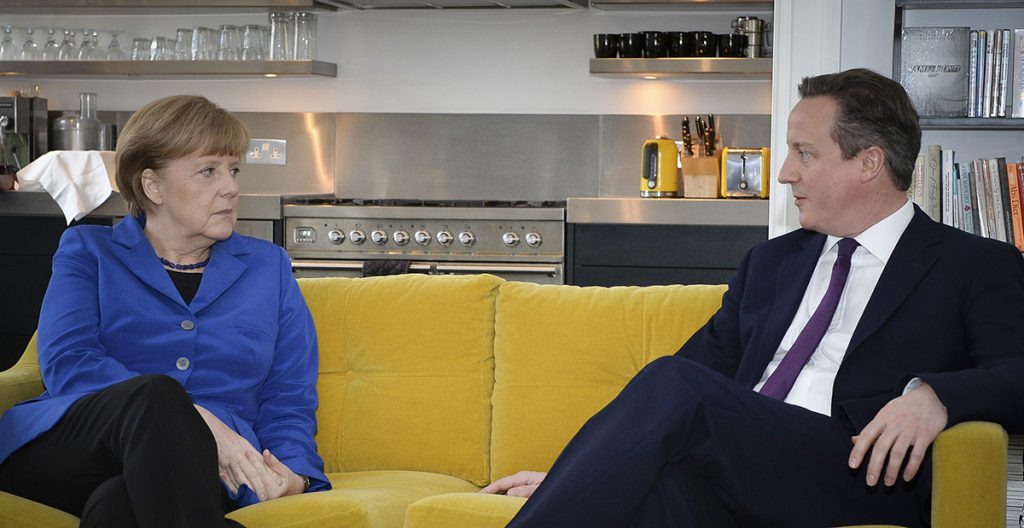
Post-lunch discussion between Angela Merkel and then UK Prime Minister David Cameron at No.10 Downing Street, 27 February 2014

Chancellor Merkel demonstrated, once again, that her overriding priority was the political and economic integrity of the European Union rather than narrower UK debates. Despite this, her message seemed to have only a limited impact on the British politicians watching – many of whom would go on to play roles in the Brexit referendum over two years later. Far too many of these politicians invested far too much faith in the ability and desire of Angela Merkel (and, by extension, Germany) to help the UK out.

Why? It is this question – and this puzzle – we sought to partly answer in our recent article. To tackle the issue, we employed the concept of political myth.

Political myths (and why we should study them)

What exactly is a myth – and a political myth? The British philosopher Mary Midgley worked throughout her career on comprehending different frameworks of meaning. Consequently, when we talk about myth, we mean much more than something popularly believed but not actually the case. Rather, and following Midgley, myths to us are one kind of tool to help humans to comprehend the world. They are products of our creating and assigning meaning to things. They are imaginative, and they are far more prevalent and important than we often recognise.

Midgley, of course, is not the only philosopher to think deeply about myth and meaning. Chiara Bottici’s recent work on political myth has restated both the importance and usefulness of the concept. Bottici notes the special ‘significance’ that a political myth accrues through the process of creating and bringing together different meanings in a political context. This idea – the ‘significance’ generated through the process – comes from Hans Blumenberg’s philosophical reflections on myth.

One further philosophical influence on our research came from Charles Taylor. In his book The Language Animal, Taylor argued that myths have the effect of combining different meanings. These meanings, in turn, produce a mythical meaning that is fully appreciated as a whole. In other words, myths have different elements, but they are understood together.

The Merkel myth

Our recent article in the Journal of European Integration argues that such a myth existed within British politics. The myth centred around Angela Merkel, and it goes some way to explaining why British politicians could hear one thing from the Chancellor (and indeed hear something similar from other experts on the EU, political, academic or otherwise), yet think quite another.

The ‘Merkel myth’ had several component parts. It featured the belief among UK political actors (a) that the then German Chancellor was the most important decision-maker within the European Union, (b) that she would more than likely deliver on her supposed commitment to smooth UK-EU relations, (c) that German industrial interests (notably carmakers) would insist upon a close and open UK-EU trading relationship, and (d) that Merkel herself was a pragmatist who would persuade her EU partners do a last-minute deal – as was apparently her habit – so the UK should hold its nerve come what may.

In 2013, David Cameron announced his decision to include, in the next Conservative Party manifesto, a referendum on Britain’s membership of the European Union. This, we argue, was the moment the Merkel myth really became a part of British politics. Merkel was considered to be the European politician who could signal what kind of deal Britain might get in a future renegotiation.

Merkel’s opinions on the plausibility of any reform were influential on Cameron’s pre-referendum renegotiation. After Britain voted to leave, her views remained a key consideration. Leave-supporting actors had blind faith that Merkel would ‘see sense’ and give Britain the deal it wanted – seemingly regardless of the EU institutions and the EU team actually empowered to negotiate on behalf of the EU27. Yet it wasn’t only those committed to leaving who bought into the Merkel myth. Those who wanted the ‘softest’ Brexit – or even no Brexit at all – figured an alternative plan could somehow be agreed with (you guessed it!) Angela Merkel.

Why did people believe this?

The often agonising (and seemingly endless) Brexit process never seemed to come close to matching the confident assumptions of British political actors. So why did so many (although not, we should emphasise, all) of them believe that Chancellor Merkel – and the German government as a whole – would ultimately come to the UK’s rescue?

We think this is another reason why ‘myth’ as a concept for understanding certain kinds of meanings is so useful. The meanings around Merkel had heightened significance within British political elites. These beliefs often seemed to paper over the cracks of the UK’s diplomatic strategy, but only ever really provided political reassurance.

That latter point (the reassurance) is, perhaps, part of the reason some British political actors upheld the Merkel myth. It provided meanings to substantiate the preferred political strategy of some actors: to undermine the solidarity of the EU27, and benefit from negotiations with individual member states perceived as sharing the UK’s economic and trade goals.

Many myths

The world is, we suspect, full of political myths. And this is why we believe the concept is very useful for political analysis. But if that’s the case, we will need further theoretical reflection, as well as more empirical case studies. Part of Mary Midgley’s philosophical mission was to unearth myths, to consider their effects, and to engage with them critically. This is the exercise we have tried to play a small part in, too. We hope others will be tempted to join us.

Originally published at https://theloop.ecpr.eu/brexit-and-the-merkel-myth/

Posted in Uncategorized | Leave a comment

‘The Tony Blair Rock Opera features bagpipes, Lady Macbeth and a wrestling match with Gordon Brown’, The Conversation, 9 October 2023

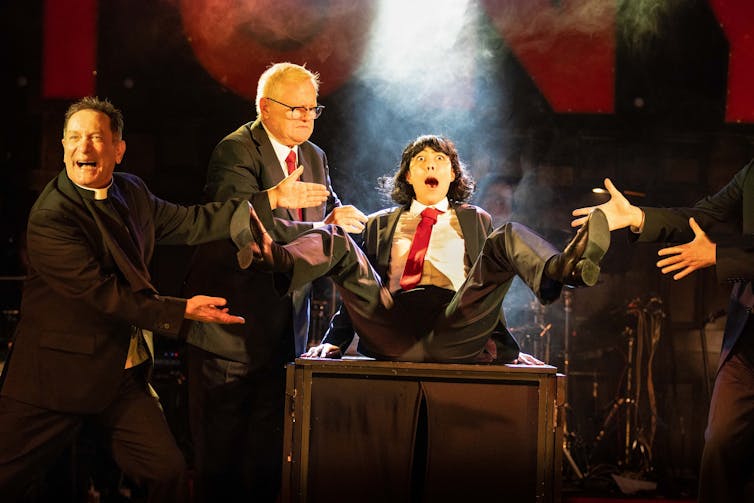
If you’re looking for subtlety and sophistication, Harry Hill and Steve Brown’s Tony! The Tony Blair Rock Opera is probably not for you. It starts – literally – with a bang and careens through a hectic hour and a half of high-energy songs and skits.

The committed cast are happy to provide their audience with caricatures, as opposed to characters. John Prescott (Rosie Strobel) is portrayed as a professional northerner, Robin Cook (Sally Cheng) as a priapic ginger gnome, Cherie Blair (Tori Burgess) as a sharp-tongued Scouser – you get the picture.Trailer for The Tony Blair Rock Opera.

Although the occasional joke misfires (blind David Blunkett walking into a door frame, really?) and some of the actors’ accents are as woeful as the deliberately dodgy wigs they whip on and off, it works on its own terms.

The music and the lyrics might not be that memorable, but the songs rhyme well. In the run up to the 1992 election, for example, Neil Kinnock (Martin Johnston) sings: “We’ve been waiting in the valleys, I’ve been storming it at rallies.” And Princess Diana’s fatal accident is neatly, if rather bluntly, summed up as “the chauffeur was smashed, no wonder he crashed”.

And they cohere nicely – perhaps even especially – when they stray beyond the bounds of good taste. Osama Bin Laden and Saddam Hussein’s numbers (the latter done via a Groucho Marx impression) are a case in point.

The occasional cameos are particularly well done (Britpop’s Liam Gallagher was a favourite of mine), the impressively athletic choreography is basic but effective and one or two of the set pieces work particularly well. The momentous Granita deal (at which Brown was persuaded to give Blair a free run at the leadership in the wake of John Smith’s untimely death) is staged as a wrestling match complete with ropes and shiny leotards. Believe it or not, this actually conveyed what was allegedly discussed and agreed during that dinner pretty accurately.

The show’s limitations

So far, so good(ish), then. But there are some downsides. The most obvious is that in order to get most of the rock opera’s jokes, you probably had to be there – “there” being the 1990s and the early 2000s. Those under 50 might struggle to appreciate some of the political and cultural references, unless they’ve done or are doing a politics degree that covered the New Labour years.

Having not only lived through them but taught them, too, I had no trouble. But that didn’t mean I had no problems with the show.

Man on stage in a long blonde wig holding a union jack guitar.
Jack Whittle in Tony! Mark Senior

First and foremost, it fell into the trap of inferring that Blair (Jack Whittle) was driven almost entirely by his love of the limelight. As a result, he is portrayed as an amoral airhead throughout – a puppet whose strings were pulled by Peter Mandelson (Howard Samuels).

In reality, I suspect even Blair’s toughest critics wouldn’t deny that his extraordinary powers of communication rested not just on his natural charisma but on a penetrating intelligence, too. Nor would they deny he was animated by a passion to do what – by his own lights anyway – was right.

Whether that sense of moral purpose (misguided or otherwise) deserted Blair once he left Downing Street and entered the shadowy world of high-paid, globetrotting consultancy is another story. But it’s a story that the authors (who were apparently determined not to write something too long) stop short of telling.

Other all too familiar tropes are much in evidence. Mandelson, who is effectively the narrator of the show, is predictably portrayed – albeit with considerable aplomb – as some sort of vampire or Mephistopheles. And by the same token, Cherie, although wonderfully played, is presented (not for the first nor, I suspect, the last time) as Lady Macbeth.

Tori Burgess as Cherie Blair in a black suit.
Tori Burgess plays Cherie Blair. Mark Senior

Meanwhile, Gordon Brown comes over (very amusingly, as far as the audience were concerned) as a stereotypical angry Scotsman. Alastair Campbell, for good or ill, only gets a brief walk-on part, coming on, complete with kilt and bagpipes, after the ghost of Princess Diana has – bear with me – persuaded Blair to sex up the “dodgy dossier”.

My main gripe, however, was with the supposedly showstopping last number. Blair, not unreasonably, reminds the audience that 9.5 million of us voted him in for a third term, notwithstanding his decision to go to war in Iraq. The song that follows declares that “The whole wide world is led by assholes”, accompanied by pictures of a bunch of strongmen leaders from around the world.

To equate the UK’s prime minister, however little one may think of him, with the likes of Kim Jong UnBashar al-Assad and Putin seems, to me at least, a category error. And, even if you disagree, the underlying message merely serves up more of the populist take on politics that, frankly, we could probably do with rather less of these days.

That said, if you happen to be in Liverpool for the Labour Party conference next week, don’t miss the chance to go see it at the city’s Playhouse. You might not love it, but there’s no way it won’t leave you laughing.

Originally published at https://theconversation.com/the-tony-blair-rock-opera-features-bagpipes-lady-macbeth-and-a-wrestling-match-with-gordon-brown-214753

Posted in Uncategorized | Leave a comment

‘Signal vs Noise at Tory Party Conference’, UK in a Changing Europe, 6 October 2023

It’s over ten years since American electoral guru Nate Silver reminded us that we need to forget about the stuff that only seems important and focus on what really matters – to distinguish, as the title of his best-selling book put it, between the signal and the noise.

In reality, of course, things are more complicated. Political parties in particular will often make one hell of a noise precisely in order to send a signal. Now and again, however, they’ll do it to obscure one. Sometimes they’ll even do both at the same time. And sometimes, of course, they’d rather there was no noise at all but are simply powerless to prevent it.

So what, in the wake of their roller-coaster of a Conference in Manchester, can we meaningfully say about the Conservatives?

We’ve now got a pretty good idea, if we didn’t have before, of how they’re hoping, under the guidance of their campaign mastermind Isaac Levido, to frame the narrative of the election as polling day draws closer.

OK, the story runs, things may not be perfect right now but they’re getting better by the day. Are you really going to take a punt on a Labour Party that doesn’t share your values? Especially when, if it’s change you’re after, then Rishi is your man. Who do you prefer? A fresh-faced, fortysomething meritocrat who’s prepared to make tough choices and bin politics as usual in order to shore up the nation’s finances and stand up to the wokerati? Or that wrinkly, flip-flopping, lefty-lawyer, Keir Starmer and the LGBTQ+ spendthrifts lined up behind him?

Moreover, we can now pretty much guarantee that this message will be amplified by the party in media – the true-blue newspapers that wasted no time in declaring Sunak’s closing speech a total triumph by the man The Times’s frontpage headline (hoping, perhaps, to render the prime minister reassuringly middle, as opposed to club, class) chose to label ‘Son of a pharmacist’, the alternative, ‘Husband of a billionaire’, presumably not quite fitting the bill.

Yet they’re going to have a tough job persuading an electorate which, if months of polling are anything to go by, already looks to have decided that the Tories are – in no particular order: responsible for a cost of living crisis and a collapsing health service; unable to ‘stop the boats’; out of ideas; at the mercy of events; and led by a guy who’s not only not quite up to the job but so stratospherically wealthy that he can’t possibly understand what life’s actually like for the rest of us.

Now, it would be an exaggeration to suggest that Conservative MPs briefing journalists in Manchester that they’re beginning to see light at the end of the tunnel know full well that it’s actually the light coming from the proverbial oncoming train. But many of them are finding it impossible not to think about who will take over from Sunak should they lose a general election likely to take place this time next year.

Given the Tory party has always been, as one of the party’s many historians memorably put it, ‘an autocracy tempered by assassination’, its annual conference is always a heady combination of beauty-contest and drive-by shooting. But this year especially so – thanks especially to a barnstorming speech by Suella Braverman and a warm-up routine by Penny Mordaunt.

If such a contest does take place, it will only serve to confirm what has been evident to those of us who have spent years studying the Conservatives but became all-too-obvious in Manchester. Namely that, if they continue to play along with the culture war stuff on the grounds that it might not be pretty but could still prove effective, then the party is in severe danger of slipping its moorings as a party of the mainstream centre-right and sailing off into the shark-infested, migrant-bashing, war-on-woke, multiculturalism-has-failed, conspiracy-fuelled waters of national populism.

True, there is a potential market for that – a fairly sizable one if support for Trump in the US and Orbán in Hungary is anything to go by – but, in a country that’s getting ever more diversemore liberal, and (whisper it softly, less Labour be listening) less Brexity, it’s probably a shrinking one, at least in the long run. And anyway there’s a tricky tension between the radical-right wing populism that some Conservatives are now espousing and the bog-standard Thatcherism that brought most of them into the party in the first place.

Unless the former is simply intended to distract from the latter (and nobody should dismiss that possibility), then eventually it entails splashing a bit more cash.That, after all, is what Boris Johnson’s claim to be ‘levelling up’ on behalf of ‘the left-behind’ was supposed to be about. But, as Manchester made clear, cutting out on supposedly profligate spending so as to make room for tax cuts (the sooner the better, naturally) is what continues to animate an awful lot of Tories. That’s why the predicted row over the cancellation of the northern leg of HS2 – whether or not it was inspired by Dominic Cummings – turned out to be a something of a damp squib, notwithstanding the damaging signal it sends about the country’s ambition and ability to see things through.

On the upside for the party, the fact that the vast majority of its MPs and activists (in public at least) rowed in behind the PM on that and almost everything else suggests that its collective will to power has not yet deserted it. Whether that will be enough to rescue Rishi Sunak from the unfortunate fate of most takeover prime ministers, remains to be seen, although the post-conference loss of the party’s deposit in the Rutherglen and Hamilton West by-election doesn’t exactly bode well.

Originally published at https://ukandeu.ac.uk/signal-vs-noise-at-tory-party-conference/

Posted in Uncategorized | Leave a comment

‘Margaret Thatcher’s part in Liz Truss’s spectacular downfall’, The Independent, 5 September 2023

Liz Truss has been called many things – many of them unprintable. Given what she did to the country’s economy, people’s mortgage repayments and the Tories’ poll ratings, that’s hardly surprising. But it still shouldn’t let her party off the hook.

Obviously, Truss, along with her similarly clever-silly chancellor, Kwasi Kwarteng , can’t wholly escape personal responsibility for what happened. After all, it was ultimately her decision to push through a tax-cutting mini-budget that, together with her refusal to let the Office for Budget Responsibility (OBR) take a look at it first, was almost bound to spook the markets.

Yet to heap all the blame and opprobrium on Truss herself is to understate the extent to which her decisions were a product of a mindset, a curse even, that has afflicted the Conservative Party for well over three decades – namely that the key to solving Britain’s socio-economic problems will always lie in asking – “What would Maggie do?”

In many ways, that reflex is understandable. Margaret Thatcher presided over a profound restructuring of the UK economy that, in some aspects at least, was long overdue and maybe even inevitable. Moreover, she did so against much of the conventional, “establishment” wisdom of the time while winning three general elections on the trot – the first from the opposition and the second and third from the government, and with massive majorities.

Nor, contrary to the arguments of some of Thatcher’s “wet” critics, is it the case that the small-state, deregulatory policies she pursued were somehow out of keeping and kilter with Tory tradition.

Indeed, one can argue – as her supporters frequently did – that she was merely returning to the eternal verities from which her post-war predecessors had either reluctantly (Churchill) or very deliberately (Macmillan) moved away.

There are, of course, more than a few holes in this convenient narrative.

For a start, the party was led for a large part of the pre-war era by Stanley Baldwin – a politician with a decent claim to be the Tories’ first genuinely “one-nation” prime minister.

And then there is the ridiculous idea that the party lost its way after 1990 because it not only dumped Thatcher herself but junked her policies too. Try telling that to anyone who lived through the John Major years – years in which even more of the public sector was privatised while health and welfare were kept chronically short of cash.

Equally, the notion that the tax rises implemented by Ken Clarke , Major’s chancellor (who, by the way, wasn’t seen as half as cuddly and centrist back then as he is now) represented a clear departure from the one true path is nonsense. Thatcher loved to talk about cutting taxes. But she also raised them in order to squeeze out inflation, shift the burden from direct to indirect taxation, and to make it look as if she was balancing the books.

Liz Truss clearly idolised Thatcher – so much so that she attracted plenty of ridicule for supposedly cosplaying the Conservative Party’s first and most successful female leader. Yet her tribute act was even more ideological than it was sartorial. As such, however, it placed her firmly within rather than outside what is now the Tory mainstream – the bog-standard Thatcherism that continues to treat its progenitor as an icon rather than the canny, often cautious and occasionally contradictory politician she really was.

Had the Tories remembered this living, breathing Thatcher instead of placing her on a pedestal, they might still have elected Truss in the summer of 2022. After all, the only realistic alternative to her as a replacement for a broken Boris Johnson was Rishi Sunak – hardly a Mr Charisma with the common touch. But she might have been less likely to have blown up her premiership within a fortnight or so by forgetting that the first woman ever to enter No 10 as prime minister was as much a fiscal conservative as a no-holds-barred state-shrinker.

True, some Tories – most evidently Sunak and those who helped run his leadership campaign – did at least recall (unlike the party in the media to whom the mini-budget initially appeared as manna from heaven) that there was rather more to their icon than simply slashing taxes.

But let’s not rewrite history here. An awful lot of their colleagues turned on Truss and against what she’d done only after it became apparent (admittedly very rapidly) that it had all gone horribly wrong. Had things turned out differently, you can bet they would have hailed her as something like the second coming. But things did go horribly wrong, and Sunak was drafted – not so much a departure from Thatcherism as simply another variant, and, as such, no less of a dead end than Truss. Unless – and until – the Tories finally move on and develop a truly 21st-century, forward-facing conservatism, then not only the party but the country as a whole looks likely to be stuck in that cul-de-sac forever.

Originally published at https://www.independent.co.uk/voices/tories-thatcher-curse-conservatives-b2404459.html

Posted in Uncategorized | Leave a comment