‘Tim Bale: Inside Labour’s massive membership base’, LabourList, 6 October 2017,

People who join political parties are abnormal.  Even if we take into account the phenomenal growth of Labour’s grassroots support since 2015, fewer than five per cent of British adults are party members.

That doesn’t mean, of course, that people who join political parties are weird. Despite a stereotype that sees them as either ideological zealots or crazed careerists, most of them are simply folk who are interested in politics and enjoy mixing with people who, like them, believe in their chosen party’s values and would much rather see them govern than the other lot.

True, there are big differences in how the members of different parties view the same issue – whether we’re talking about austerity, immigration, law and order, or Brexit.  But we need to be careful that those political differences don’t blind us to the fact that, demographically-speaking, the members of different parties may have more in common than they might care to admit.

The ESRC-funded Party Members Project that I work on with Paul Webb, from Sussex University, and Monica Poletti who, like me, is based at Queen Mary University of London, has enabled us, with the help of YouGov, to survey samples of party members immediately after both the 2015 and 2017 general elections. As a result we hope we have a pretty good idea of what Labour members, in the aggregate, look like and how they compare to members of other parties.

Our research suggests that, like it or not, Labour’s membership is not much less middle-class and less white than the memberships of its two main rivals.  Three-quarters of Labour members fall into the ABC1 category, and while this is by no means an ideal measure of class – objective or subjective – it doesn’t throw up a huge difference with the Tories and the Lib Dems, nearly nine out of ten of whose members fall into the same category. As for ethnicity, white British members make up over 95 per cent of the total in each and every one of the three parties.

That said, Labour does stand out from its counterparts when it comes to gender. Partly because of those who have joined it since 2015, the party has far more female members as a proportion of its total membership than do the Conservatives and the Lib Dems. Indeed, Labour is getting close, probably for the first time in its history, to gender parity among its members.

When it comes to where Labour members live, there is an interesting – but, given the importance, of London, by no means total – mismatch between the party’s electoral heartlands, which are in the north, and where nearly half of its grassroots supporters are located, in London and the south.

And finally, age – the thing that seems to excite so much interest, not least because it was such a big deal when it came to voting in this year’s general election. In June, the Conservatives did badly among “young” voters, those aged between 18 and 44, and where Labour performed poorly among more “middle-aged” and “older” voters.

Labour’s membership, however, doesn’t exactly mirror that split. Although the post-2015 narrative has been all about a flood of younger people into the party, the reality appears to be a little different. Sure, some young people have joined, but so too have many middle-aged people, many of them folk who left the party in the Blair era but who have now re-joined under Jeremy Corbyn.

But while the Labour membership’s age profile (28 per cent 18-44, 42 per cent 45-64 and 30 per cent 65+) might not meet the expectations of those members who would prefer it to project purely youthful idealism and energy and look “better” than that of the Lib Dems, it is at least healthier (no pun intended) than that of the Conservatives, getting on for half of whose members are at or nearing retirement age.

Now, there are bound to be caveats and criticisms of all this, arguing, for example, that way more Labour members live in London or are younger than our research suggests. And they might have a point. Even though YouGov’s work on Labour leadership elections suggests it has a pretty good handle on the party’s membership, the surveys it conducted for us will never be perfect and, given how much churn there is in parties’ memberships, it can only ever be a snapshot of a moving target.

Moreover, we would love to be able to compare and weight our data to the data on members held by the parties themselves, presuming of course that they hold it accurately and comprehensively, which in the Conservatives’ case is open to serious doubt. But, thus far, they have all proved rather reluctant to make it publicly available.

Any readers who feel we’ve got it wrong are most welcome to visit our website and email us – and, if they’re members, who knows, they might feel like putting forward resolutions at conference encouraging their parties to publish the figures themselves!

Originally published at https://labourlist.org/2017/10/tim-bale-inside-labours-massive-membership-base/

Posted in Uncategorized | Tagged , , , | Leave a comment

‘OMG Britain’s Tories are SO OLD. Conservatives are right to be worried about their lack of popularity with young Brits’, Politico, 5 October 2017.

The Tories have an age problem. In June’s general election, some two-thirds of British voters aged 18-25 voted Labour. Only one in five voted Conservative. That’s got the party worried — and rightly so.

Once upon a time, statistics like these were easier to dismiss. Young people might lean left rather than right, but since so many of them couldn’t be bothered to actually turn up at polling stations on the day, did it really matter? And weren’t they bound to see sense as they got older anyway?

Well, no actually. There is some evidence that people become slightly more conservative as they get older, but this “life-cycle” effect is potentially offset by a “cohort effect” — the idea that, since generations carry their early political preferences with them as they age, any party that loses young voters will pay a high price as time passes.

Seen from this perspective, last summer’s election is even more worrying for the Tories than it appeared at first glance.

True, they beat Labour hands down (59 percent to 23 percent) when it came to the over 65s, and comfortably (47 percent to 33 percent) when it came to those aged 55 to 64.

But among those aged between 45 to 54, Labour drew level (taking 39 percent to the Conservatives’ 40 percent). And what’s most alarming: Among 35- to 44-year-olds, Labour won by 50 percent to 30 percent, and among 25- to 34-year-olds, it led by 58 percent to 22 percent.

Admittedly, younger people — and not only in the U.K. — still vote in significantly smaller numbers than older generations. But in the 2017 election, the gap between young and old narrowed noticeably.

Wandering around and talking to people at the Conservative Party conference in Manchester, it’s obvious that a fair number of Tories know they have a problem and are beginning to wonder what they can do.

And yet, just when you think the Conservatives might figure something out, along comes a minister — in this case, self-sabotaging failed leadership contender Andrea Leadsom — to provide yet another face-palm moment.

Speaking about the brave new world that Brexit apparently constitutes for Britain’s young people (most of whom voted against it), she reassured them that “For some of you it may feel scary. But for me, on your behalf, it’s really exciting.”

If that weren’t patronizing enough, she went on to remind them of “the incredible advances in medical science, where your generation will have things fixed by robots — isn’t that extraordinary? Not only that, but probably your raspberries will be picked by robots.”

Perhaps some young adults — yes, they are adults, not toddlers — can’t wait to munch on machine-harvested fruit while recovering from android-assisted surgery. But knowing a few of them as I do in my day job as a university lecturer, I doubt that such a vision will prove sufficient to assuage their anxieties about securing a decent job.

Nor will it do much for their paramount concern: getting on the country’s increasingly unaffordable — some would say broken — housing ladder.

They’re also understandably concerned that NHS waiting lists are getting longer and longer, and primary and secondary schools are losing resources.

The Tories will have to come up with something convincing to offer people in their 20s, 30s and 40s on bread-and-butter issues if they are to have any hope of clawing back some of the support they have lost to Labour in recent years.

And doing something about university tuition fees, as the government announced it would this week, won’t cut it. Drill down into post-election survey analysis, and you will see that young people have fled the Tories because they are anxious about their future — not just because they are current or former students.

Changing how the Conservatives look and sound — and, quite frankly, are — as a party might help too. Research by the ESRC-funded Party Members Project run by Queen Mary University of London and Sussex University, suggests that nearly seven in 10 grassroots Tories are men and nine in 10 are middle-class, as opposed to working-class. It also suggests that close to half of the party’s grassroots members are older than 65, while only a quarter are aged between 18 and 45.

Attracting younger members, as well as more working-class and female members, might help address another of the party’s challenges: their members’ ability to assist the party on social media compared to their Labour counterparts.

But, crucial as it is, upping the party’s game on Facebook and Twitter won’t be enough to win back young voters on its own. Neither will scrambling to set up some half-arsed equivalent to Labour’s Momentum. Nor, by the way, will replacing Theresa May with Boris Johnson or Jacob Rees-Mogg do the trick.

True, as Labour’s Jeremy Corbyn has shown, the right leader can help enthuse and mobilize young people. But in the end, a party needs to persuade them that it’s on their side. For the Tories, that prospect still seems an awfully long way off.

Originally published at https://www.politico.eu/article/omg-britains-tories-conservatives-party-are-so-old-demographics/

Posted in Uncategorized | Tagged , , | Leave a comment

‘How the Tory party can solve its membership crisis, in three easy steps’, Guardian, 3 October 2017.

The Conservative party no longer seems capable of winning elections by a convincing margin. Nor does it attract as many members as its main rivals. Arguably, the two things are related. A successful campaign requires cash, as well as an attractive offer to voters. But it also needs members capable of selling that offer on the ground.

The fact that the party hasn’t released membership figures since 2013 (when it was apparently around 150,000) doesn’t suggest they’re very healthy. But it’s not just numbers that matter. It’s also about who those members are and what they’re prepared to do for their party. And the findings for the Conservatives aren’t great, according to research by the Party Members Project (which I help to run, and is funded by the Economic and Social Research Council).

For a start, Tory members don’t look much like voters in general. Over two-thirds are men and nearly nine out of 10 are middle class. Meanwhile, getting on for half the party’s membership is over 65, with only about one in 20 in the 18-24 age group. That helps to account for the fact that, as well as being significantly more Thatcherite on the economy than the average voter, they are socially very conservative.

The same skewed demography also contributes to the fact that Tory members seem to have done less campaigning than their counterparts in other parties at the 2017 general election. They were much less active on Facebook and Twitter, and only half as likely to display a poster. When it came to canvassing, honours were more even, and on leafleting they actually did slightly better than Labour members (though way behind the Lib Dems in that department).

But perhaps the most alarming fact is that more than four in 10 Conservative members admitted to having spent no time whatsoever helping Theresa May deliver the party’s message to voters during the election. Perhaps this dovetails with the finding that when talk turns to politics in social or work situations, Tory members seem more reluctant than members of other parties to open up to friends and colleagues about their political affiliation.

So much for the problems. What about the solutions? How does the Conservative party bag itself more boots on the ground? Our research, because it took in both members and people who strongly support the party but don’t belong to it, offers a few clues.

First, the party needs to work hard to dispel a number of pervasive myths about membership. Far too many potential members wrongly believe people join parties for essentially self-interested reasons, or simply because they belong to a certain family or social milieu – and that they end up spending huge amounts of time on mind-numbingly boring tasks.

Second, the party needs to do more to persuade people that its members are respected by the leadership and can actually play a part in determining its direction. Currently, a third of Tory members (compared with well under 10% of Labour, Lib Dem and SNP members) don’t believe – and they’re right not to – that they are respected, and more than half of them would like to see the membership have more influence on policy.

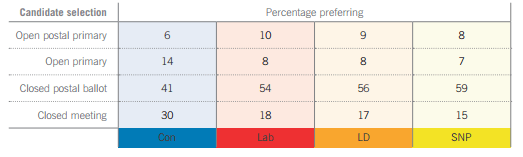
Last, the party needs to avoid giving the impression that, in an ideal world, it would really rather not involve its members even in choosing its leader – something that’s happened in two out of the past three Tory leadership contests. Around one in six of those who strongly support the party but don’t actually belong to it said it might be worth joining to have a say in who got the top job next time round. Sure, balloting the grassroots introduces more uncertainty into the process. It also involves revealing to the world just how many (or how few) members the party really has. But if it helps bring in fresh faces, then that’s a risk very much worth running.

Originally published at https://www.theguardian.com/commentisfree/2017/oct/03/tory-party-membership-crisis-members-conservatives

Posted in Uncategorized | Tagged , , | Leave a comment

‘Is capitalism at a crossroads?’, Observer, 1 October 2017.

Seen from space, capitalism seems to be ticking along quite nicely. Globally, at least, the markets and growth they promote have pulled millions out of absolute poverty. Zoom in, though, and the picture is more worrying – and not only in those post-colonial nations whose resources continue to be exploited by unscrupulous businesses and the kleptocratic despots and pseudo-democrats they rely on. Even in developed countries, the belief that things can only get better and that a rising tide lifts all boats is increasingly being exposed for what it is – an assumption based on a kind of capitalism constrained by unions and governments, as well as by technology.

Thanks to technological progress, the decline of organised labour and politicians who think the easing of those constraints would promote faster growth, capitalism is failing to generate social mobility and even basic welfare provision for those who need it most. But the extent to which that is the case varies considerably between countries, and that comes down to political choices. Britain has always sat somewhere between the more managed, corporatist capitalism of, say, Scandinavia, and the devil-take-the-hindmost, liberal version practised in the US.

The alternatives offered by Corbyn and May, then, are neither so stark nor so unfamiliar as they seem. If capitalism here is at a crossroads, it’s more likely to stumble hesitantly straight on than to turn sharply left or right, whichever party wins the next election.

Originally published at https://www.theguardian.com/politics/2017/oct/01/is-capitalism-at-a-crossroads

Posted in Uncategorized | Tagged , , | Leave a comment

‘Labour in Brighton: it’s not a cult, it’s too big for that now’, The Conversation, 27 September 2017.

If you’ve ever been to a party conference – maybe any conference actually – you’ll have experienced that disconcerting feeling you get when you walk out of the building it’s being held in and re-enter the real world.

Sometimes the contrast can be alarmingly stark: I particularly recall the discombobulation I felt as I emerged blinking from wherever it was that the last Conservative Party conference was staged in Blackpool to streets that could easily have served as the backdrop for a supposedly gritty drama about “left-behind Britain”. Who knows, maybe that’s why the Tories don’t go there any more?

But Brighton and the new model Labour party: that’s a different story. As long as you avoid the buses, betting shops and arcades of West Street, you can slip out of the Brighton Centre, or any of the various venues in which events are being held, and find yourself in the Laines, where you quickly discover that, in this city, there’s not really that big a difference between the delegates and the denizens.

That’s not just because the Laines are chock-full of folk who’ve decided to eschew the main hall and the official fringe for the delights of Momentum’s World Transformed events, which really are, it should be said, every bit as packed and as popular as the organisation (many of whose key people are Sussex University graduates, incidentally) claims.

It’s also because so many of those who’ve chosen to attend #Lab17 – a lot of them for the first time – look and sound like the kind of people who anybody familiar with the studenty/boho bits of Brighton (as opposed to, say, the city’s Whitehawk estate) will have seen in their coffee bars and retro shops. They’re caring; they’re concerned; they’re outraged; they believe another world is possible – and many of them are already living in it.

Little wonder, perhaps, that a grumpy Blairite friend of mine who’s been coming to conference for decades tells me he hardly recognises it (or indeed anyone) anymore – apart, that is, from a handful of hard-left activists he thought he’d seen off in the 1980s.

Speaking as someone who’s been to a few Green Party conferences, he’s stretching it when he says this is like one of them. Contrary to what you might read in the right-wing tabloids, there are a fair few quote-unquote “normal” folk around. And there are still a few young thrusters roaming around in suits, even if most of them are lobbyists and journos – oh, and trade unionists, who are still very much a moving presence here.

But that Blairite friend is right when he says – as columnists including Owen Jones (very much up for it) and Marie Le Conte (not quite so sure) have noted – that, even if he still belongs to the party, the party no longer belongs to him.

It’s going to stay like that for a while. The left currently controls many of the big unions. Moreover, unlike the early eighties, they can boast about a general election result which convinces many in the party that Labour can win it next time round.

And after this conference, the Corbynistas have control of the leadership, the rulebook, the machine and the membership. Yes, the leadership has fudged Brexit – but its followers, who are overwhelmingly Remainers and want to stay in the single market and the customs union, don’t seem, to me anyway, to be prepared to make that much of a fuss about it. Cognitive dissonance? Not so much.

“Is it a cult?”, some ask – especially if they were sitting in the hall as the party leader approached the platform for his closing speech. That’s when adoring delegates, fresh from clapping along to an LGBT choir’s acapella version of “Something Inside So Strong”, stamped their feet as they belted out the now obligatory “Oh, Jeremy Corbyn”. Ironically, perhaps, we’ve not seen the like of it since Margaret Thatcher (the mention of whose name by Corbyn was, naturally, booed and hissed like a panto villain’s) took the Tory conferences of the mid-1980s by storm.

But I’d say no, not a cult. It’s now too big for that. The main hall in Brighton resembled nothing so much as an American mega-church with a congregation of wildly enthusiastic true believers. Whether some of the more agnostic folk going about their daily business outside it – or the voters in constituencies that look nothing like this city and never will do – can be made to share that enthusiasm remains, of course, to be seen.

Originally published at https://theconversation.com/labour-in-brighton-its-not-a-cult-its-too-big-for-that-now-84802

Posted in Uncategorized | Tagged , , , , , | Leave a comment

‘The Tory temperament means a U-turn on Europe is always possible’, Financial Times, 27 September 2017.

The prime minister’s speech in Florence may well help, in the short term, to clear some of the obstacles that currently stand in the way of the UK’s departure from the EU in 2019. But here is a heretical thought: in the longer term, however unlikely it now seems, do not be too sure that a Conservative government, under a different leader and in changed circumstances, will not one day be looking for a way back in.

Next month sees the 45th anniversary of the European Communities Act — the legislation that took the UK into what was then the European Economic Community. It was passed, of course, by a Conservative government.

We need to be careful, however, not to draw too simplistic and stark a contrast between the Tories’ Europhilia of yesteryear and their Euroscepticism today. Conservative prime minister Ted Heath, after all, only managed to secure parliamentary agreement to accession with the help of Labour’s social democrats and in the teeth of furious opposition from some of his own MPs.

Go a little further back to earlier, unsuccessful attempts to gain entry to the EEC in 1961 and 1967, and it becomes obvious that the Tories have long been arguing over the UK’s relationship with “Europe”, in all its guises.

True, Margaret Thatcher handbagging her way to a budget rebate in 1984 and making her Bruges speech in 1988 brought these passions to a pitch. The ferment continued with her subsequent defenestration in 1990 and the country’s humiliating exit from the Exchange Rate Mechanism on Black Wednesday two years later. Passing the Maastricht treaty in 1992 saw the Tory benches in the Commons riven, with nine MPs deprived of the party whip. The Lisbon treaty (2007), Tony Blair’s decision to allow unfettered access to the UK’s labour market to eastern European migrants after enlargement in 2004, and the eurozone crisis, all reopened the wounds.

But these events only meant so much to Tories because they tapped into a much deeper well of age-old Conservative concerns: about paying something for nothing; about the machinations of scheming foreigners; and about sacrificing national sovereignty, border control, and both diplomatic and economic room for manoeuvre.

And while we cannot dismiss each and every Tory Brexiter as a nostalgic imperialist, pathetically hankering after a revived Anglosphere, many of them see our involvement in Europe and our ability to trade freely with the rest of the world as a zero-sum game.

So far, so Conservative, some would say. They would be wrong. One reason why the Tory party can lay claim to being the world’s longest surviving and most successful political party is its ability to meld together, more or less convincingly, several contradictory strains — not least the longing of some of its adherents for (neo) liberal clarity and its more pragmatic members’ instincts towards messier compromise and incrementalism.

As a consequence, there will always be tensions within the party — profound faultlines that Europe, perhaps more than any other issue, has a nasty habit of exposing.

For instance, for all that Brexit may fulfil some present-day Conservatives’ fantasies of Britain’s gloriously deregulated global destiny, it seems to run completely counter to the party’s long-established political economy which, since the collapse of empire at least, has relied on progressively freeing up the movement of goods, services, capital and people within our nearest, most lucrative overseas markets. The most striking example is via the qualified majority voting embodied in the Single European Act — designed by Thatcher’s personal pick as European Commissioner, Arthur Cockfield, and signed into law by her in 1986.

At an even deeper level, the current government’s determination to undo decades’ worth of economic and political integration flies in the face of what Michael Oakeshott, the party’s pre-eminent postwar philosopher, termed the conservative “disposition” or “temperament”. The conservative, wrote Oakeshott “is not in love with what is dangerous and difficult; he is unadventurous; he has no impulse to sail uncharted seas; for him there is no magic in being lost, bewildered or shipwrecked . . . What others plausibly identify as timidity, he recognises in himself as rational prudence . . . He eyes the situation in terms of its propensity to disrupt the familiarity of the features of his world.”

Of course, any quick-witted Tory Brexiter will argue that this is precisely the advice that Macmillan and Heath — and even Thatcher by her campaigning for a Yes vote in the 1975 referendum — failed to heed. Are we not, half a century later, simply righting a wrong, rejoining the prudent path from which we should never have strayed so recklessly?

Likewise, to the blindingly obvious psephological argument that a large majority of today’s younger voters regard Brexit as utterly bonkers, and that the Conservatives only win elections when they are seen to embody the future as well as the past, the party’s hardcore Leavers can claim to be doing just that. The west, they will argue, is on the wane. Power is shifting inexorably to Asia. Get with the programme! You may think we have stolen your future. But Brexit will get you there faster.

It is this very eclecticism and flexibility of thought that has served the Tories so well over two centuries that has allowed the party to enthusiastically embrace Europe, then renounce it and all its works. But remember these qualities — they also mean it may not be the end of the story.

Originally published at https://www.ft.com/content/2f2c6512-9ebe-11e7-8b50-0b9f565a23e1

Posted in Uncategorized | Tagged , , , , | Leave a comment

‘To me, golliwogs are racist – but a tearoom tangle and a new poll shows Britain disagrees’, The Conversation, 20 September 2017.

There is a café at the foot of the South Downs. On the wall hangs a golliwog. And that bothers me. So much so that, on discovering it a few weeks ago, I got into a heated argument with the owners which resulted in them calling the police, me contacting the council, and, in the end, nothing whatsoever happening.

That’s because the owners are adamant that they won’t be told what to do. Said golliwog has never caused offence before. Moreover, and in spite of the fact that, apparently, the stuffed toy originally came into their possession because someone left it outside the café to cast a racist slur against them (one of the owners is a Greek immigrant), it definitely isn’t racist.

I beg to differ. Although, as a child in the sixties and seventies, I grew up with golliwogs – on the sides of Robertson’s jam jars, in Enid Blyton’s books, in toyshops – I don’t think I actually owned one. And as I grew up, I fairly quickly came to realise – as eventually did Robertson’sBlyton’s publishers, and maybe even former prime minister Margaret Thatcher’s daughter, Carol – that they were inescapably demeaning to black people.

Obviously, readers can make up their own minds – perhaps after consulting this excellent primer on the golliwog produced by Ferris State University’s Jim Crow Museum of Racist Memorabilia, which uses objects of intolerance to teach tolerance and promote social justice.

What no one should do, however, is to go away with the idea that, if they end up on my side of the argument rather than on the side of the café owners and sundry other seaside shopkeepers, then they’re in the majority – not if they live in the UK in 2017 anyway.

I know this because I commissioned a poll by YouGov to find out. We asked two questions: “Generally speaking, do you think it is or is not acceptable to sell or display a golliwog doll?” and “Do you think it is or is not racist to sell or display a golliwog doll?”

Surprising attitudes

The answers we got reveal that the majority of British people don’t really have a problem with golliwogs: some 53% think selling or displaying them is acceptable, compared to 27% who don’t and 20% who don’t know. Interestingly, the majority who don’t consider doing so as racist is even bigger: 63% don’t, compared to 20% who do and 17% who don’t know.

But the answers also reveal big differences driven by demography, education, ethnicity, and political preferences. Indeed, the “golliwog test” might have been a pretty good predictor, for instance, as to whether someone was going to vote for or against Brexit.

The older you are, the less likely you are to have a problem with golliwogs. Some 70% of over 65s think it’s acceptable to sell or display one and 80% of them are convinced that doing so isn’t racist. The figures for 18- to 24-year-olds are just 24% and 34% respectively.

Education seems to make a difference, too – although not as big as you might think. A plurality, but only a small one, of graduates (40% vs 37%) think it’s unacceptable to sell or display golliwogs. And when it comes to whether doing so is racist, that plurality is reversed: only 31% of graduates think it is, as against 47% who think it isn’t.

Less surprising, perhaps, are the stark differences with regard to ethnicity. Some 55% of white respondents think selling or displaying a golliwog is acceptable, as opposed to 29% of their ethnic minority counterparts, 43% of whom consider it unacceptable. That said, only a minority (albeit a substantial one) of the minority respondents (32%) think doing so is racist, compared to just 19% of white respondents, 65% of whom think it isn’t.

Maybe, though, it’s politics that provides the most striking finding. Lib Dem supporters, followed by Labour supporters, are the most likely to have a problem with golliwogs, while Conservative supporters are much less bothered. Only one in three Lib Dems think selling or displaying one is acceptable, compared to four out of ten Labour supporters and seven out of ten Tories. And when it comes to whether doing so is racist, 78% of Tories dismiss the idea, dropping to 56% of Labour supporters and 46% of Lib Dems.

Leave or Remain?

Most eye-catching of all the survey’s findings, however, is quite how differently the issue is seen by those who voted to leave and those who voted to stay in the EU in June 2016. Displaying or selling a golliwog is seen as acceptable by almost twice as many leavers (72%) as remainers (37%). And some 81% of leavers are convinced that doing so isn’t racist, compared to 48% of remainers.

Now, no one – least of all me – is arguing that we judge whether a symbol or stereotype is or isn’t unacceptable or racist according to whether a majority or plurality of people think it is. It’s perfectly legitimate to argue that something is (or is not) racist, irrespective of public opinion. Conversely, it is equally possible to argue that, if a minority group feels demeaned by a symbol or stereotype obviously aimed at them, then that symbol or stereotype is demeaning whether or not others regard it as such. An awareness – implicit or explicit – that this may be the case is presumably why a few respondents to the survey don’t see displaying or selling a golliwog as racist but nevertheless think it’s unacceptable to do so.

Of course, what is and isn’t considered offensive or racist is socially constructed and reconstructed over time and space. Why is a golliwog, for instance, deemed acceptable when a stuffed toy based on a caricature of other enslaved racial minorities probably wouldn’t be? And could we – should we – try to change people’s views on golliwogs by telling them more about their origins?

Then there’s the whole debate around whether racist slurs can somehow be appropriated and turned around by those they were originally used to offend, with the paradigmatic example being the use of the N-word by (some) African Americans. Yet, even if you’re convinced that such reappropriation somehow works, how far can it be taken? Put bluntly, can a Greek really reappropriate a golliwog?

Finally, there is the question of property rights and free speech. In this case, the café owners, were they ever to see the results of this poll, would see that around a quarter of their potential customers would find something they’re doing unacceptable and that a fifth would find it downright racist. But if they chose to carry on regardless, taking any potential opportunity cost on the chin on the basis of their right to do as they please with their own business, should public policy support or constrain that right?

Answers on a (seaside) postcard, please.

Originally published at https://theconversation.com/to-me-golliwogs-are-racist-but-a-tearoom-tangle-and-a-new-poll-shows-britain-disagrees-84314

Posted in Uncategorized | Leave a comment

‘Will Boris Johnson be the next Prime Minister – No’, City AM, 19 September 2017

Boris Johnson is a classicist. So was Machiavelli. And I’d say it was the Renaissance special adviser, rather than some ancient Greek or Roman, who provides the better clue to the foreign secretary’s behaviour in the last few days.

Rather than making it more difficult for Theresa May to sack him, Boris might actually be trying to force her hand, thus leaving him free, when the Brexit brown stuff finally hits the fan, to say “I told you so”, and thereby claim his princely inheritance.

Except that it’s not his inheritance any more. Boris’s time was straight after the EU referendum, and he blew it. He simply didn’t have the parliamentary numbers to make it through to the final round decided on by grassroots members.

Since then, even they seem a little less keen. And there’s no evidence that Boris has persuaded more colleagues at Westminster to back him either.

Nil desperandum BoJo! But, right now, at least, Downing Street looks like a distant prospect.

Originally published at http://www.cityam.com/272272/boris-johnson-next-prime-minister

Posted in Uncategorized | Tagged , , | Leave a comment

‘Pro-EU Tories flirting with rebellion need to put their votes where their mouths are’, Times Red Box, 6 September 2017.

How much more of this can we be expected to take? With each and every passing day, we seem to read more and more about the looming threat posed to the government’s supposedly precarious commons majority on Brexit by rebellious pro-European Tory MPs.

But, so far anyway, we’ve seen precious little sign that they’re really going to put their votes where their mouths are.

Don’t get me wrong. I’m a big fan of Anna Soubry. And the same goes for Nicky Morgan and Dominic Grieve. They’re my kind of Tories, after all. I just hope they realise that there are only so many times they can allow themselves to be paraded as potential supporters of opposition amendments designed to soften or even scupper Brexit before they actually have to deliver rather than simply flatter to deceive.

I know, I know. I’m jumping the gun, right? The Repeal Bill has barely begun its journey through parliament so they haven’t yet had a chance to prove to doubting Thomases like me that they’re not all talk and no action. It’s also true, especially after the Syria vote and under the Fixed Term Parliament Act, that government defeats on arguably existential matters no longer imply no confidence, meaning that it’s less easy to convince rebels that doing the dirty (or the decent thing, depending on how you look at it) could trigger a general election.

But reading between the lines, and comparing today’s Tory pro-Europeans with, say, the Eurosceptic whipless wonders who made John Major’s life such a misery back in the nineties, you’ve got to wonder whether, when it comes to the crunch, they’ll actually have the courage of their convictions.

For one thing, they – like the Scots Tories who some think could also cause Mrs May problems on Europe – aren’t zealous obsessives on the outer fringes of either reality or the Conservative Party. They’re worried about Brexit precisely because they’re pragmatic, centrist politicians who don’t want their own government to take liberties with parliament or the devolved legislatures in order to promote a course of action that they fear will crash both the economy and its electoral fortunes.

For another, some of the potential rebels still harbour hopes that (though perhaps only in the dim, distant future and under a different prime minister) room might be found for them again (or in some cases for the first time) on the frontbench. Rebellion, as my Queen Mary colleague Phil Cowley and his various collaborators have shown, isn’t necessarily a one-way ticket to the graveyard of ambition. But there’s a big difference between making a handy name for yourself by being an occasional pain in the proverbial and doing something frankly unforgivable when colleagues who share your reservations have agreed to swallow them and take one for the team.

At the moment anyway, it looks to me like the Tory pro-Europeans’ game-plan is to flirt with rebellion in order to wring concessions out of the government, either by persuading it to table its own amendments or, if that proves impossible, to make verbal assurances in debate to take their concerns into account later on. My question for them is whether they really think that flirting – and those verbal assurances – will ultimately be enough.

So far, we’ve seen a lot of huff and puff from Ms Soubry and her ilk.

But unless they take the opportunity, at least once – even if it’s only on the most innocuous of amendments – to actually blow the house down then their whips, and the rest of us, are going to realise they’re sheep in wolves clothing: big talkers whose baaa turns out to be so much worse than their bite.

Originally published at https://www.thetimes.co.uk/edition/news/pro-eu-tories-flirting-with-rebellion-need-to-put-their-votes-where-their-mouths-are-cp7vhwlqz

Posted in Uncategorized | Tagged , , , , , , , , , | Leave a comment

‘Blue on blue: the 10 greatest Tory feuds’, New Statesman, 14 August 2017.

The Conservatives have descended into infighting over Europe, but that shouldn’t surprise anyone – they have been at each other’s throats many times before. The Tory expert Tim Bale provides a guide to the most acrimonious feuds, starting in 1945…

10) Winston Churchill v Lord (Fred) Woolton

You’ve probably never heard of Lord Woolton – of course you haven’t. And that’s just the way Winston hoped it would turn out. The two men started out on pretty good terms. After all, it was Churchill who appointed his wartime minister of food to the chairmanship of the Tory party in 1945.

It proved a shrewd appointment. Woolton increased the membership and raised a shedload of money, which helped Churchill win office again in 1951. But by that time, every­one who worked with either of them knew that they didn’t see eye to eye, although the tension tended to bubble rather than boil over. It was partly down to jealousy on both men’s parts, but also because Churchill’s enthusiasm for an electoral pact with the Liberal Party went far beyond what Woolton (and most of his colleagues and the Tory grass roots) thought was necessary or wise. The result? Churchill is mythologised and Woolton largely forgotten.

9) Anthony Eden v Winston Churchill

Remember how Gordon Brown kept nagging Tony Blair to stand down so he could take over, and how Blair kept stringing him along? The relationship between Anthony Eden and Winston Churchill followed a similar dynamic. Many Tories assumed that Churchill, after regaining the premiership in 1951, would promptly hand over to the man widely tipped as his successor. But Churchill clung on to office despite increasingly serious concerns about his health and, indeed, his fitness to govern.

Eventually, he bowed to the inevitable but let it be known to a few close associates that he feared Eden would make a hash of things. He was right. After Eden’s handsome victory at the 1955 election, it only took weeks for the new prime minister’s high-handed manner to grate on his cabinet colleagues, with the result that few were upset when, after the humiliation of Suez, he resigned on the grounds of ill health.

8) The Tory establishment v Rab Butler

If it’s tough at the top, it can be even tougher getting there – or not getting there. When Eden went, many expected Richard Austen Butler, familiarly known as Rab, to succeed him. They were wrong.

After consultations among the party – there was no such thing as a leadership contest back then – it was Harold Macmillan who “emerged” as Tory leader and therefore prime minister. Butler felt the slight deeply but continued to serve loyally.

When Macmillan, who had won an impressive victory at the 1959 general election, resigned in 1963 after the Profumo affair, it looked as if Butler would finally get his chance. But he was again denied it by the “customary processes” that (allegedly with Macmillan’s help) handed the leadership and the premiership to Alec Douglas-Home, who had to renounce his place in the House of Lords to claim his prize.

Not everyone was pleased, and two high-profile ministers pointedly refused to serve under him. Enoch Powell was one of them. The other (better known at the time) was Iain Macleod, who used his position as editor of the Spectator (think George Osborne but still in parliament) to write an exposé in which he claimed that an Old Etonian “magic circle” had manipulated the consultation process to block Butler in favour of one of their own.

7) Enoch Powell v Ted Heath

Powell was always seen as a bit of an oddity – albeit a rather brilliant one – by his colleagues. When the Tories held their first democratic leadership contest in 1965, he came third with the support of just 15 MPs, far behind the winner, Ted Heath, with 150.

His fellow MPs knew that Powell was becoming increasingly concerned about what he saw as the long-term downsides of mass immigration from the Caribbean, Africa and the Indian subcontinent. But both the content and the tone of his “rivers of blood” speech in April 1968 came as an enormous shock. Ted Heath never forgave or, apparently, even spoke to Powell again. Yet Powell – a Thatcherite and a Euro­sceptic avant la lettre – was, according to contemporary polling, one of the most popular politicians in the country. He then spent most of the next five years opposing Heath’s ultimately successful attempt to get Britain into Europe. In 1974, Powell quit the Commons and urged people to vote Labour.

6) Ted Heath v Margaret Thatcher

A true grudge match. Heath only appointed Thatcher to his shadow cabinet and then his cabinet because he felt obliged to give something to a woman, and she was by far the most talented available. She stuck loyally to her education brief during his 1970-74 government, although privately she thought his government was a disaster. After he lost both of the 1974 general elections, she had the temerity  to challenge and then beat Heath for the leadership the following year.

He never forgave her, descending into what became known as “the long sulk”. She refused to offer him an olive branch or a way back into high office. They died unreconciled.

5) Margaret Thatcher v John Major

Thatcher, like Heath, bought into the myth of her own indispensability and was devastated when her parliamentary party decided in November 1990 that she had passed her sell-by date. Fearing that she might be succeeded by Michael Heseltine, she alighted on her chancellor, John Major, as the man most likely to stop Hezza. But things soon began to turn sour as (according to Thatcher) her anointed successor proceeded to stray from the path of true Conservatism. Their relationship grew increasingly strained as she grew more Eurosceptic and made her displeasure ever more public.

4) Team Hague v Team Portillo

For sheer comedy value, this one had it all. Michael Portillo’s dream of taking over from John Major after the Tories were blown out of the water by New Labour in 1997 came crashing down as he lost his seat in the landslide. William Hague got the job, but it wasn’t too long before Portillo made it back in a by-election, after which there was much talk – at least among Hague’s paranoid praetorian guard – about the Portillistas scheming to snatch the top job for their Iberian icon. Every policy announcement, media interview and speech by the shadow chancellor was analysed for disloyalty (and for signs that he might be making a move).

Meanwhile Team Portillo grew increasingly frustrated by the right-wing populist thrust of Hague’s operation and its sheer incompetence. At the time, Tony Blair was walking all over the Conservative Party, so their infighting was a fine illustration of Sayre’s law: “In any dispute, the intensity of feeling is inversely proportional to the value of the issues at stake.”

3) Iain Duncan Smith v almost everyone

By 2001, Michael Portillo was privately convinced that the Tory party wasn’t ready for the modernisation that he thought was crucial to reviving its electoral fortunes. So after that year’s election defeat, he stood for the leadership with a measure of reluctance. What happened proved him right. Portillo had his youthful gay experiences dragged up by his opponents and didn’t make it into the ballot of grass-roots Tory members, who promptly chose the right-wing “headbanger” Iain Duncan Smith over the cuddly Europhile Ken Clarke.

As many predicted, Duncan Smith was a disaster and fast became a national joke.  He was eventually defenestrated in a confidence vote after party donors made it clear that his time was up.

2) David Cameron (and the Notting Hill set) v Derek Conway and others

Remember Conway? The MP for Ted Heath’s old constituency? A good mate of David Davis? Got in trouble with the parliamentary authorities for employing his son as his parliamentary assistant while he was a full-time student? In 2004, after a story went round that the leadership wanted rid of “bed-blocking”, “old”, “suntanned faces” in the parliamentary party, Conway appeared on the BBC to denounce what he called the “Notting Hill set”– the modernisers around David Cameron. Cameron had the last laugh. In 2008, the committee on standards and privileges produced a damning report on Conway and the Tory leader withdrew the whip from him – no doubt more in sadness than in anger…

1) George Osborne v Theresa May

Throughout the coalition years, there were bitter policy disagreements between Osborne and May – particularly when she, as home secretary, insisted on trying (in vain) to cut immigration in ways that he, as chancellor, considered politically risky and economically illiterate. But then the Brexit vote happened, not only foiling Osborne’s plans to take over from Cameron but giving May a chance to humiliate him by refusing to offer him a cabinet post.

That led Osborne to the editorship of the London Evening Standard, which he has turned into a bully pulpit, helped by knowing where pretty much all the bodies are buried. Given that the Prime Minister presumably has only a limited shelf life after she blew the general election, let’s enjoy this feud while we can.

Originally published at http://www.newstatesman.com/politics/uk/2017/08/blue-blue-10-greatest-tory-feuds

Posted in Uncategorized | Tagged , , , , , , , , , , , , , , , , , | Leave a comment