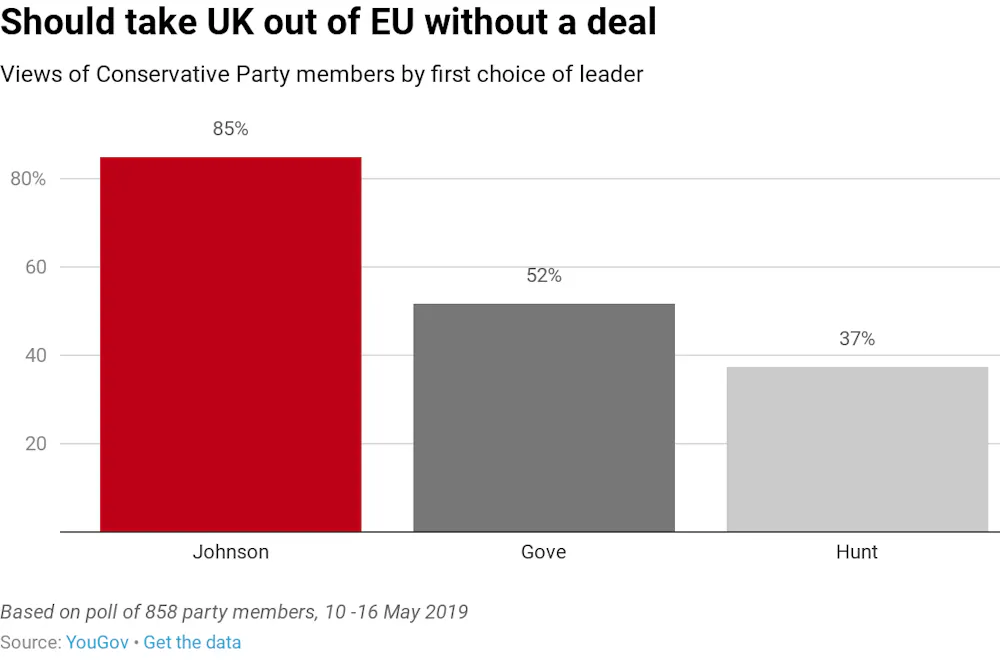
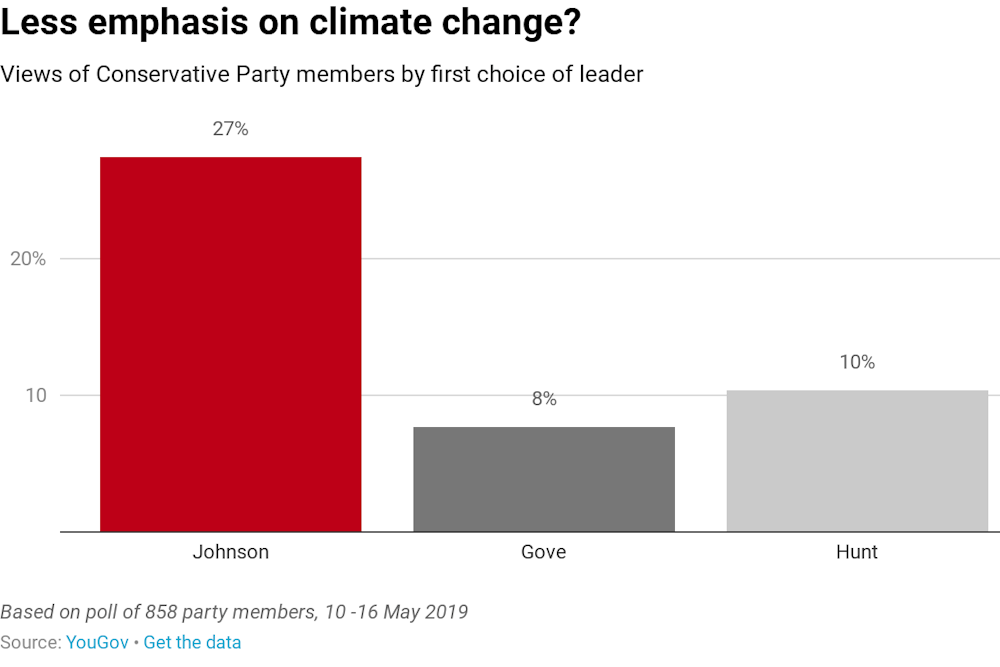
‘Both the Conservatives and Labour are in thrall to member power’, FT, 25 May 2019.

“It’s a funny old world,” observed Margaret Thatcher as she was forced by her party to step down as Tory leader and UK prime minister back in 1990. She’d won the Conservatives three elections on the trot — two of them with three-figure majorities in the House of Commons — and yet here they were, unceremoniously dumping her and moving on.

Well, since then the world — or at least Toryworld — has got funnier still.

Notwithstanding the reputation for ruthlessness that Thatcher’s defenestration served to reinforce, it has taken the party two whole years to get shot of a leader who not only failed to increase its parliamentary majority but actually managed to blow it completely in a campaign whose wheels fell off as soon as it got going.

Moreover, the party now proposes to conduct a leadership contest that, unlike the one that followed the Iron Lady’s forced departure, will be decided not simply by its MPs, at least some of whom will have a pretty good idea of what the job entails and, therefore, the capacity of the contenders actually to do it, but by 100,000 or so grassroots members, who, with the best will in the world, maybe aren’t as well placed to judge.

Nor can those rank-and-file members be said to resemble anything approaching a microcosm of the country over which whoever they choose as their leader will soon be charged with running. They don’t look like it and they don’t think much like it either. This is particularly true when it comes to Brexit: indeed, they are three times as likely as voters to favour Britain leaving the EU without a deal.

And therein lies one of the most intriguing paradoxes of British politics — namely that the party that gives its members the least formal say on policy has found its policy most influenced by them, especially on the existential issue of Europe. And this in spite of the fact that their numbers have dwindled rather than burgeoned in recent years.

Without being able to discuss, let alone actually pass, a single policy resolution at conference (an occasion that, for the Conservatives, is little more than a corporate cash cow crossed with a beauty contest-cum-networking opportunity for the egregiously ambitious), the grass roots have helped turn what was once a heretical view held only by a few Eurosceptic ultras into what, for the majority of the party, is now an absolute given — namely that the UK is “better off out”.

Compare that to the influence (or rather the lack thereof) wielded by Labour’s much larger membership. For all their party’s much-vaunted internal democracy — albeit a democracy somewhat mitigated by the muscle of the trade unions — an overwhelmingly Remain rank and file has so far found it impossible to push its leadership off the fence on Brexit. And this in spite of the fact that said leadership was elected in no small part because it promised, in terms, and unlike Voldemort (sorry, I mean Tony Blair), to be guided by what they wanted.

Certainly, if Jeremy Corbyn changes his mind anytime soon it won’t be because he has finally decided to honour those promises, but because he (or rather his advisers) have been persuaded by the results of the European Parliament elections that his pro-Brexit prevarication is no longer the magical masterstroke it appeared to be the 2017 general election.

All of which suggests that member power does not, in the end, really lie in any formal involvement in a party’s policymaking — something that most leaders can navigate their way around anyway.

Rather it lies, first, in members’ dogged determination to pick as parliamentary candidates only those hopefuls who conform to their preferences on the one thing they decide really matters. And, second, in their perceived willingness to support the removal of their leader by someone else they can be persuaded to believe better reflects those preferences — something that MPs (actual and prospective) cannot help but pick up each and every time they get their ears bent at events back in their constituency.

Political parties, whether they call themselves leftwing or rightwing, mainstream or insurgent, are, like businesses, so much more than a bunch of organograms showing who’s in charge of who. They are living, breathing cultures — an ever-shifting balance of forces between the management, the workforce, the salesforce and the customer. Who runs the show is clearly important — but it’s by no means all that matters.

Originally published at https://www.ft.com/content/65dd73f0-7e17-11e9-8b5c-33d0560f039c

Posted in Uncategorized | Leave a comment

‘Tory leadership: Who gets to choose the UK’s next prime minister?’, BBC, 25 May 2019.

With Theresa May finally on her way out of Downing Street, a Tory leadership contest that has been bubbling under for months is now starting.

It’s a two-stage process. The first sees votes among Conservative MPs designed to whittle the contenders down to just two front-runners. The second stage sees the party’s grassroots members choose between them in a postal ballot.

In other words, it is members of the public – those who pay £25 a year to join the Conservative Party – who get the final say on who the next prime minister is. There will not be a general election because the party is already in power.

So, who are its members and what do they think on key issues, not least of course Brexit?

Beebtoryage

We don’t know exactly how many Conservative Party members there are because – unlike the UK’s other parties – the Conservatives don’t regularly release the figures.

The last time they did so was back in March 2018, when they put the figure at 124,000.

That’s larger than some of the more pessimistic guesstimates, but way down on the peak of nearly three million that the party boasted in the early 1950s.

Membership plunged after that before levelling off at around one million in the 1970s and 1980s, since when it has been dropping almost inexorably.

One thing we can be sure of, however, is that the Tories have far fewer members than the Labour Party.

Even if we assume that Labour’s membership has fallen from the late 2017 peak of more than 550,000, it still has a huge advantage over the Conservatives when it comes to campaigning on the ground.

Right now, however, none of that matters as much as the fact that those 100,000 or so rank-and-file members of the Conservative Party have a crucial role.

They are going to be choosing the next prime minister of a country of over 65 million people – something which has never happened before.

Most members of most parties in the UK are pretty middle-class.

But Conservative Party members are the most middle-class of all: some 86% of them fall into the ABC1 category used by market researchers to describe the top social grade.

Beebsocgrade

Around a quarter of them are, or were, self-employed and nearly half of them work, or used to, in the private sector.

Nearly four out of 10 put their annual income at over £30,000, and one in 20 put it at over £100,000. As such, Tory members are considerably better-off than most voters and, indeed, the members of other parties.

On the other hand, the fact that 97% of Conservative Party members are white doesn’t do much to distinguish them from their counterparts in other parties.

It does inevitably mean, however, that ethnic minorities, who make up well over 10% of British people, are heavily under-represented in the Tory rank and file.

So, too, are women. Other parties – notably Labour and the Greens, but also the SNP – now come close to gender balance, but seven out of 10 Conservative members are male.

Beebrank

Tory members are also older than the members of most other parties. True, their average age may “only” be 57, but this disguises the fact that four out of 10 are over 65.

They are concentrated in the southern half of the country. Nearly 60% of Tory members live in Eastern England, London, the South East and the South West.

So much for demography and geography. What about ideology?

Well, not surprisingly, Tory Party members are more right-wing than the population as a whole.

On a scale where zero represents very left-wing and 10 very right-wing, the average voter places themselves at the centre point. The average Conservative Party member places themselves at 7.6.

Certainly, grassroots Tories are socially conservative.

Three quarters of them believe, for instance, that young people today don’t have enough respect for traditional values. Nearly six out of 10 support the death penalty.

They are also conventionally right-wing on some aspects of economic policy.

For example, only 15% of them believe that government should redistribute income from the better-off to those who are less well-off.

But on other issues they hold views that may be more unexpected.

A third of Tory rank-and-file members believe that ordinary working people do not get their fair share of the nation’s wealth and that there is one law for the rich and one for the poor.

About half believe that big business takes advantage of ordinary people.

Interestingly, they have also cooled on austerity. In the summer of 2015, some 55% said government spending cuts hadn’t gone far enough, but two years later that had fallen to 28%.

What Tory members haven’t cooled on, however, is Brexit.

Indeed, since we started tracking them in 2015, they’ve hardened their position.

It is clear that they are not supporters of the deal negotiated by their outgoing leader.

In fact, it is now the case that fully two-thirds of them back a no-deal Brexit – an outcome supported by only a quarter of voters as a whole.

Nor are they in the least bit keen on the idea of letting the public have another say on the UK’s EU membership.

Some 84% of them oppose the idea of a new referendum on the issue.

In short, the grassroots aren’t simply sceptical on Europe; they can’t wait to leave, whatever that might take.

This, then, is the Conservative Party electorate.

And those MPs hoping to succeed Mrs May will need to pitch their promises accordingly.

Originally published at https://www.bbc.co.uk/news/uk-politics-48395211  NB The BBC has exclusive publication rights: commercial re-use of this post is therefore prohibited.

Posted in Uncategorized | Leave a comment

‘What Londoners really want is local people on their councils’ (with Philip Cowley), Times, 20 May 2019.

London might be one of the world’s most multicultural, multi-ethnic cities but recent research shows that BME people, especially BME women, are seriously underrepresented in the capital’s local politics. The proportion of black and Asian councillors has risen over the past two or three decades so that in 2018 it stood at about 26 per cent compared to a Black and Asian population of about 32 per cent.

But while, broadly speaking, the proportion of Asian councillors is now roughly equivalent to the proportion of London’s population that is Asian, black Londoners are still underrepresented.

When Queen Mary University of London’s Mile End Institute polled Londoners, over a third of them said they would like to see that change. Nearly four in ten (37 per cent) say they’d like to see more councillors from an ethnic minority background and only one in 20 (5 per cent) said they’d like to see fewer. Perhaps not surprisingly, however, improving ethnic representation is more of a priority for BME Londoners, 50 per cent of whom would like to see the proportion rise compared with 29 per cent of white Londoners.

There’s also a whacking great age gap when it comes to this issue. Some 56 per cent of Londoners aged 18-24 would like to see more ethnic minority representation in London’s councils. But when you ask Londoners over 65 years old, the figure plummets to just 16 per cent.

There are big (and not unrelated) differences between London’s Tory and Labour voters, too, and between Leavers and Remainers. Just 18 per cent of Conservative voters say they’d like to see more ethnic minority councillors – a figure that rises hugely to 53 per cent among the capital’s Labour supporters. There’s a similar split between London’s Leavers and Remainers (18 per cent against 49 per cent and, again, not unrelated).

To some, this will look like another battle, or at least a skirmish, in the “culture wars” that some people like to bang on about these days. And you can see why, at least in the sense that a similar pattern is repeated when Londoners are asked about Muslim councillors.

True, the most common, and most encouraging, answer given by both Remainers and Leavers is that it doesn’t matter whether councillors are from this group or not (41 per cent and 37 per cent respectively).

But it’s nonetheless striking that a quarter (24 per cent) of London’s Leavers and exactly the same proportion of its Tory voters say they’d actually like to see fewer Muslim councillors in the capital’s local government, compared with just 4 per cent of Remainers (and 6 per cent of Labour voters) who say the same.

Conversely 28 per cent of London’s Remainers (and 34 per cent of its Labour voters) say they’d like to see more Muslims serving on the capital’s councils – a feeling shared by just 10 per cent of London’s Leavers and 8 per cent of its Conservative voters.

Tellingly perhaps, similar differences are evident between, on the one hand, Leavers and Tory voters and, on the other, Remainers and Labour voters when it comes to councillors from the LGBT community. There’s also a difference on gender, with Remainers and Labour voters nearly twice as likely to say there should be more women on London’s local authorities.

In the end, though, perhaps the most important thing to emerge from our polling is something that also comes out when you ask voters about their MPs. When it comes to councillors, what matters far more to Londoners than ethnicity, religion and sexuality is whether they’re local. Six out of ten of the capital’s voters would like to see more councillors come from the area they represent.

And although it seems to be an even bigger priority for Labour (and Lib Dem) supporters than for Conservatives – something that’s even more true, incidentally, when it comes to getting more working-class people elected – the idea that councillors should come from the area they represent is not only widespread but transcends any of the familiar demographic differences. It’s even something that (whisper it softly!) Remainers and Leavers can actually agree on.

Originally published at https://www.thetimes.co.uk/article/culture-wars-bubbling-under-but-ultimately-londoners-prefer-local-and-working-class-people-wvn8gfddq

Posted in Uncategorized | Leave a comment

‘Is the Conservative Party full of Islamophobes?’, Independent, 12 May 2019

Talk of Tory Islamophobia has some way to go before it rivals Labour antisemitism but it is getting louder. This week there was a damning report about Facebook posts by self-identified grassroots members of the Conservative Party, some of whom seem bent on preventing Sajid Javid, the UK’s Muslim Home Secretary, becoming their leader.

CCHQ has pledged to take action against any Tory members who indulge in the kind of noxious and explicit religious hatred revealed in the story, but continues to argue that those who it has suspended (or may go on to suspend), investigate and possibly expel constitute a few bad apples.

It may well be right. But is there any measurable evidence of a wider and deeper undercurrent of prejudice against Muslims amongst rank-and-file Conservatives?  One way to tell is to look at the responses they give when asked about the kind of MPs they’d like to see in the Commons.

This is exactly what we did when we surveyed the Tory grassroots just after the 2017 election as part of the ESRC-funded Party Members Project run out of Queen Mary University of London and Sussex University.

The exact question ran as follows: “To what extent do you believe that more or fewer MPs in parliament should come from the following backgrounds?” We then listed, for instance, “people who come from the area they represent”, women, ethnic minorities, LGBT people. Also on the list were Muslims.

Respondents could then tell us whether they’d like to see a lot more, slightly more, same as currently, slightly fewer, a lot fewer – or they could say they didn’t know.

We also asked the same of members of other parties, which revealed some very marked differences.

Labour members, for instance, were actually pretty positive: some 62 per cent thought there should be slightly more or a lot more Muslims in the Commons – a figure which can’t really be accounted for, incidentally, by ethnic background since only one in twenty of Labour members identify as anything other than White British.

At the other end of the spectrum were Ukip members, a mere 4 per cent of whom said they’d like to see more Muslim MPs. Now, if you think that the Commons should be a microcosm of British society, then there should be an increase, since Muslims currently make up 5 per cent of the country’s population but just 2.5 per cent of MPs.

This notwithstanding, some 10 per cent of Ukip members said they’d prefer to see slightly fewer Muslim MPs, and 45 per cent wanted a lot fewer.

So what about Tory members? It turns out that they are nowhere near as enthusiastic at the thought of more Muslim MPs as their Labour (or, indeed SNP, Lib Dem, and Green) counterparts. Only 17 per cent picked that option.

On the other hand, nearly half of all Tory members (44 per cent) were satisfied with the status quo, which suggests that getting on for two-thirds (61 per cent) of them can’t really be said to have a serious issue with Islam.

However, that still leaves a quarter (26 per cent) of grassroots Tories who’d prefer to see fewer Muslim MPs – twice as many, incidentally, who said the same (13 per cent) about ethnic minority MPs and (for good measure) six times more than said the same (4 per cent) about female MPs.

That, along with some of the anecdotal and social media evidence that’s emerged recently, suggests that there is there really is a degree of at least low-level Islamophobia at the Tory grassroots.

CCHQ should be careful not to overreact – after all, the party’s rank and file is already up in arms over Brexit; the last thing it needs is to feel that it’s being accused of religious and racial prejudice. But the party’s leadership – and, very importantly, its potential leadership contenders (not just Sajid Javid) – do need to take the issue seriously.

As Labour has vividly shown, denying there’s a problem, and so leaving it to fester, is neither a good look nor a good idea.

Originally published at https://www.independent.co.uk/voices/tory-islamophobia-racism-sajid-javid-conservatives-members-ukip-a8865331.html

Posted in Uncategorized | Leave a comment

‘Would Margaret Thatcher have taken the US side against Huawei? Not necessarily’, Guardian, 10 May 2019

Lady Thatcher may be an icon to her most devoted fans but, as far as I know, none of them has ever worn a “What would Maggie do?” wristband. That’s not to say that they don’t find themselves asking (or being asked) the question now and then. After all, Thatcher, together with her eponymous –ism, have become lodestone and touchstone to rightwingers the world over. However imperfectly remembered or understood, Thatcher and Thatcherism simultaneously exert a magnetic attraction and provide a litmus test. They also conjure up the Conservative party’s glory days – a state of ideological grace, global respect and seemingly endless electoral success, all of which it could enjoy again if only it were to return to the path of free-economy/strong-state righteousness.

So when the US secretary of state, Mike Pompeo, addressing London’s hesitation in following Washington’s hard line on Huawei, said: “Ask yourself: would the Iron Lady be silent when China violates the sovereignty of nations through corruption or coercion?” he was touching – and presumably fully intending to touch – one of the most sensitive of all Tory nerves.

Pompeo’s implied answer to his own rhetorical question was, of course, no. How could anyone even imagine Britain’s latter-day Boudicca putting up with Beijing’s attempt to undermine security and sovereignty by force or fraud? Maggie would have told the Chinese where to get off – and sharpish, right?

Wrong. As always, the question “What would Maggie do?” isn’t as easy to answer as it might appear to be. Sure, Thatcher was (like her great ally back in the day, Ronald Reagan) very much a cold warrior – and, given the value of the special relationship and the existential threat posed to western liberal democracy and capitalism by the Soviet Union, some of us would say: quite right, too.

But many of those who worship her but weren’t around at the time forget that she was also, for most of her premiership at least, a pragmatist, particularly when it came to foreign policy. Indeed nowhere, perhaps, was that pragmatism more on display than when it came to China, especially over what was then the biggest potential beef between the two countries: the handover of Hong Kong .

Under no illusion about Britain’s lack of bargaining strength or its consequent inability to enforce any promises made to the population of its former colony, Thatcher signed the Sino-British declaration of 1984. In so doing, she not only recognised the reality of Chinese Communist power but also prioritised the maintenance of market confidence in Hong Kong, as well as the need to dampen fears back home that hundreds of thousands, maybe even millions, of its citizens might end up fleeing to the UK.

Moreover, China was by no means the only powerful country that Britain’s first female prime minister allowed to do pretty much what it wanted. Corruption and coercion in Middle Eastern monarchies was fine and dandy, as long as they kept up their lucrative orders from the UK’s defence industries. And those less positive than I am about the US will no doubt point to its numerous violations of other countries’ sovereignty, especially those in Latin America. Let’s not forget, when Thatcher herself was prime minister, Washington’s full-scale military invasion of Grenada in 1983 – a country whose head of state was none other than Queen Elizabeth II.

Then, of course, when it comes to allowing Huawei to get involved in building the UK’s 5G network, we need to recall Thatcher’s free-market enthusiasm for “outsourcing” if that meant getting, in one of her favourite phrases, value for money. Yes, she liked to go in to bat for successful British companies abroad. But, as her reaction to the destruction of much of the UK’s manufacturing base in the early 80s clearly showed, she had precious little sympathy – and precious few words – for those firms that failed to compete at home against superior foreign competition.

So the Iron Lady did sometimes choose to remain silent – at least when she felt it was in Britain’s best diplomatic or economic interests to do so. Whether, on this particular issue, then, she would have kept her own counsel or instead come out swinging is ultimately anyone’s guess.

Originally published at https://www.theguardian.com/commentisfree/2019/may/10/margaret-thatcher-us-huawei-mike-pompeo-china

Posted in Uncategorized | Leave a comment

‘Forty years ago, Thatcherism swept Britain. Could our new parties repeat the trick?’, Observer, 28 April 2019

Forty years ago this week, the Conservative party won the UK general election with 44% of the vote, netting the country’s first female prime minister, Margaret Thatcher, a comfortable overall majority of 43 seats and setting her up nicely for what turned out to be more than a decade in Downing Street.

How things have changed. No 10’s current occupant may still be a Tory woman, but she presides over a minority government barely worth the name and she’s unlikely to be there for more than a few months, let alone years. And, zooming out to look at the party system as a whole, the Conservativesnow find themselves in a far more diverse and challenging environment than the one that Maggie confronted as she stood on the steps of Downing Street paraphrasing St Francis of Assisi.

Sure, back then, the party’s main rival was, as it is today, a Labour party racked by internal divisions, albeit led by someone, Jim Callaghan, who was not only genuinely of working-class stock, but who most voters could at least imagine as prime minister, largely because he’d been doing the job for the previous four years. And sure, rather spookily, Labour were on almost exactly the same number of seats (269 on 37% of the vote) as they’re on today. So, indeed, were the UK’s “third party”: the Liberals won 11 seats in 1979 compared with the Lib Dems’ 12 in 2017.

But just look at the differences. The SNP won just two seats in 1979 compared with the 35 they won in 2017 and the 56 they won in 2015. The Greens, who won just over half-a-million votes in 2017 and just over a million in 2015, won only just under 40,000 in 1979, fighting as the Ecology party. Sinn Féin didn’t even feature in that election, while the DUP was still playing second fiddle to the slightly more biddable Ulster Unionists.

Just as importantly, there was no Ukip. Britain’s populist radical right party may have performed poorly in 2017 as Theresa May’s hard Brexit strategy partly did what it was designed to do – hoover up lots of its erstwhile voters. But let’s not forget that just two years earlier there had been nearly 4 million of them – some 13% of the electorate. In 1979, the only alternative on the Tories’ right flank was the National Front, which won fewer than 200,000 votes on a share of less than 1% of an electorate that largely regarded them as beyond the pale.

Zoom out further beyond these shores, and we can see that the voter fragmentation of the party system that has characterised this country has also affected many of the other supposedly liberal democracies. Their systems, and the established parties that dominated them for perhaps too long, have likewise failed to keep pace with a raft of profound and often cross-cutting social, cultural and economic changes, changes that have fractured familiar bases of support and created a less tribal, more consumerist electorate. At the same time, the rise of 24/7 multichannel and social media has encouraged an insatiable public demand for the novel, spectacular and hyperbolic.

All this has helped new parties to gatecrash not just electoral markets but also parliaments and governments the world over. Quite how they do that is the theme of a new book just published by Radix, the self-styled thinktank of the radical centre. In it, authors Nick Silver and Zoe Hodge take a look at political insurgencies, particularly in Italy, France, Spain and Canada, and try to work out what helped them upend the status quo.

True, some will quibble with the book’s broad definition of insurgency. Movimento 5 Stelle, La République En Marche and Podemos, we can probably all agree on. But Justin Trudeau’s Canadian Liberals? Maybe not so much. Still, taken together, their case studies arguably provide us with an off-the-shelf recipe for success applicable to “potential new parties or old parties that wish to reinvent themselves” over here. And, handily, it’s one the authors developed before either the Brexit party or Change UK came on the scene, which, because it wasn’t developed with them in mind, makes it a reasonably objective way of judging their prospects.

Three things, according to Silver and Hodge, appear to be particularly crucial.

First, charismatic leadership by an individual who can convincingly portray him or herself as an outsider would seem to be essential, not least because this leader needs to embody the differences between the new party and the “more of the same” on offer from politicians who are made to look tired, unrepresentative, compromised, even corrupt, by comparison.

However much some people might complain that Farage has been a fixture of this country’s political scene for what seems like for ever, and however much they might admire the guts of Heidi Allen and Chuka Umunna for leaving their old parties, it’s pretty clear that – on this criterion anyway – the Brexiters beat the Tiggers hands down.

Second, process is as important, if not more so, than policies. The emphasis is on new, often digital, methods of consulting supporters in order to arrive at supposedly commonsense yet innovative solutions to problems that established parties have allowed to fester for years, in hock as they are to vested interests of various hues.

On this one, it’s probably a little early to make a proper judgment, especially on the consultation front. But it’s all too easy to imagine the Brexit partybeing happy to travel policy-lite for as long as possible. By contrast, the more earnest Change UK (many of whose existing MPs, after all, have held government jobs in their time) feels obliged sooner rather than later to respond to Labour and Conservative criticisms that it doesn’t yet have a coherent or comprehensive platform.

Third, communication, particularly targeted communication based on harvesting data and involving some seriously savvy playing of the 21st-century media game, is also vitally important. One thing successful new parties seem to share is the ability to use digital platforms to mobilise potential supporters, many of whom may previously have given up on politics. They succeed in moving them from online, initially passive support to the offline, “in real life” activity that helps get voters out on the day.

Here again, the Brexit party seems to have hit the ground running while Change UK has been slow out of the traps. It’s not just the contrast between the launches of their respective candidate lists for the European elections, it’s their online presence. And we’re not just talking better branding – we’re talking basic functionality and financial nous.

Whether Farage can eventually get his second “people’s army” out “on the doorstep” is a moot point: that was always one of Ukip’s problems and the embarrassingly damp squib that was his March to Leave hardly bodes well. Change UK, on the other hand, can look hopefully to the hundreds of thousands who marched through central London and the millions who signed the revoke article 50 petition. But unless the party can actually get hold of their contacts, how much use are they really? Meanwhile, sources tell me that, as of the end of last week, the Brexit party had signed up more than 70,000 “registered supporters” – at a (very profitable) £25 a pop.

Neither of Britain’s two newest parties has members in the conventional sense. That’s by no means unheard of among new parties in other parts of the world. But it does mean any claim they might make to be “democratic” has to be taken with a gigantic pinch of salt. Their belief that intermediate layers of internal governance might somehow break what they see as a sacred bond of trust between leader and followers, and between “movement” and “the people”, means that, in reality, the former rather than the latter remain in charge. Ultimately, then, there is more than a touch of populism about the outfits that seem to be succeeding right now. As such, they constitute a potential challenge not just to the “political class” they love to target but to representative democracy itself.

As new parties in this country have found before, of course, first past the post, the system that delivered Thatcher two even bigger majorities despite her party’s declining support, can prove a very cruel mistress. But if Brexit continues to blow apart traditional political identities, and if the poor handling of the issue by both main parties continues to alienate even the kernel of their core support, we may well find the UK’s political system is rather less resistant than many imagine to the shock of the new.

Originally published at https://www.theguardian.com/commentisfree/2019/apr/28/forty-years-ago-thatcherism-swept-britain-could-our-new-parties-repeat-the-trick

Posted in Uncategorized | Leave a comment

‘Brexit is tearing apart Britain’s establishment political parties’, Telegraph, 29 March 2019.

Brexit threatens to blow the British party system apart. Differences over the UK’s relationship with the EU have never been deeper, more salient and more entrenched than they are now.

Europe has become a fundamental cleavage, rivalling those which have traditionally helped determine, and continue to help determine this country’s party politics.

Tectonic shifts like this are rare. But when they do occur, they throw up the possibility of profound change and realignment. Inasmuch as voters ever identified with the programmes and the parties on offer, they may forget any loyalties and any preferences they once had. New contenders for their support may emerge, and indeed already have. Existing parties may split – or at the very least reconfigure themselves, and their appeals to the electorate, in order to try and cope. All that seemed solid may melt into air, with profound consequences for electoral competition.

We know that Remain and Leave now seem to constitute political identities as powerful as those once created by, say, class and partisan loyalties. It is those identities which, along with sociological change and electoral systems, help to determine a country’s party system – the pattern of interaction between political parties in a society, most commonly characterised according to the number of parties and their ideological spread.

Cleavages – profound splits in society, some of which are rooted in economics (such as differences between owners and workers), some of which are attitudinal (such as differences over the extent to which a country should be open or closed, cosmopolitan or parochial) – often find expression in politics, with parties positioning themselves on either side of the split.

New cleavages don’t come along every day.  However, when they do, they can reshape party systems by bringing forth new parties that mobilise along them. But they can also prompt existing parties either to adapt and/or to break apart. The introduction of democracy at the start of the twentieth century, for instance, made the UK’s latent owner-worker cleavage manifest, leading the Conservatives to transform themselves from the party of the landed aristocracy and agricultural interests to the party of business, low taxation and a smaller state.

Meanwhile, the Liberals, pulled apart by war and hobbled by their reluctance to take on working people as candidates, fragmented and floundered and were soon overtaken by Labour and left out of government for almost a century.

Later on, European integration, the failure of corporatism and industrial decline drove a further wedge into cracks between left and right in the Labour Party, resulting in the formation of the Social Democratic Party (SDP) – and later the Lib Dems – which eventually forced Labour to adapt in order to stay competitive.

Meanwhile, on the right, concerns about cultural change and immigration in particular, combined with the media’s hunger for controversy and novelty, helped to put rocket boosters under UKIP, which then pushed the Conservative Party towards a more Eurosceptic position that eventually resulted in the holding of the EU referendum in 2016.

The question is whether that referendum, and its result, will produce tensions – socio-economic and cultural – that can no longer be contained by the UK’s party system in its existing form?

Will the Conservatives, for example, become a party dominated (even more than is already the case) by antipathy to the European Union and supported by older, less highly-educated people alarmed by the UK’s increasingly multi-ethnic character and longing for a return to a country they recognise as their own?

Will Labour, for its part, see its electorate become more like its membership – overwhelmingly middle-class, university-educated and socially-liberal? And is that (admittedly growing) segment of society yet big enough to win it elections in our current electoral system, even presuming Labour holds on to its predominant position among ethnic minority voters?

And how will all this impact on the geographical reach of both parties: will Labour become even more urban and the Tories ever more rural and small-town? Will the North-South divide in support begin to break down? Or will Labour’s cautious ambivalence on Brexit eventually see Remainers flood to the Lib Dems?

Alternatively, perhaps will we see the new centrist formation, currently known as The Independent Group, displace the Lib Dems. Could success on its part eventually persuade the Conservatives to change course and veer off the right-wing, nationalist road they have been travelling down since Theresa May took over? Would this, in turn, open up space for a new, more populist radical right insurgency on their flank, whether it be led by Nigel Farage and friends or a UKIP 2.0 prepared to tap more directly into widespread Islamophobia than they were ever prepared to? Or could an end to PR elections for the European Parliament spell doom for minor parties like the Ukip and the Greens, who have since the early eighties benefited from the opportunity the European elections have given their supporters not to, for once, cast a ‘wasted vote’?

As for the Scottish National Party (SNP), Plaid Cymru and the Democratic Unionist Party (DUP), all of which are more fortunate in that they enjoy more geographically concentrated support, will their very different stances on Brexit hinder or help them? And will Brexit mean that the party systems of the constituent parts of the UK become even more dissimilar than they already are?

There are, it is clear, more questions – far more questions – than answers. So much so that anyone who claims they know what’s going to happen to the UK’s party system in the next few years is either a knave or a fool. Educated guesses, on the other hand, are permitted. So here goes.

If Brexit goes ahead and continues to structure political identities as strongly as it seems to be doing right now, then Labour could well be in big trouble since large numbers of its voters will feel badly let down and could jump ship if a new centrist party can displace the Lib Dems and develop not just a coherent post-Brexit platform but an organizational infrastructure.

Meanwhile, the Tories, contrary to much conventional wisdom, will probably hang together – partly for fear of hanging separately and partly because we’ve forgotten, absent Europe, how much they all agree on.

And if Brexit doesn’t happen, the polarities are reversed: the UK remaining in the EU would almost certainly make things far more difficult for the Conservatives than for Labour.  As to whether Labour, or any other party, would then be capable of winning a comfortable majority in the Commons, well watch this space….

Originally published at https://www.telegraph.co.uk/politics/2019/03/29/brexit-tearing-apart-britains-establishment-political-parties/

Posted in Uncategorized | Leave a comment

‘Is this Britain’s Macron moment?’, Politico, 18 February 2019.

A split in one of the two big British political parties has long been the subject of fevered speculation. Now it’s finally happened.

Pundits and pollsters are racing to weigh in on the decision of seven Labour MPs to leave their party and sit in the House of Commons as a group of independents.

Some are heralding the creation of the so-called Independent Group as the start of a new political era akin to the one started by Emmanuel Macron in France. Others are predicting that the bid to blow up Britain’s two-party system is bound to end in tears.

The truth is we’ll have to wait and see. While there are many reasons for doubt, there are also reasons to believe the Labour rebels stand a chance of redrawing the rules and battle lines of British politics.

Let’s start with cold water. To begin with, to pull a Macron — to come from virtually nowhere to win victory at the polls in the space of months rather than years — you need, well, someone like French President Emmanuel Macron.

In 21st century politics, leaders aren’t everything. But they still matter — a lot.  At the moment, it’s by no means obvious who among the seven rebels would (or even could) be capable of becoming the face of such an insurgency, never mind its driving force.

And then there’s their putative pitch to the electorate. We don’t know what they’re for, only what they’re against: a party they believe has become institutionally anti-Semitic, and that is led by a man disliked and distrusted by many voters.

They consider Labour leader Jeremy Corbyn to be lying to his own overwhelmingly pro-EU mass membership by effectively colluding with Prime Minister Theresa May to deliver Brexit. Going into bat for a second referendum on leaving the EU in the hope of convincing voters to overturn their previous decision might pay dividends in the short term — but in the long term it won’t be enough.

There may be a market for a party that is vaguely left-of-center on the economy, but there will be far fewer takers for a party spinning a defiantly liberal line on, say, immigration, crime and welfare.

Resources are crucial, too. Not only do parties spend millions of pounds at elections, they are also surprisingly expensive to run between contests. They need tens, if not hundreds, of thousands of members who can contribute at least some of that money, who campaign for them on the ground, who select their candidates and who ultimately help anchor them to whatever worldview they espouse. None of this can be conjured up out of thin air.

Nor, of course, can a proportional electoral system — the one thing that would presumably transform the prospects of any new party. As it stands, Britain’s first-past-the-post electoral system constitutes the most hostile environment imaginable. Unless, like the Scottish National Party (SNP), your support is geographically concentrated, winning anything below around 30 percent of the vote means you’ll never win your fair share of seats in the Commons. The Social Democratic Party (SDP) that broke away from Labour in the 1980s found this out to its ultimate cost.

But while the parallels with the SDP are instructive, the Independent Group’s fate is by no means sealed.

For one thing, at least among voters, if not among party members, we live in a much less tribal society. As partisan as our era might sometimes seem, political identities are more fluid, and fewer and fewer people are “Labour (or indeed Conservative) through-and-through” these days.

Notions of what’s “left” and what’s “right” have been disrupted, even eroded, by a politics that revolves as much around culture as economics — and of course around Brexit, which is a heady brew of both.

That means there may be more voters up for grabs than many imagine, especially when we consider that many people are turned off by ideology and just want competence — something they don’t seem to be getting from either of the two main alternatives currently on offer.

Macron may be finding it tough to deliver on his promises right now, but it’s clear he sensed this dynamic. And it’s notable that he won the presidency without a change to France’s similarly non-proportional electoral system.

The French president also took advantage of the fact that we now live in a 24/7 media cycle with an insatiable craving for novelty. That means any new party, if it gets its messaging and its image right, can attract far more attention far more quickly than ever before.

If more MPs join the rebels — be they Labour MPs fed up or facing deselection or Tory MPs who are increasingly facing the same dilemma — things could snowball quickly.

Digital platforms might also be a big help when it comes to crowdfunding and recruiting new members. Absorbing the Liberal Democrats — a party whose brand may be bust and whose leader has made no impact — would obviously provide a massive boost, too.

The odds on this splinter group turning into a full-blown split seem pretty long right now, and the odds of it resulting in a successful party to rival at least one of the big established parties even longer. But we shouldn’t write off the seven — magnificent or otherwise — just yet.

Originally published at https://www.politico.eu/article/labour-breakaway-7-mps-independent-group-is-this-britain-macron-moment/

Posted in Uncategorized | Leave a comment

‘Brexit poll: British public thinks the EU has been harsh in negotiations’ (with Sarah Wolff and Javier Sajuria), 12 February 2019.

Nearly two thirds of British people think that the EU has been a harsh negotiator over Brexit, according to the latest survey by the Center for European Research at Queen Mary University of London.

Donald Tusk recently caused anger by suggesting that there is a “special place in hell” for campaigners who promoted Brexit without having a plan in place. But even before his remarks, voters on the UK side felt the EU was playing hardball.

Overall, 58% of the UK public believe the EU has been harsh towards the UK during Brexit negotiations – although that varies according to age and, of course, on how how people voted in the referendum. Conservative voters (83%) and Leavers (84%) overwhelmingly reckoned the EU had been harsh.

And while three quarters (78%) of over 65s felt the EU has been either fairly or very harsh towards the UK during the negotiations, just 37% of 18- to 24-year-olds and 48% of 25- to 49-year-olds felt the same.

This stands in stark contrast to European politicians’ views about the British domestic political situation. Although Michel Barnier, the chief negotiator for the EU, has been a good communicator in leading the negotiations, insisting frequently that what unites the two sides is “much stronger than what divides us”, other European politicians are now showing signs of impatience with the British quid pro quo.

In a speech after May’s deal was voted down in January 2019 in the UK parliament, French president Emmanuel Macron said: “Good luck to the representatives of the nation who have to implement a thing which doesn’t exist and explain to the people: ‘You have voted on a thing, we lied to you’.”

Similarly, European Commission president Jean-Claude Juncker declared that the British “need to say what they want, instead of asking us what we want”.

Interestingly, though, even a majority of young people think the EU will be weakened by the UK’s departure. That said, only a minority of Brits think Europeans will be sorry to see the UK go.

And at a moment when Theresa May is going back to Brussels to ask to re-open the negotiations on the Irish backstop, the survey suggests that a third of Brits (32%) think the EU should agree to a deal without a Northern Ireland backstop. That said, only just under a quarter think it shouldn’t. Some 45% of Brits don’t know, suggesting that neither side of that particular debate has so far put a convincing case for its exclusion or inclusion.

We also found that the prospect of not being able to move freely across Europe to live, work and study is a big deal for young people. Nearly two thirds (63%) of 18- to 24-year-olds think that losing mobility rights is a serious loss for British people – a view shared by 67% of Labour voters and 82% of Remain voters across all age groups. Only a third (34%) of people over 65 were concerned about it. Nearly half (47%) of Leave voters think mobility is a loss but a price worth paying to leave the EU, while nearly a quarter of them (24%) aren’t really worried about losing such rights.

It seems that the people who, at least theoretically, stand to lose most in the future from Brexit, at least in terms of their rights to live, work and study in the EU, are far more bothered about the loss. This is yet more evidence of a continuing generation gap that the EU referendum exposed and opened up.

Despite the view that the EU has been harsh during negotiations, some 54% of British people think that the remainder of the EU will be weaker after Britain has left the bloc. The survey shows that again there is a generation gap, with almost 70% of people aged 65 and over thinking the EU will be weaker. And again the gap between Leavers and Remainers is high: 66% of Leavers think the EU will be weaker, compared to 55% of those who voted Remain – although it’s worth noting that that’s still a majority of them.

Originally published at https://theconversation.com/brexit-poll-british-public-thinks-the-eu-has-been-harsh-in-negotiations-111548

Posted in Uncategorized | Leave a comment

‘Tim Bale: Johnson and Rees-Mogg are still in with a shout in the race to succeed May’, ConservativeHome, 7 January 2019

In order to stay in office, the Prime Minister had to promise her party that she would be gone before the next election.  But there’s little agreement among Conservative members – and even less agreement among Conservative voters – as to who should replace her.

The ESRC-funded Party Members Project, run out of Queen Mary University of London and Sussex University, surveyed 1215 Conservative Party members between 17th and 22nd December, and a total of 1675 voters between 18-19 December, including 473 individuals who were intending to vote Conservative. The fieldwork was conducted by YouGov.

Respondents were asked the following question: Theresa May has said she will stand down as Conservative Party leader before the next scheduled general election in 2022.  Who would you most like to see replace her as Conservative Leader?  Neither group was presented with a pre-determined list of candidates but was instead asked to write in a name, and they were of course free to say that they didn’t know or weren’t sure, et cetera.

The table below gives the results, leaving out all those names that received only a handful or so of mentions – a group of people which included some relatively high-profile figures who are sometimes mentioned as potential candidates: Esther McVey is one example, since her name was suggested by only four Tory members (out of the 1162 who answered the leadership question) and no Tory voters. The table also contains a column allowing comparison with the results published by ConservativeHome on 31 December 2018, although their survey, unlike ours, gives respondents a list of names to choose from.

Tory Voters %  Tory Members %  ConHome % 
Boris Johnson 15 20 27
Jacob Rees-Mogg 7 15 4
Don’t Know 38 12 N/A
David Davis 4 8 7
Sajid Javid 2 8 13
Dominic Raab 3 7 12
Jeremy Hunt 2 6 9
Amber Rudd 4 5 5
Michael Gove 2 4 3
Penny Mordaunt 0 1 4


The results of the survey provide an insight into why Theresa May survived the confidence vote she was subjected to by some of her MPs just before Christmas. Right now, it’s anyone’s guess as to who might replace her – and that very uncertainty is bound to have worked to the PM’s advantage.

Clearly, Johnson and Rees-Mogg, both of them Brexiteers with high name-recognition, currently have the edge over other potential candidates to succeed May. Indeed, all the other candidates are beaten by ‘Don’t know’, even among Tory members. That said, when it comes to Tory voters, the same is true even of Johnson and Rees-Mogg.

Importantly, neither Johnson nor Rees-Mogg is so far ahead of the rest of the field as to be impossible to catch.  In any case, both are likely to find it hard to make it through the parliamentary round of voting that, according to the party’s rules, narrows the field to two candidates before grassroots members are given the final say.

Also striking is the dominance of men over women: at the moment it looks unlikely that the Conservatives will replace their second female leader with a third. Amber Rudd is almost certainly too much of a Remainer for a membership dominated not just by Brexiteers but by hard Brexiteers. Meanwhile Penny Mordaunt (mentioned by just 14 out of 1162 Tory members and by no Tory voters) clearly still has an awful lot to do.

The same looks to be true, however, of the three or four men likely to throw their hats into the ring – Sajid Javid, Dominic Raab, and Jeremy Hunt, whose recent trip to Singapore has been widely interpreted as part of his ongoing leadership bid. And Michael Gove is not so far behind as to make a second crack at the top job a complete fool’s errand, in spite of the mess he made of the last leadership contest.

Perhaps the bookies are right in marking Gove at 10/1. This isn’t far off the 9/1 you’d get if you put your money on Hunt and the 8/1 you’d get on Raab, but still some way off the 6/1 offered for Johnson and, interestingly, Javid – who, like Hunt, many claim has been very much ‘on manoeuvres’ recently.

Originally published at https://www.conservativehome.com/platform/2019/01/tim-bale-johnson-and-rees-mogg-are-still-in-with-a-shout-in-the-race-to-succeed-may.html

Posted in Uncategorized | Leave a comment