‘Why is the Conservative Party so good at winning?’, Bloomberg, 18 November 2019.

British Conservatives can claim to be the world’s oldest and most successful political party. They’ve been written off more than a few times in the 200-plus years they’ve been around. But they’ve always bounced back. Their secret? The ability and willingness to reinvent themselves – even when that means giving up what supposedly defines them and the values they hold most dear.

The party’s arch pragmatism doesn’t mean that it’s immune from ideological preoccupations. Indeed one can look back at the party’s history and find plenty of examples: refusing to extend the vote franchise in the 1830s, holding onto the British Empire in the 1950s, joining the European Economic Community, the precursor to the European Union, in the 1960s and, after the global financial crisis of 2007/8, insisting on austerity. It’s just that those ideas, held so passionately at the time, are also mutable.

The Tory party does have a basic disposition – namely, the desire to defend private property and personal liberty against a state that, except when it comes to its core task of maintaining domestic and national security, should be kept from growing too large and too expensive over the long term, primarily by ensuring that it is run by Conservatives rather than their opponents. But anything above and beyond that tends to be a temporary obsession or else a temporary solution.

More often than not, the problem to be solved is an electoral one. It’s often better, think most Conservatives, to compromise in order to capture or stay in office. Even if one is forced to adopt some of the policies of one’s opponents, once in power one can at least limit any damage those policies might do and any financial cost to taxpayers they may involve.

Take the immediate postwar period. After Winston Churchill unexpectedly lost the 1945 election, and with it the chance to unwind the expansion of the state brought about by the need to defeat Hitler, it quickly became apparent to all but the most antediluvian Tory that there could be no going back.

Unless and until the union-friendly, essentially social democratic regime ushered in by the Labour Party could be shown to have failed those it was designed to benefit – something that was to take some 30 years and a crusader like Margaret Thatcher to achieve – then it would have to be met at least half way.

Consequently, from 1951, when the Conservatives (still under Churchill but now armed with an updated, more moderate manifesto) returned to office, the Conservatives managed to win a share of the working class (and union-member) vote not just by dint of being in office during Europe’s postwar economic boom but by appeasing organized labour, ensuring wage-earners could afford all the new consumer goods that suddenly became available.

And while the welfare state may have been kept on relatively short rations, it was never seriously threatened, with the overwhelmingly popular state-run National Health Service seen as off-limits even by the otherwise mostly free-market of Tories.

And as for those temporary obsessions – the preservation of empire, say, or becoming part of ‘Europe’ – all too often they were misinterpreted at the time as somehow integral to Toryism. The reality was more prosaic: They were sacred cows that the party ultimately proved willing to slaughter as time and perceived partisan advantage dictated.

Perhaps the best example of all in this respect is the fact that, after insisting that anything even approaching democracy would be the death of England in 1832, it was the Tories, who – under Benjamin Disraeli – passed the next great reform act some 30 years later, doubling the number of men (including many working-class men) eligible to vote.

And, after decades spent styling itself the party of empire, beginning with Disraeli himself proclaiming Queen Victoria “Empress of India,” it was a Conservative government under Harold Macmillan which in the late 1950s oversaw the bulk of its dismantlement – the same Harold Macmillan who set the Tories on the path to becoming, for a quarter of a century at least, “the party of Europe,” until from the late 1980s onwards it gradually ceased to be so.

Which brings us neatly to a general election which is supposedly all about voters giving the current Conservative leader and prime minister, Boris Johnson, a mandate and a majority to “get Brexit done.”

In order to persuade them to do that, however, the Conservatives have suddenly changed tack on public services, like health and education. Having spent nearly a decade in government since 2010 insisting on the absolute necessity of austerity and denying (very much in keeping with the gospel according to Thatcher) that there was any such thing as a “magic money tree,” they suddenly seem to have discovered a huge one in the back garden of Number 10 Downing Street and are giving it a quite a shake.

Many traditional small-c conservatives are now anxious that the Tories’ new-found enthusiasm for spending completes their transmogrification from mainstream, fiscally orthodox conservatism to devil-may-care radical right-wing populism.

It is certainly true that if the election goes according to plan Boris Johnson will be obliged to deliver at least some of what many of his new MPs will have promised voters. Still, conservatives need not worry. The party’s history is replete with switches and shifts.

If that history is any guide, the new look won’t last long. And — a prophecy that will worry another kind of conservative — even its Europhobia may eventually pass. When it comes to the Conservatives, whatever we see now is rarely forever.


Originally published at https://www.bloomberg.com/opinion/articles/2019-11-18/why-u-k-conservatives-are-so-good-at-winning
Posted in Uncategorized | Leave a comment

‘Nigel Farage will fight Labour seats after pact with Boris Johnson fails – so what’s he up to?’, The Conversation, 15 November 2019.

Some 200 years ago, Britain, France and Austria agreed a treaty designed to counter their common rivals, Russia and Prussia. It was signed in secret by the British foreign secretary Viscount Castlereagh and his opposite numbers, the French Duke of Talleyrand and the Austrian Prince of Metternich.

No one, of course, remembers the treaty but the names of its authors and signatories may ring one or two bells for some people.

Castlereagh was one of Britain’s heartless governing class named in Percy Shelley’s poem Masque of Anarchy, now something of an anthem for Corbynistas everywhere. Talleyrand and Metternich are probably best remembered for a famous quote. The latter, on hearing of the death of the former, is said to have remarked “I wonder what he meant by that”. His reaction beautifully captures how those observing or involved in politics are obsessed with (over) interpreting the every move of the main players.

Which brings us neatly to the decision by Nigel Farage not to stand Brexit Party candidates in the constituencies won by the Conservatives won in 2017. Hours of airtime and acres of newsprint have been consumed in offering more or less convincing explanations for his decision.

And you can see why. Clearly the stand-down was a climb-down from a politician normally inclined to cross the street to get into a fight rather than avoid one. But that isn’t the strangest aspect of the decision. No, the weirdest thing is Farage’s seeming determination to carry on the fight in constituencies that the Tories need to gain to win the election. These are seats that voted Leave in 2016 but have traditionally been held by Labour.

Johnson hopes that support for Brexit in these areas will deliver him a parliamentary majority if he can convince voters who traditionally back Labour to support him. But splitting the Leave vote with Farage puts that in jeopardy. To be effective, any pact with Farage worth the name would have had to centre on marginals in the West Midlands. And the so-called Labour “red wall” that the Conservatives are aiming to breach in the North is a far greater risk in these areas. But, with nominations closed, the Brexit Party still appears set on standing candidates in those (and plenty of other) seats.

Sure, what Farage has offered Johnson improves the latter’s chances of holding off the challenge from the Liberal Democrats in south-west England and the Scottish National Party in Scotland. It also sends a pretty clear signal to those Leave-supporting voters not naturally inclined to support the Conservatives that, if they really do want to “get Brexit done”, then they’d better hold their noses and vote Tory. Yet, as it stands, Farage is only offering Johnson half a loaf. What, then, is he playing at?

The real deal

In trying to work that out – wondering for example whether it’s down to some desperate need on Farage’s part to maintain his place in the limelight for just a little longer – perhaps we are all over-interpreting and over-complicating things. Rather than messing about with Metternich, maybe we should be opting for Occam and his razor. Maybe it would be better to take the explanation that requires the fewest assumptions.

On that basis, then, we should give up the attempt to get inside Farage’s head – which will doubtless come as a relief to many. Perhaps the simple fact is that this is a man who has spent his life in politics campaigning to get the UK out of the EU, ideally in a form that leaves it completely untethered from Brussels.

Having helped push the Conservatives into dumping Theresa May in favour of Johnson – a prime minister who, especially if he wins a comfortable majority, looks likely to be able to pass a hard Brexit through parliament and may even be persuaded to go for a no-deal departure – Farage knows he is close to getting what he’s always wanted. Yet he is simultaneously in danger of throwing it all away by splitting the Leave vote.

However, because Johnson cannot be trusted, it surely makes sense, for a few more precious weeks at least, to maintain the pressure on him to make more and more public promises as to what will happen in post-withdrawal trade negotiations before eventually granting the PM what he really needs.

Putting it bluntly, Farage is paying Johnson to do a job. As in all good gangster movies, it’s a case of half now and half when the job’s done.

In an ideal world, for Farage anyway, that second transaction would only be made once the UK has actually left the EU. But in the real world, a binding (or at least supposedly binding) manifesto commitment covering next year’s negotiations will probably have to do.

If and when that commitment comes, then don’t be surprised to see Farage handing over the other half of the payment. It won’t be in used £50 notes in a big brown envelope but in what Johnson sees as the most valuable currency of all: an announcement a few days before polling day by the Brexit Party’s leader that Leavers should vote, not for his candidates, but for the Conservatives.

That announcement, if it happens, won’t of course guarantee a Conservative victory on December 12 but, for Boris Johnson, could make winning a whole lot easier.


Originally published at https://theconversation.com/nigel-farage-will-fight-labour-seats-after-pact-with-boris-johnson-fails-so-whats-he-up-to-127030

Posted in Uncategorized | Leave a comment

‘Why do people support Boris Johnson’s Brexit deal?’ (with Stephen Fisher and Eilidh Macfarlane), YouGov, 12 November 2019.

Lots of exasperation, not that much enthusiasm and a big dollop of don’t know: support for Boris Johnson’s EU deal and implications for the election

Brexit is going to play a big part in determining who wins the general election, especially if the Conservative Party has any say in the matter. Boris Johnson’s deal with the EU may not have majority support among the public but more people support it than don’t. And when we look in more detail at why people support it, it’s clear that the Tory tagline, “get Brexit done” – or at least the sentiment it encapsulates – is resonating with voters.

When YouGov interviewed a representative sample of 1,689 adults in Britain on 27th and 28th October, 39% said they supported Johnson’s deal, while some 32% opposed the deal, leaving 30% who didn’t know.

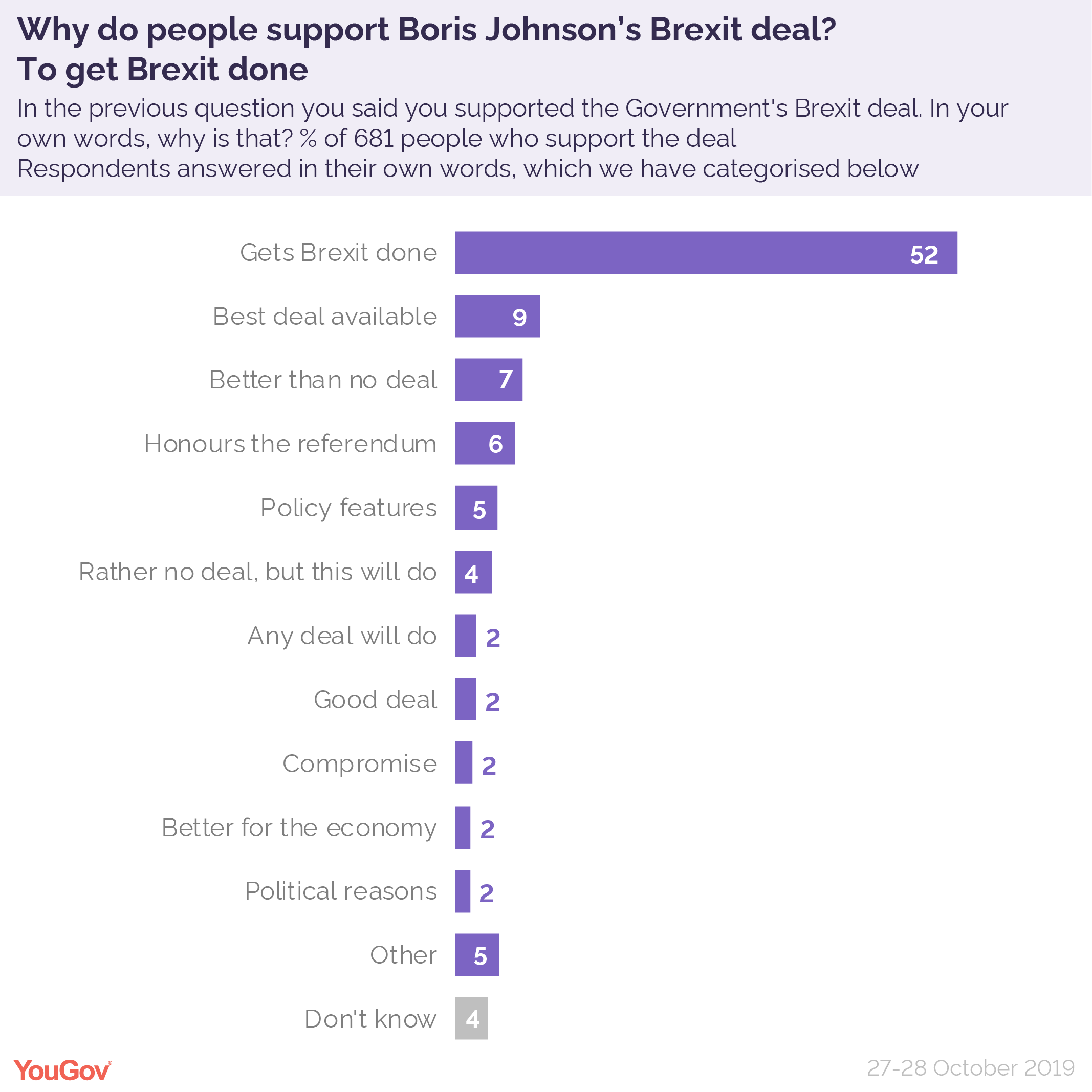
And, when asked to give their reasons for supporting or opposing the deal in their own words, there is just one dominant reason people give for supporting the deal: getting Brexit done. No other identifiable category from our manual coding of these freeform responses accounted for even 10% of supporters’ main reasons.

True, our “get Brexit done” category doesn’t include only those repeating Johnson’s campaign slogan word for word. But it is nevertheless testimony to how many people share the sense of exasperation it captures. Respondents said their support was because, “it needs dealing with”, “to end the impasse”, “just get on with it”, “just to get out”, and “want to get it over and done with”. Many also expressed frustration with how the process had “gone on too long” and how it was a “farce”, “rubbish” and “nonsense”, and how they were, “just fed up”, “bored” or “sick of it”. There was the odd expletive too.

Back in January when YouGov asked the 23% who supported May’s deal for their reasons, the mood among them was one of unenthusiastic acceptance of a satisfactory deal. May’s deal was justified as being the “best deal available”, “delivering Brexit” and “better than no deal”. There was already then substantial demand for politicians to get on with it, but now that is the overwhelming mood among supporters of Johnson’s deal.

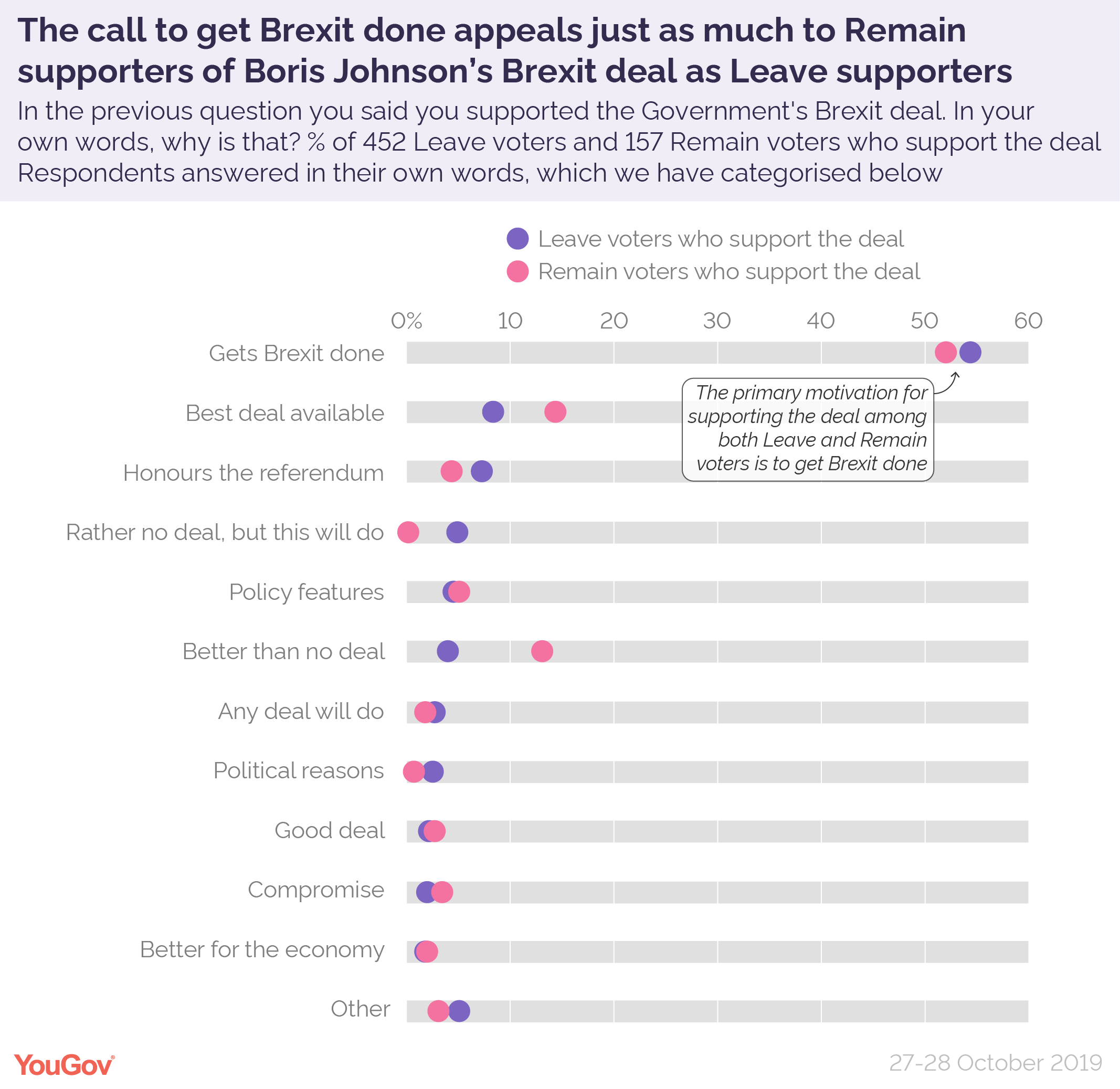
Interestingly, the call to get Brexit done appeals almost as much to Remain voters who support the deal (52%) as it does to their Leave counterparts (54%).  And those supporters of the deal who voted Labour in 2017 are actually more likely (56%) to be motivated by getting it done than those who voted Conservative (53%).

Digging deeper, it’s pretty clear that the details of the deal aren’t what matters. Talk to the advocates of leave and they will tell you that the most important virtue of Johnson’s over May’s deal is that it allows scope for Britain to reach agreements with non-EU countries on trade in goods. Yet just 2% (a mere 15 of the 681 supporters of Johnson’s deal) mentioned trade deals, some without acknowledging that as a benefit of this particular deal and all without drawing any contrast with May’s deal. A further 1% (just nine respondents) said Johnson’s deal is better than May’s, but only one said anything about how that was the case. There were a further 2% of supporters (15) who claimed that Johnson’s deal resolved the Irish, Northern Irish or backstop problem, but often with reasoning compatible with support for May’s deal or with no explanation at all.

The paucity of references to features of the deal shows that support for Johnson’s deal is barely, if at all, based on evaluations of the deal. Instead most people who want Johnson’s deal just want any Brexit settlement, and they want it now.

As for those who oppose the deal (something we’ll look into in more detail in another post) the biggest reason is that they don’t want to leave the EU at all, especially, of course, if they voted Remain back in 2016. Among those who voted Leave and oppose the deal, however, the biggest single reason is that they want a harder Brexit (a ‘cleaner break’ as some would put it) than Johnson is offering them. Among those currently intending to vote for the Brexit Party, however, only 40% oppose the deal.  On this basis, the Brexit Party is in danger of losing around half of its support to the Tories.

Whether Labour voters are quite so likely to be won over, however, is a moot point. Concerns about leaving the customs union, weakening workers’ rights and environmental protection were mentioned by many who oppose the deal. Hostility to a trade deal with the USA was mentioned by some. Even the lack of an official economic assessment of the consequences of the deal was raised, despite the Chancellor, Sajid Javid, saying that Treasury estimates are not necessary because it is “self-evidently in our economic interest.”

We should remember, too, that a third of voters are still unsure what they think of the deal, and that the campaign should (we use the word advisedly) be a period where people learn more about the deal, including the arguments for and against – a debate that we hope (based on the somewhat surprising fact that the responses threw up very few accusations hurled at “Leavers” or “Brexiteers” among opponents of the deal and very few complaints about “Remainers” and “Remoaners” among its supporters) might turn out to be slightly less poisonous than some assume.

And if that debate does take place, then, with so many people still unsure about Johnson’s deal, who knows?  Just as Theresa May’s call for “strong and stable” government wore thin over the course of her 2017 campaign, so too could “get Brexit done”.


Originally published at https://yougov.co.uk/topics/politics/articles-reports/2019/11/12/support-boris-johnsons-eu-deal-and-implications-el

Posted in Uncategorized | Leave a comment

‘How much do Londoners care about Brexit?’ (with Alan Wager), UK in a Changing Europe, 11 November 2019.

How important will Brexit be in deciding the general election in the UK’s capital? To hear some people talk you’d think that London is also the capital of Remainia, jam-packed with voters who can’t wait to send a full slate of EU-flag-waving MPs to Westminster in order to stop Brexit in its tracks.

The truth – as ever – is a bit more complicated. Brexit is a big issue – but not the only issue.

Queen Mary University of London’s Mile End Institute and YouGov asked voters across the capital for their views on Boris Johnson’s deal.

It turns out they split three ways: 26% support the Prime Minister’s deal, 36% oppose it, and the biggest (and, who knows, maybe the most honest?) group of all – 38% – say they don’t know how they feel about the treaty.

Londoners were also asked to name the three most important issues that will determine how they will vote in the upcoming general election. And one thing’s for sure: Brexit will be uppermost in people’s minds when they head to polling stations across the capital on 12 December.

Age matters, though. The older you get, the more likely you are to see the question of whether or not Britain leaves the EU as one of the key factors determining how you vote.

Brexit is a top three issue for two-thirds (67%) of Londoners over 65. Yet fewer than half (46%) of Londoners aged 18 to 24 say the same.

care about Brexit

Key to Labour’s success in December will be its ability to make the general election – for as many voters as possible – about more than just Brexit. And it’s clear from polling in the capital that this strategy chimes with its voters.

Some 78% of people planning on backing Boris Johnson’s Conservatives, along with 71% who are planning on voting for Jo Swinson’s Lib Dems, say that Brexit is a top-three issue for them. But the same is true for just 52% of Londoners planning on backing Jeremy Corbyn’s Labour Party.

So what do London’s Labour voters care about if they’re not thinking about Brexit?

Perhaps unsurprisingly, if you’re a Labour supporter you’re more than twice as likely to say that the NHS is driving your vote choice than if you’re planning on voting Tory: twice as many (52% vs 25%) of Labour voters than Conservative voters name the health services as a top-three issue.

Housing is the third issue most likely to be identified as important by London’s Labour voters, with 32% saying they will have the issue at the front of their minds when casting their ballot –a big contrast, once again, with Conservative voters in London, just 10% of whom say the same.

So what is it that the capital’s Conservative and Liberal Democrat voters do care about beyond Brexit?

The answer for Tories is crime – and if you are a Conservative voter you are far more likely (38%) to say that your vote is being determined by the rise in crime than if you are a Liberal Democrat (11%) or Labour supporter (17%).

This is in part reflective, once again, of a generation gap, but it also reflects where you live in London.

Despite young people being far more likely to be the victims of the spike in violent crime in the capital, they are far less likely to say the issue will define their electoral choice.

If you are over 50 you are twice as likely (28%) to list crime as a top-three issue compared to if you are a voter under 24.

Equally, if you live in outer London you are more likely to list crime as an issue than those living in inner London.

As for the Lib Dems, they seem to be gaining in popularity in London.

Indeed, support for them is up from 8% in 2017 to 19% today. Perhaps reflecting the fact that they were three times as likely to support Labour as they were the Tories back in 2017, their voters are exercised by healthcare (39%), the economy (38%), and the environment (35%).

As we’ve seen, though, for London’s Lib Dem voters, like London’s Tory voters, the biggest issue by far next month will be Brexit. Whether that focus will see a fair few seats switch in the capital, we’ll have to wait and see.


Originally published at https://ukandeu.ac.uk/how-much-do-londoners-care-about-brexit/

Posted in Uncategorized | Leave a comment

‘The ground war: Conservatives likely to be outgunned’, UK in a Changing Europe, 6 November 2019.

For all the increasing interest in the way parties these days fight elections on social as well as on broadcast and print media, the ground war – fought by ordinary people on streets up and down the country – still matters, especially in marginal constituencies.

Indeed, one of the reasons that Labour surprised many observers back in 2017 may well have been down – in part anyway – to the fact that, since its membership was four or five times the size of its Conservative and Liberal Democrat opponents, it could put far more boots on the ground than they could.

Since then, Labour’s membership has dropped, while the Conservatives and the Liberal Democrats have increased their numbers. But Jeremy Corbyn can still count on far more warm bodies than Boris Johnson and Jo Swinson.

Quite how warm those bodies will be, particularly in December, however, is another matter: it’s all very well having lots of members but if they aren’t willing to get out on the proverbial doorstep – and/or start bashing their keyboards for the cause – then they may not be quite the asset they seem to be.

Which brings us neatly to a number worth remembering at the beginning of any discussion about the ground war during this general election – one of many hopefully fascinating figures that feature in a recently published book, Footsoldiers: Political Party Membership in the 21st Century, co-authored by me, Paul Webb and Monica Poletti.

In the 2017 campaign, as Table 1 shows, some 36% of the 5,000-plus members of the six parties we surveyed (Labour, Conservatives, Liberal Democrats, SNP, Greens and Ukip) told us they spent no time whatsoever helping their party during those seven weeks. In other words, we need to be careful not to mistake members for activists.

Just as crucially, we need to realise that some party members do much more than their fair share of the donkey work – and, even more importantly, that members of some parties do more than others.

This is obvious whether we look at estimated time spent, as per Table 1, or the specific activities they say they engage in, as per Table 2.

The clear winners in 2017, at least when it comes to activism, were members of the SNP and the Liberal Democrats, although it’s interesting to note (in keeping with talk of hate-filled ‘Cybernats’ and endless Focus leaflets dropping onto doormats) that they had strengths in different areas, with SNP being particularly active online and the Liberal Democrats maintaining their reputation as kings of the letterbox.

Labour (and perhaps its sidekick, Momentum, too) can draw satisfaction, however, from the fact that, as well as being pretty active online, its members appeared to be particularly strong when it came to canvassing, whether face-to-face or on the phone.

Combine all that with the fact that Labour had so many more members than any other party and it almost certainly means the party has a considerable advantage in the ground campaign over most of its opponents – and in particular its main rival, the Conservatives.

For the Conservatives, the figures from 2017 are depressing to say the least: essentially four out of ten of their members admitted to doing nothing to help their party during the campaign.

True, the party may well have, say, one-and-a-half times as many members now as it did back then.

But unless those members are significantly more active than their counterparts back then – both online and offline (the latter probably being a function of age as much as anything else) – then, at this election, the Conservative Party is going to need all the paid-for Facebook ads, phone-banks, and leaflet-deliveries it can afford if it’s to come anywhere near matching its opponents’ efforts.

That said, there may be one or two crumbs of comfort for the Conservatives.

Firstly, as more detailed research we’ve published clearly shows, it’s not just paid-up members who do stuff for their preferred party at election time: there are, believe it or not, far more people who really like parties but don’t actually join them than there are people who do, meaning that the efforts of the latter are by no means the only game in town.

Secondly, look at the figures for Ukip. Not exactly impressive, are they? Which points perhaps to a potential problem for Nigel Farage’s Brexit Party.

He and his supporters (the party doesn’t actually have members in the conventional sense) may talk a good game on the telly and at their mass rallies.

But do they actually have the volunteers required to trouble the more established parties in the seats where it matters?

Of course, it’s worth pointing out that the activity rates for Ukip two years earlier, in 2015, were significantly better than they were in 2017 – one of the reasons, maybe, why it managed to win nearly four million votes four years ago.

But that difference between what Ukip members did in 2015 and what they did in 2017 points to something that should worry all the parties in 2019.

Our research at those general elections shows a clear drop off in party members’ campaign activity between the first and the second of the two – possibly due to sheer election fatigue.

December’s election might be billed as truly historic in terms of the outcome determining whether or not the UK leaves the EU but, as the third nationwide contest in four short years (the fifth if you count the 2016 referendum and this year’s European elections), it might not excite quite as much effort on the ground as its obvious importance deserves.


Originally published at https://ukandeu.ac.uk/the-ground-war-conservatives-likely-to-be-outgunned/

Posted in Uncategorized | Leave a comment

‘A warning to Tory rebels: running as an independent MP is harder than it looks’, Financial Times, 1 October 2019.

Going it alone is rarely as easy as we think. That’s almost certainly true as far as a no-deal Brexit is concerned.

But it’s also something that needs to be borne in mind by the MPs who were kicked out of the Conservative party for trying to block Boris Johnson from taking the UK out of the EU by October 31 without a deal.

That’s especially true if they intend to stand as independents at the next general election.

Some of the Tory rebels, including Ken Clarke, Justine Greening and Oliver Letwin, say they plan to stand down, and several others — Sam Gyimah, Philip Lee and Sarah Wollaston — have joined the Liberal Democrats.

But David Gauke, the former justice secretary, said on Tuesday that he is considering an independent run, as are Rory Stewart and maybe even Philip Hammond, who served as chancellor under the former prime minister, Theresa May.

Over the past 45 years, fewer than half a dozen people have run as independents and won.

Among them are BBC journalist Martin Bell, was given a clear run when Labour and the Liberal Democrats withdrew their candidates to let him take on Tory Neil Hamilton on an anti-corruption ticket in Tatton in 1997.

In 2001, a doctor, Richard Taylor fought and won Wyre Forest to save his local hospital and was re-elected in 2005.

That same year, Peter Law left the Labour party over its decision to introduce an all-women shortlist in Blaenau Gwent and won the seat.

There’s a reason for that.

Our electoral system, and the laws that underpin it, has been fashioned by political parties for political parties.

Without their support then, baby, it’s cold outside.

First of all, any candidate standing as an independent will have to get his or her head around the legal framework.

Laws like the General Data Protection Regulation impose detailed requirements on candidates, but those affiliated with big parties can rely on HQ to train and supply local agents and organisers to ensure they don’t fall foul of the law.

Without that support, independent candidates will struggle.

As any seasoned campaigner will attest, winning a modern election is all about data — knowing where your potential supporters are so that you can target them in the run-up to the election and get them to the polling station on the day.

Parties already have this information, and are busy revising and supplementing it as we speak.

Independent candidates, however, will have to start from scratch, and GDPR means that they can’t expect anyone else to share voter data with them.

Nor, if they are an MP, can they use any of the data on constituents, such as home and email addresses, gathered in that capacity.

But let’s assume, for the sake of argument, that the former Tory MPs can work out where all their supporters live.

How will they muster the boots on the ground needed to leaflet all those letterboxes and knock on all those doors?

It won’t be easy to persuade Conservative party activists to work for them.

Membership surveys carried out for our new book clearly show that those activists are likely to feel pretty committed to their local associations and even more committed to Brexit — deal or no deal.

Couldn’t an independent candidate simply make up for the lack of volunteers with paid labour? Well, no.

Candidates are only allowed to spend around £15,000 on their constituency campaigns — a limit that is carefully audited.

Parties get around this by using the tens of millions of pounds they are permitted to spend nationally to promote their causes in ways that will resonate in particular constituencies.

But if you have no party, you have no tens of millions, leaving you at a serious disadvantage.

And that doesn’t touch on what, even in the internet era, is still the most powerful means to get your message across — television.

Parties are entitled to fair coverage and, in many cases, free party political broadcasts.

Representatives of the biggest outfits are also invited to participate in nationwide TV debates. Independent candidates receive none of this.

That means that for those Tories cast aside by their parties and now thinking of standing as independents, their political life — to borrow from Thomas Hobbes — could well be “solitary, poor, nasty, brutish, and short”.

Miracles and upsets do happen.

But history suggests that even a big beast like Mr Hammond — should he eventually decide to go it alone — is likely to end up with a vote-share nearer the 0.4 per cent that Lord Buckethead took when he stood against Mrs May in 2017 than the 60.9 per cent share Mr Hammond racked up last time around.


Originally published at https://www.ft.com/content/a1347880-e141-11e9-b8e0-026e07cbe5b4

Posted in Uncategorized | Leave a comment

‘Corbyn’s conference win may see Labour caught in Brexit Star Wars crusher’, UK in a Changing Europe, 26 September 2019.

The Labour Party owes the UK Supreme Court – big time.

Before its president, Lady Hale, delivered the Court’s bombshell verdict on the government’s unlawful prorogation of parliament on Tuesday morning, the mood in the party had matched the dreadful weather that was battering Brighton, where it was meeting for its annual conference.

The previous day, Conference had decided to ignore the overwhelming desire of Labour’s grassroots membership that it not only reiterate its support for a second referendum but also commit to campaigning for the UK to remain in the EU should a so-called ‘People’s Vote’ take place – something that no-one now should rule out.

Some three quarters of members think the party should officially campaign in favour of remaining in the EU, but a motion to that effect was not carried.

This came as a huge relief to Jeremy Corbyn but not to all of his colleagues, many of whom believe passionately (and are prepared to say publicly) that Labour is bound to suffer electorally as a consequence.

One of them, the party’s foreign affairs spokesperson, Emily Thornberry, put their feelings best. Speaking as the rain lashed down on the Sussex coast, she admitted:

“I’ve been thinking about this quite a lot and I keep running through lots of films. You get the hero who is standing in the middle and the walls are coming in.

“It is used lots of times, it’s used in Indiana Jones where the walls are coming, or Zorro, and I think there’s also a bit in Star Wars where they’re in the crusher.

“And the answer is not just stand there and go ‘oh well, I know I’m right’ – the idea is to get out of there and that’s kind of where we are with these two sides pushing us.”

The two sides of the crusher are Boris Johnson’s Conservative government and Jo Swinson’s Liberal Democrats. And, right now, it’s hard to say which of them constitutes the bigger threat to Labour.

Parliament, it seems, has (at least temporarily) blocked a no deal Brexit.

Meanwhile, the obstacles to Johnson pulling off a last-minute deal with Brussels remain formidable – especially after his performance in the recalled House of Commons enraged so many Labour MPs, at least some of whom he needs to vote for any revised Withdrawal Agreement.

Yet the Tories are still promising voters that the UK is going to be leaving the EU on 31 October.

Who knows?

Perhaps the Prime Minister has a few tricks up his sleeve that will allow him to fulfil that pledge even after he was given what must rank as the biggest legal reprimand delivered to a sitting head of government in British political history yesterday.

But the fact that he and his colleagues continue to reiterate it regardless of the difficulties involved is a reminder that their electoral – indeed, their survival – strategy is still centred on grabbing back the people Theresa May lost to Nigel Farage’s Brexit Party and uniting Leave voters under the Tory banner.

That strategy makes a lot of sense – not least because the UK’s electoral system means the Conservatives don’t need anywhere near all of the 52 per cent of the electorate who voted Leave in 2016.

Around 35 per cent should do it, especially if Labour (and its leader) is polling as poorly as it is currently.

The decision by Her Majesty’s Opposition to sit on the fence is unlikely to do much – indeed anything at all – to turn around its dire ratings.

Certainly, it offers little to tempt diehard Leavers or even Leave-leaners into voting for Jeremy Corbyn, unless, perhaps, they are habitual, tribal Labour supporters toying with the idea of straying to the Tories or the Brexit Party but desperately looking for a reason to stay loyal.

As a defensive strategy, that might, just, have some merit; but Labour lagged some 55 seats behind the Tories in 2017, so it should be on the offensive.

Defensive or otherwise, Labour’s position is in any case likely to be tested to (or beyond) destruction ‘on the doorstep’ at any general election.

Not only is it neither one thing or the other, it is also really hard to explain to the average voter – as anyone who’s seen its spokespeople trying to do so will attest.

So to the other side of the Star Wars-style crusher, the Lib Dems. When they stopped rubbing their hands over Labour’s decision on Monday not to decide, they presumably used them to crack open a few bottles of champagne.

Just as Johnson has decided to appeal almost exclusively to Leave voters, Swinson has done the same, just in reverse.

The decision of the Lib Dem conference held in Bournemouth last week to call for immediate revocation of Article 50, which served notice to the EU that the UK would be leaving, was catnip to diehard Remainers, many of whom were losing (or had already lost) patience with Corbyn’s equivocation and for whom his big ‘win’ in Brighton will be the final straw.

Of course, the Lib Dems stand virtually no chance of winning a majority – the last time they did so was in 1906 and they are currently polling at, give or take, 20 per cent).

So, in reality, they are still relying on a hung parliament forcing a second referendum, at which point they will once again campaign hard for Remain. But as a branding exercise, revocation has got an awful lot going for it.

It has exactly the kind of clarity that Labour’s strategy so badly lacks.

And, especially when combined with Swinson’s apparent unwillingness to help Jeremy Corbyn into office, stands a reasonable chance of pulling in pro-European Tory voters, of whom, it is easy to forget, several million – a fair few of whom are located in Remain-voting constituencies where the Lib Dems came a not-too-distant second to the Conservatives last time around.

The only drawback of Swinson’s strategy is that in other seats, the Lib Dems’ aggressively pro-Remain position will, by virtue of its appeal to many disaffected Labour pro-Europeans, effectively split the ‘progressive’, anti-Conservative vote, thereby allowing the Tories to pick up some seats by coming through the middle.

But to put it bluntly, that is simply not Swinson’s problem. It is Corbyn’s.

And while the Supreme Court’s criticism of the government may have temporarily knocked his party’s travails off the news agenda, it does nothing to alter the fact that, in trying to have it both ways, Labour risks being not simply squeezed but crushed.


Originally published at https://ukandeu.ac.uk/corbyns-conference-win-may-see-labour-caught-in-brexit-star-wars-crusher/

Posted in Uncategorized | Leave a comment

‘Boris Johnson vs. Donald Trump: Why the British prime minister is worse for democracy’, NBC, 26 September 2019.

Who knows whether it was merely a coincidence that, just a few hours after flying home from meeting President Donald Trump in New YorkBritish Prime Minister Boris Johnson put on one of the most insidiously poisonous performances I have ever had the misfortune to witness from a British prime minister.

But now no one can possibly doubt that Johnson is following the American president’s divide-and-rule populist playbook. Nor that, in so doing, he is playing with fire, creating an atmosphere so dangerously toxic that politics — indeed democracy — in the U.K. may never fully recover.

Johnson is in a tight spot. He won the Conservative Party leadership and therefore the premiership this summer by promising to take the U.K. out of the European Union by the E.U.’s Oct. 31 deadline come what may — in other words, with or without a deal with the E.U. on the terms of divorce, even though the lack of one could lead to major disruptions in the economy and national security.

However, although his party runs the government, it does not enjoy a majority in Parliament, and most members do not want the country simply to exit the E.U. without a negotiated agreement. Fearing the body could take the decision out of his hands, Johnson made the extraordinary decision to suspend (or prorogue) Parliament to prevent it from doing so. But his maneuver turned out to be too clever by half.

On Tuesday morning, in surely the most dramatic decision it has ever made in its short existence (it was only established 10 years ago), the U.K.’s Supreme Court ruled unanimously that government’s prorogation of parliament was not only unlawful but null and void. Accordingly, Parliament (which prior to its suspension managed to fast-track legislation obliging Johnson to ask for an extension from the E.U. if he doesn’t get a deal by mid-October) was free to resume.

It’s hard to imagine that, faced with such a rebuff, any other prime minister — at least since Britain became a full-fledged democracy in 1928 — would not consider resigning. It is even harder to imagine them showing no contrition whatsoever. Not Johnson. Instead he doubled down, in true Trump fashion.

On Wednesday, the PM lowered the tone even below that set by his Conservative Cabinet colleague who called the Supreme Court’s judgment “a constitutional coup” and his attorney general, who declared: “This parliament is a dead parliament. It has no moral right to sit on these green benches.”

Addressing the House of Commons, Johnson declared that, since Parliament is refusing to let him ram through the “no-deal” Brexit he wants or to grant him the early election he thinks would give him the majority to do so, the chamber was, “out of sheer political selfishness and political cowardice, … refusing [to] deliver on the priorities of the people.”

Moreover, by referring on no less than 15 occasions during his appearance Wednesday to the legislation blocking a no-deal Brexit as “the surrender act,” he was effectively normalizing the inflammatory rhetoric that many worry will encourage further political polarization and even lead to violence.

His words triggered tears of anger from female opposition MPs mortified that a prime minister was legitimizing the vitriolic language to which, since Brexit, they have been subjected to almost daily— not just from social media trolls but inreal-life death threats.

Johnson’s dismissive reaction was truly breathtaking: “I have never,” he declared, “heard such humbug in all my life,” clearly implying that they were faking their emotional reaction when, as he well knows, MP Jo Cox was shot and stabbed to death three years ago by a right-wing nationalist supporting Brexit who considered her a “traitor.”

The prime minister’s aim — à la Trump — was clearly to provoke fury rather than forensic argument from his opponents; to hammer home prepared soundbites that would grab headlines and so mobilize his base; and to frame any imminent election, in true populist fashion, as “the people” against the out-of-touch elites.

He succeeded, but at what cost? If Johnson were merely making front-page news — a vaudeville villain to cosmopolitan liberals, but a superhero to Brexit supporters — that would be bad enough. We are, after all, already polarized.

But he is also encouraging the part of the country that still wants desperately to leave the E.U. to view the checks and balances we’ve long taken for granted — most obviously government constrained by Parliament and the rule of law — as some sort of impediment to, rather than vital ingredient of, British democracy.

Even worse, it’s not just him. As well as being backed by an increasingly hysterical pro-Brexit print media (One tabloid headline on Wednesday blared “Unlawful? What’s Lawful About Denying 17.4M Brexit?”), the majority of his Conservative colleagues seem to have completely forgotten their party’s historic commitment to upholding the conventional restraints on executive power.

These restraints are all the more vital in a country that lacks a codified founding document setting explicit limits on whoever is in charge, relying instead on a cobbled-together constitution of sometimes confusing and potentially contradictory laws, guidebooks, customs and practice.

If Conservative MPs carry on this way, they surely risk, as do their Republican counterparts, finding themselves defending what in their heart of hearts they must know (or at least worry) is the increasingly indefensible.

In the U.S., the separation of powers sharply cut by the Constitution provides at least some protection from executive overreach, and the two-term limit it imposes on any presidency affords some light at the end of the tunnel.

But in the U.K., our constitution, such as it is, is much more malleable, since it relies as much on gentlemen’s agreements as on written rules, and prime ministers can serve for as long as they can keep getting people to vote for them. Meanwhile, the very novelty of, and widespread unfamiliarity with, our only recently created Supreme Court may render it more vulnerable than its American counterpart to structural reforms by politicians unhappy with what many of them regard as unwarranted interference.

All that means that those of us on this side of the pond could be in for an even longer and bumpier ride than everyone on the other side — and it could take us down an even more slippery slope.


Originally published at https://www.nbcnews.com/think/opinion/boris-johnson-vs-donald-trump-why-british-prime-minister-worse-ncna1059271

Posted in Uncategorized | Leave a comment

‘Labour conference: Jeremy Corbyn battles it out with members over Brexit’, The Conversation, 22 September 2019.

Labour’s conference in Liverpool last year was essentially about defusing a bomb that threatened to go off over Brexit. And it looks like this year will be the same.

That’s because there continues to be a major mismatch between what the party’s membership wants on Europe and what its leadership – Jeremy Corbyn, his (now slightly reduced) coterie of close advisors, and a handful of powerful trade union general secretaries (most obviously Unite’s Len McCluskey) – is prepared to give them.

As the survey research for our new book, Footsoldiers: Political Party Membership in the 21st Century, makes clear, Labour’s rank-and-file are overwhelmingly pro-European. Eight out of ten of them voted Remain. Three-quarters of them want a second referendum. And if one were held, nine out of ten of them would vote to stay in the EU.

None of this is lost on the leadership, not least because they’ve seen our research reported in the media. Local constituency Labour parties (CLPs) have made their feelings clear by submitting dozens of motions for debate at conference with a heavy Remain focus. And it has made a difference. Don’t forget that Corbyn’s first response to the result of the referendum in June 2016 (after a campaign in which his efforts to persuade voters to plump for Remain can only be described as lacklustre) was to demand the triggering of Article 50 – and without a vote in parliament to do so. Now, Labour is not only adamantly against a no-deal Brexit but claims it would like to see a “People’s Vote”.

Yet doubts persist – and if you watch Corbyn’s pre-conference interview with ITV’s Joe Pike, you can see why. Asked if he supports Leave or Remain he refuses to answer – eight times.

Moreover, in the run-up to the Brighton conference, Corbyn has effectively attempted to preempt the party’s decision on what its Brexit policy should be by announcing it in advance. He has declared that the plan is to win a general election, negotiate a new withdrawal agreement (one apparently involving a closer economic relationship with the EU) and then put that to voters in a second referendum. This referendum would include an option to remain, too.

Whether this convoluted stance can carry Corbyn and co. through said general election is debateable. Anyone unfortunate enough to have witnessed what happened to Labour’s shadow foreign secretary, Emily Thornberry, when she tried to explain it to the audience on Question Time a few weeks ago is bound to have their doubts.

Emerging bloodied but unbowed from that particular car crash, Thornberry has gone on to add a new twist by asserting that Labour would support the passage through parliament of a last minute deal with the EU negotiated by Boris Johnson as long as it was made conditional on a referendum. Shadow chancellor John McDonnell, however, has very publicly poured cold water on the idea. No wonder an opinion poll released on Sunday showed over two thirds of voters thought Labour’s policy on Brexit was “unlcear”.

Quite why the leadership insists on putting its spokespeople (and presumably its members) through such agonies is not entirely obvious.

We often hear that it is worried about losing so-called “Labour Leave seats” if party policy strays too far towards Remain. Yet even a cursory look at the numbers suggests that (because a large majority of Labour voters in those seats voted Remain anyway) this fear is seriously overblown.

If that is indeed the case, then the only other explanation is that the leadership really isn’t that bothered about Brexit. That might be because it hopes the Tories will take the blame if exiting the EU makes a terrible mess or it might be because it truly believes Brexit will give a Labour government greater freedom to make a success of the economy – despite that widely being considered a fallacy.

Putting it to the vote

It is hardly surprising, then, that nearly 100 CLPs have submitted motions to conference on Brexit. More than 60 of these demand Labour commit to campaigning for Remain. Yet, if last year’s “compositing meeting” (a process during which multiple motions are turned into an anodyne one that can be put to a vote in the conference hall without overly embarrassing the leadership) is anything to go by, they may end up with a motion that says less than they’d like.

But even if Labour’s Remain membership does get the kind of wording it wants, there is no guarantee that it will gain a sufficient majority (especially given union opposition) to see it go into the party’s programme and therefore make it a contender for Labour’s next manifesto. And even if that motion is sufficiently well-supported, there is no guarantee that it would subsequently make it into Labour’s election platform – not least because it may turn out to be one of two “official” statements on Brexit that emerge from Brighton this week: the NEC, Labour’s top decision making body, opted on Sunday lunchtime (via, believe it or not, a round-robin email), to support Corbyn’s line that the party will not make up its mind on whether to campaign for Remain in any referendum until after the general election.

But anyone therefore expecting a fatal shootout on the South Coast this week shouldn’t hold their breath. Corbyn – supposedly a very different leader of the Labour Party and one who promised to be guided by its members – will probably get away with ignoring them yet again. And he’ll do so by doing exactly what his supposedly right-wing, war-mongering, neo-liberal predecessors did: namely, use a combination of good old-fashioned bureaucratic manoeuvring and trade union muscle to ensure he gets what he wants rather than what they want.

And as our research in Footsoldiers makes plain, most Labour members are very left wing and even more socially liberal. Many joined the party precisely because “Jeremy” embodies those very values. True, their infatuation might have worn off – after all, the antisemitism stories and his truly dire poll ratings have taken their toll. But most Labour members still love Corbyn. And even now, as we approach what some see as the European endgame, they may still love him more than they hate Brexit.


Originally published at https://theconversation.com/labour-conference-jeremy-corbyn-battles-it-out-with-members-over-brexit-123974


Posted in Uncategorized | Leave a comment

‘Swinson’s Article 50 pledge flirts with disaster – but it could end up grabbing “revenge votes” for the Lib Dems’, Independent, 17 September 2019.

There’s a lot to be said for clarity.

You’ll know this if you saw the clip of Labour’s Emily Thornberry on Question Time a week or so back tortuously trying, and failing, to explain her party’s Brexit policy.

So the Lib Dems’ decision to declare that they will be revoking Article 50 if they win a majority at the next general election clearly has a lot going for it. But it also comes with dangerous downsides.

One thing it certainly does is distinguish the Lib Dems from Labour. There’s no way that Corbyn can match that offer.

So for those who think “bollocks to Brexit” (which Lib Dem activists, I learned down in Bournemouth, like to sing to the tune of Waltzing Matilda), Jo Swinson really is the only game in town.

As such, Revoke is essentially a heat-seeking missile aimed at die-hard Remain voters in the constituencies, most of them Tory, that the Lib Dems have a pretty good chance of winning as long as, that is, the anti-Brexit vote isn’t split.

True, even precision-guided weapons tend to result in some collateral damage.

There will undoubtedly be some less-convinced Remain voters who will be put off by a policy that Labour and the Tories, having promised to implement the result of the 2016 referendum, are already labelling (without a great deal of justification some would say) as “undemocratic”.

But if we’ve learned anything from the last three years, it’s that you really can’t have your cake and eat it.

In politics, trade-offs come with the territory. And under first-past-the-post in particular, as the Lib Dems know better than anybody, it’s not simply about how many votes you get, it’s about where you get them.

Doubters, some of them brave enough to voice their concerns about the policy down among the faithful in Bournemouth, worry that it will remove any chance they have of winning back some of the Eurosceptic south-west seats that, until they lost them in the post-coalition catastrophe of 2015, they’d held through a combination of atavistic partisan loyalty and bloody hard work.

Well, they may be right.

But, although candidates fighting those former bastions of liberalism won’t like to hear it (and may of course prove everyone wrong) those seats are very probably lost to them anyway.

So if Revoke opens up possibilities in, say, London, where seats are genuinely in play, then that may well be a price worth paying.

A bigger problem, perhaps, is that the policy is based on a transparent falsehood, fallacy and fantasy – namely that the Lib Dems are going to win the overall majority that will allow them to implement it.

Sure, stranger things have happened.

But right now, it’s painfully obvious that far fewer voters than ex-Labour and ex-Tory MPs are coming over to the Lib Dems. Current polling puts them at around 20 per cent, if that.

True, political geography, as we’ve already pointed out, matters. But, unless the numbers change significantly, it’s going to have to weave some pretty dark magic to get them nearer to 330 than 30 seats in the Commons.

During any election, then, Lib Dem spokespeople are almost certainly bound to find themselves forced by the media to admit that their central policy is undeliverable.

They will be accused of making a promise they can’t possibly keep, and asked if they risk letting down their supporters like they did over, oh, I don’t know, the abolition of university tuition fees.

They may be able to handle that (they could argue that if they can’t get what they want, then they will resume their call for a second referendum at which they will campaign for Remain).

However, a trickier question would follow – namely, are they really saying, as Jo Swinson appears to be, that she won’t under any circumstances help put Jeremy Corbyn into Downing Street, even if that ensures a second referendum will take place?

Would doing that really be worse than happily entering into a coalition with David Cameron which, they’ll be reminded by Labour, unleashed five years and more of austerity on some of the country’s most vulnerable people?

And all that ignores what some see as Revoke’s biggest risk of all. It relies on Brexit not happening before the next election.

If Boris Johnson pulls off a miracle and takes the UK out of the EU by the time we troop back to the polls again, then the Lib Dems are going to look not so much like one-trick pony as a no-trick pony.

But hold your horses. That supposedly doomsday scenario might not be such a disaster, after all – at least for the Lib Dems if not for the country as a whole.

If we do leave, not everyone will be chuffed to bits or simply heaving a sigh of relief. And even those who are will soon find Brexit ain’t really over.

As for those who aren’t, they will be angry – really angry – and they won’t be much less angry with Jeremy Corbyn and the Labour Party than with Boris Johnson and the Tories.

At that point, “revenge voting” could become a thing – and perhaps a very big thing for Jo Swinson and the Liberal Democrats.

Originally published at https://www.independent.co.uk/voices/jo-swinson-brexit-revoke-article-50-liberal-democrats-a9108886.html

Posted in Uncategorized | Leave a comment