“It’s one thing to say the economy is not doing well and we’ve got a fiscal challenge … but cutting the benefits of the most vulnerable in our society who can’t work, to pay for that, is not going to work. And it’s not a Labour thing to do.”
So says former Labour big beast turned centrist-dad podcaster Ed Balls about the government’s welfare reform proposals. Cue furious nods from all those who were hoping and expecting better – or at least not this – from Keir Starmer and Rachel Reeves.
Reactions like these are wholly understandable. After all, the Labour party has long viewed support for the welfare state as both a flag around which the party can rally, and a stick with which to beat the Conservatives.
But while that may have been the case in opposition, in office things have been a little more complicated.
Going all the way back to the MacDonald and Attlee governments, through the Wilson era, and into the Blair and Brown years, Labour governments have often seen fit to talk and act tough to prove to voters, the media and the markets that they have a head as well as a heart. And if that means upsetting some of their MPs, their grassroots members and their core supporters in the electorate, then so be it.
Welfare encompasses a raft of policies that are as much symbolic as they are substantive. Choosing between them has tangible implications for those directly affected. But those choices also say something – and are intended to say something – about those politicians and parties making that choice.
For Labour governments – and in particular Labour chancellors – cuts in provision, even (indeed perhaps especially) if they involve backtracking on previous commitments, have always been a means of communicating their determination to deal with the world as it supposedly is, not as some of their more radical colleagues would like it to be.
On every occasion, those decisions have provoked outrage: a full-scale split in the 1930s, the resignation of three ministers (including Harold Wilson and leftwing titan Nye Bevan) in the 50s, parliamentary rebellions and membership resignations in the 60s, more generalised despair in Labour and trade union ranks the 70s, and yet another Commons rebellion in the 90s.
But what we need to appreciate is that the fallout is never merely accidental. Rather, it is a vital part of the drama. For the measures to have any chance of convincing sceptical markets and media outlets (as well as, perhaps, ordinary voters) their authors have to be seen to be committing symbolic violence against their party’s own cherished principles.
The proof that sacred cows really are being sacrificed is the anger (ideally impotent anger) of those who cherish them most – Labour’s left wingers. Their reaction is not merely predictable (and expect, by the way, to see Labour’s right wingers employ that term pejoratively in the coming days), it is also functional.
The cruelty is the point
Away from the Labour party itself, both those directly affected by the changes to sickness and disability benefits and those who campaign on their behalf, are – rightly or wrongly – already labelling those changes as cruel. But, likewise (and to put it at its most extreme) the cruelty, to coin a phrase, is the point.
The government will naturally be hoping that, in reality, as few people as possible will be significantly hurt by what it is doing. But the impression that it is prepared to run that risk in pursuit of its wider aim is, in many ways, vital to its success.
As to what that wider aim is? Labour’s essential problem is that, for all its social democratic values, it understandably aspires to become the natural party of government in what is an overwhelmingly liberal capitalist political economy.
It has all too often sought to achieve that, not so much by creating expectations among certain key groups and then rewarding them, as it has by aiming to demonstrate a world-as-it-is governing competence.
That, in the view of its leaders (if not necessarily its followers), is the master key to the prolonged success experienced by the Conservative party – a party which has traditionally enjoyed the additional advantage of being culturally attuned to the market and media environment in which governing in the UK has to be done.
So, no, Ed Balls, you’re wrong: for good or ill, this week’s announcement is very much “a Labour thing to do”.
Nigel Farage has been banging on about ‘the People’s Army’ for over a decade. Turns out he’s finally recruited one. Reform UK says it now has a membership of well over 100,000, overtaking that of the Conservatives. So, who are those members, what are they like, what do they think, and what might they do for the party?
Just after the election, we – the Party Members Project run out of Queen Mary University of London and Sussex University – surveyed the members of five UK-wide political parties, including Reform UK. Here’s what we found.
Age-wise, there’s not much to distinguish Reform UK from other parties, especially the Conservatives. Their average age is 61 – not surprising when hardly any of them are aged 18 to 24 – very nearly half of them are over 65 and a third of them are aged between 50 and 64.
Like the members of other parties, they are predominantly middle-class: six in 10 of them fall into the ABC1 category, although that would still make Reform an ever-so-slightly more working-class party than Brexit or UKIP. It’s also a little less male-dominated, even though six out of 10 members are men. It’s not, however, any more representative of the North or the Midlands than those parties were, with about a fifth of members come from each of those two regions. But London-centric they are not: only five per cent live in the nation’s capital.
As to their values: they’re particularly keen on order, fairness, love of country, tradition, and some 95 per cent agreed that “respect for authority is something all children need to learn”. Some 98 per cent also said they were proud of Britain’s history, so they’re no more likely than their Conservative counterparts to appreciate criticism of our imperial past. And Reform members were even more likely to think that “men and women each have different roles to play in society”– a statement with which 85 per cent of them agreed. More generally, nearly all of them voted leave and some 90 per cent see themselves as on the right of the ideological spectrum: 29 per cent “right-of-centre”, 50 per cent “fairly right-wing”, and 11 per cent as “very right-wing”.
As far as individual policy issues are concerned, Reform UK members look a bit like Tory members, only more so – and occasionally much more so. For example, opposition to the UK’s commitment to cutting carbon emissions to net zero by 2050 is fairly widespread among the Conservative grassroots at 45 per cent; among Reform members that figure rises to 86 per cent. On immigration, the gap is much smaller: the proportion of members thinking immigration has been too high over the last decade is 92 per cent for the Conservatives, and 98 per cent for Reform UK.
Interestingly, and this is where there may be an awkward mismatch between Reform’s members and its target voters, some 56 per cent of the party’s members thought government should cut taxes and spend less on public services, rather than increase taxes and spending or leave things as they are. Since only 44 per cent of Tory members said the same, Reform members may well be even more Thatcherite than they are.
Reform members are also, of course, huge fans of Farage – not surprising, perhaps, when the top three qualities of a leader Reform members picked were qualities that Farage possesses in abundance: “being able to stand up for the UK in dealing with other countries” (61 per cent), “being in touch with ordinary people” (55 per cent), and “being a good communicator” (37 per cent).
Digging a little deeper into the darker side of Reform UK members’ views on leadership only strengthens the impression that Farage is very much the right man in the right job. Only 14 per cent said they didn’t like “charismatic leaders who show off every now and then”, as against 55 per cent who did. A mere five per cent weren’t keen on “leaders who can give as good as they get on social media”, whereas 81 per cent were. And a whopping 96 per cent said they were into “leaders who aren’t afraid of speaking bluntly and stirring up a bit of controversy”.
So, the People’s Army is right behind Farage. But does that mean they’ll help him win the electoral war – particularly the ground war?
If the answer involves leafletting and canvassing, then perhaps not: during the 2024 election campaign, Reform UK members were generally less likely to get involved in those activities than members of the other four parties.
If, however, we’re talking about online, then it’s a very different story. We asked whether members had “shared or liked something which promoted their party and/or its policies on social media”. The responses? Tories, 45 per cent. Lib Dems, 48. Labour, 57. Greens, 67. And Reform UK? Top on 71 per cent.
If the 2024 election proved anything – aside from the fact that the majority of people who bothered to vote rid of a government that had run things for 14 long years – it reminded us that the UK is no longer a country conveniently carved up between Labour and Conservatives. So as we move into 2025 and beyond, we need to ask ourselves whether we can continue to put up with an electoral system that’s less and less fit for purpose. It’s a dysfunctional system which could open up a big opportunity for Nigel Farage and Reform.
The tendency of people to feel a degree of tribal loyalty to one or other of the big two – often based on their class identity – has actually been waning ever since researchers first began to measure it using surveys in the 1960s.
Partly as a result, and partly because it’s got more and more difficult for governments to deliver a decent, no-worries standard of living for the average Brit, we’ve occasionally seen so-called ‘third parties’ make breakthroughs, at least in terms of vote-share, though not seat-share in the Commons. The Liberals in the early 1970s and then again, in an alliance with the Social Democrats, in the 1980s are one example; the SNP is another.
But recently this fragmentation has accelerated in both scope and pace. In part because the elections of 2010 and 2015 were followed by two contests which seemed (but only seemed) to restore the two-party regime, many of us failed to notice they signalled a further weakening of the big two’s grip on British politics. In reality, however, 2017 and 2019 were blips – pauses in the melting of an iceberg that’s starting to look unstoppable.
Such is the mainstream media’s continuing obsession with the familiar government vs opposition dynamic that it’s all too easy to ignore the underlying message of July’s results. This year Labour and the Tories together accounted for a measly 57% of the votes cast. Compare that to 82% in 2017 and 76% in 2019 – or to 1951 when the figure was, believe it or not, 97% per cent.
And look at where the rest of those votes went – not just to the familiar ‘third parties’, the Lib Dems (12%) and the SNP (2.5%) but to the Greens (7%) and, most worryingly perhaps for both of the big two, the radical right wing populists of Reform UK led by Nigel Farage (14%).
Labour also lost the support of significant numbers of Muslim voters to pro-Gaza Independents – voters that, who knows, it might never get back. Of course, not all those parties won a number of constituencies commensurate with their support in the country as a whole.
The UK, then, is more and more a multiparty system still trapped (but only just) in a two (or two-and-a-half) party body, its true nature distorted by a first-past-the-post system that’sfinding it increasingly tricky to do the job it’s supposed to do – namely to constrain the number of parties in parliament, even at the cost of leaving a substantial minority of voters feeling completely unrepresented.
In 2024, those supposedly “extreme” parties – the Greens and Nigel Farage’s Reform – did win seats at Westminster, albeit only a handful each. Not only will their presence allow them to further highlight the essential unfairness of the existing electoral system, it will also provide a golden opportunity for something we’ve never really seen before in the debate over our dysfunctional electoral system – a genuinely charismatic politician from the right of the political spectrum banging the drum for change.
Whether Nigel Farage chooses to seize said opportunity to bang that drum remains to be seen, of course. He may just decide to play the same old anti-immigration, anti-woke, and anti-net zero tunes that have served him so well in recent years in the hope that he can somehow overhaul the Tories by beating them at their own game under first-past-the-post.
If so, however, he’s likely to find himself playing a very long game indeed – unless, of course, he can somehow persuade a desperate Tory leader to cut him a deal whereby they don’t contest Labour-held seats that are Reform targets in return for him doing the same for them in Tory targets.
The danger for the Conservatives in such a deal is that it results in a hung parliament whereby they’re reliant on Reform to make it back into Number Ten. At that point Farage would be a fool if he didn’t insist on PR as his price.
Love him or loathe him, Farage is no fool. Watch this space.
In 1964, US Supreme Court Justice, Potter Stewart, famously gave his opinion in a case that revolved in part around what did and did not constitute hard core pornography. ‘I shall not’, he wrote, ‘today attempt further to define the kinds of material I understand to be embraced within that shorthand description; and perhaps I could never succeed in intelligibly doing so. But I know it when I see it’.
As for pornography, so for leadership. We all think we know what it is, yet we find it hard to come up with a universally-agreed definition − mainly because our conceptions of what constitutes it are very often subjective and, indeed, contextual. Many British voters, for instance, lionised Winston Churchill as a war leader, but famously decided after the conflict ended in 1945 that he was not the man to ‘win the peace’.
Understanding leadership
Our understanding of what constitutes a good and bad leader is also cultural and even, perhaps, psychological − something that recent research on Britain’s party members certainly seems to suggest.
The Party Members Project based out of Queen Mary University of London and Sussex University has been surveying the members of five political parties since 2015. We did so again just after the 4 July General Election. Having explored extensively both the sociology and ideology of party members, we decided this time to focus on the psychology of membership. And as part of that effort, we included in the survey (one we also fielded to the general public as well as members) a number of questions about leadership, some of which were designed to tap into the so-called dark triad − Machiavellianism, narcissism, and psychopathy.
What we discovered is that there are very significant distinctions between what the members of different parties want from, and expect of, leaders − distinctions which, for the most part, split people who belong to the Reform and Conservative Parties, on the one hand, from those who belong to their ‘progressive’ counterparts, the Liberal Democrats, Labour and the Greens.
We also found that, more often than not, the general public’s views on and expectations of leaders aligned more closely with those held by the members of the progressive parties than they did with those of their right-wing equivalents − not entirely surprisingly perhaps, given that those who voted Labour, Lib Dem, and Green outnumber those who voted Conservative and Reform, but enough maybe to give those on the political right pause for thought about what kind of leadership they should be projecting.
Certainly, it would seem sensible for the Tories’ new leader, Kemi Badenoch, to think long and hard on that score. But so, too, perhaps, should Keir Starmer, who, if his less-than-impressive poll ratings are anything to go by, has hardly got off to a great start as Prime Minister.
Members’ views
So how, then, do the qualities the general public think are important for leaders to demonstrate compare with those of the members of the country’s two largest parties? We began by asking respondents the following question: ‘Which, if any, of the following qualities do you think are most important for a leader to possess?’, allowing them to pick up to three from the list in Table One, which also displays the results in both percentage terms and rank order.
Two things stand out. The first is that when it comes to what is expected in a leader, the public are closer to Labour members than they are to Conservative members. The second is that the overall gap between Labour and Conservative members is huge: we’re not just talking chalk and cheese but Mars and Venus − carnivores and herbivores, even. These very different responses suggest many Labour members have all sorts of reservations and compunctions which many Tory members would regard as unnecessary, indeed positively counterproductive, hangups.
Table 1: The Qualities it’s Important for a Leader to Possess
Of course, there are some qualities on which the views of the general public are closer to those of the Tory grassroots than to Labour’s membership. Take, for instance, ‘being able to stand up for the UK in dealing with other countries’. Here the gap between the public and Conservative members (for whom that quality ranks as number one) is only half the size of the gap between the public and Labour members (who rank it way down at number nine).
Yet that gap is smaller than the one that exists between the public and Conservative members when it comes to what the public ranked number one, namely ‘being in touch with ordinary people’ − a quality that Labour members also ranked very highly. Given some of the post-election polling which shows that one of the main reasons for voters deserting the Tories in July was the feeling that ‘they are out of touch with people like me’, this is one that the party’s members and leaders clearly need to rethink.
It is, however, the second stand-out feature of the table that is really striking: it is clearly far more important to Tory members than to Labour members to have a leader who can demonstrate ‘strength and authority’. The Tories ranked this quality at number four compared to number eight for their Labour counterparts, while ‘being able to unite the party’ was also considerably more important to Conservatives. Whether, though, this reflects an underlying preference for hierarchy over equality and unity over dissent, or whether it reflects the state of the two parties in the run up to and during the election (one divided and poorly led, the other disciplined and with a leader firmly in control) is a moot point.
The darker side of leadership
It is when we move on to what we might call the darker side of leadership, that the differences get really big − and, some would say, really revealing. Table Two once again records the responses of the general public and Tory and Labour members. This time they were presented with a series of statements and asked to disagree or agree. The net agreement or disagreement records the gap between those who agreed (or agreed strongly) and those who disagreed (or disagreed strongly).
What stands out is that Tory members are far more inclined than their Labour counterparts (and, indeed the general public) towards self-confident, charismatic, even show-off leaders who regard themselves as exceptional, who are capable of dominating people, occasionally through displays of aggression, and who aren’t afraid to speak bluntly and stir up controversy. They are also more inclined to favour leaders who are ‘prepared to hurt the feelings of others without worrying about the consequences’ and ‘able to manipulate situations to get their way’. Labour members are also much more inclined than their Tory equivalents to reject the idea that ‘Britain needs strong leaders who are prepared to break the rules in order to get things done.’ True, it is important here to note that almost as many Conservative members disagreed with that statement as agreed with it. But, given all the above, their enthusiasm for Boris Johnson and (initially at least) Liz Truss, makes a lot of sense. It should also come as no surprise, perhaps, that, when we surveyed them just after the election, those members most likely to agree with these more controversial statements tended to favour Badenoch − the eventual winner of this autumn’s leadership contest.
Again, while it is tempting (and may well be accurate) to argue that this suggests a fundamental difference between the members of both parties − and one that is even more pronounced if we were to look at the gap between, on one hand, members of an avowedly populist party like Reform (inasmuch as donors to a company can properly be called members) and the Liberal Democrats or the Greens, on the other − we need to enter one or two caveats. The fact that Labour members are clearly uncomfortable with take-no-prisoners, potentially rule-breaking, leaders who stand out from the crowd may well be down, for instance, to greater agreeableness (something we plan to test) or to their inherent egalitarianism (or, to put it more mischievously, their tall-poppy syndrome). But could also be, for example, a long-lasting reaction to Tony Blair or else a desire to reflect the relatively modest, almost self-effacing way that Keir Starmer went about presenting himself as leader of the Opposition.
It’s also important not to run away with the idea from their responses that all ordinary members of the Conservative Party are somehow narcissistic, Machiavellian, psychopaths who therefore like leaders who are just like them. For one thing, their responses will seem to some to be merely realistic rather than hopelessly idealistic: to those who believe, albeit in heavily diluted form, in ‘survival of the fittest’ rather than in ‘from each according to his ability, to each according to his needs’, politics is inevitably a no-holds-barred sport played by people engaged in a permanently competitive struggle to climb to the top of Disraeli’s now-proverbial greasy pole. This is one reason, along, perhaps, with a degree of respect for plain speaking, why there are a couple of things on which they appear to be no further away from the public than Labour members, such as the need for leaders not to suffer fools gladly and to give as good as they get on social media.
For another, the willingness on the part of Tory members to tolerate the darker side of leadership − something, incidentally, which research suggests might be characteristic of populist voters − only goes so far. True, fewer Conservative than Labour members may disagree with the idea that ‘leaders must be able to take revenge on those who cross them’ but only just over one in ten actually agree with it. And eight out of ten disagree when it comes to a leader using ‘any means at their disposal in order to get things done, including lies and deceit’.
Be careful what you wish for
All of which raises a question: to what extent do views of what makes for a good leader determine the politicians who are selected by their party members to take charge? The answer is clearly impossible to calculate with any precision, but it’s hard to escape the impression that they do play an important part. Take, as a case study, Boris Johnson. In 2019, he could lay fair claim to ticking both boxes when it came to the qualities ranked first and second by Tory members, namely being able to stand up for the UK in dealing with other countries and being a good communicator. But, perhaps, more importantly, he was almost the personification of the kind of leader they say they like − a self-confident, charismatic, show-off who regards himself as exceptional, who is capable of dominating people and displaying aggression, who isn’t afraid to speak bluntly and stir up controversy, who is willing to manipulate situations to get his way, and who is prepared to break the rules in order to get things (in his case Brexit) done.
Sadly, of course, Tory members were prepared to overlook (or else genuinely did not foresee) the lies and deceit that were also part of the package and which (not surprisingly given the dim view taken by the public of both those and some of the other aspects of the darker side of leadership) eventually saw him booted out of Downing Street. Even more sadly, however, Tory members have very short memories − possibly because their views on the darker side of leadership are so hard-wired, possibly because those views have been so influenced by Johnson himself. When asked in another survey of party members by YouGov in August this year whether Johnson had been a good or bad Prime Minister, only a quarter (27 per cent) responded negatively while a third (35 per cent) said he’d been a good Prime Minister and a fifth (22 per cent) thought he’d been great. And when asked, ‘Hypothetically, and assuming it was possible, to what extent would you support or oppose [him] becoming Conservative Party leader in the future?’ only a third (32 per cent) opposed the idea, compared to over half (52 per cent) who supported it.
Our research, however, suggests they might want to think again. The public turned to Johnson in 2019 more out of desperation to resolve Brexit than because he represented what they wanted to see in a leader. They then turned on him when he displayed many of the traits and behaviours they seem to dislike most. Once bitten twice shy is an age-old adage, but one that the Tories, whenever they pick their leaders, should − if, that is, they are culturally and psychologically capable of doing so − take as seriously as the rest of us. As for Labour, does the party’s faltering and occasionally chaotic start to government suggest that its members’ ambivalence about leadership has led them to select a leader who, ultimately, lacks both the charisma and the killer-instinct that are necessary (though by no means, of course, sufficient) conditions to become a great Prime Minister?
Elections can sometimes make us crazy, even when they’re going on elsewhere – especially, perhaps, when they take place in the USA, where the results inevitably have more implications for the rest of us than do contests taking in smaller, supposedly less consequential countries to which our media pays far less attention.
Irrationally or otherwise, we often pick a side – normally the one that seems closest to the side we’ve picked at home. We follow – sometimes despite ourselves – the ups and downs of a campaign upon which we have no influence. And when the results come in, we not only celebrate or commiserate but immediately begin to read across to politics back home: what does it all mean, and what does it tell us about what our parties and our politicians should do and say next?
But we should slow down – and calm down. Those of us who enjoy analysing politics already have a tendency to over-interpret elections, even when they take place on our side of the Atlantic. We routinely insist, for example, that one-offs must be seen as more than that, carrying consequences that, we argue with all the portentousness at our command, will be with us for a very, very long time. In the wake of the “stonking majority” Boris Johnson won in 2019, for instance, plenty of gleeful commentators on the right (along with a fair few of their gloomier counterparts on the left) decided that the Conservative Party had constructed a new voter coalition that would endure, if not forever, than for at least a decade – only to discover that its victory owed more to rapidly-reversible contingency than to shifting tectonic plates.
No surprise, then, that Donald Trump’s successful bid for a second term, as well as the clean sweep that the Republicans have made of both houses of Congress, is already encouraging commentators on this side of the Atlantic to draw lessons for whichever party they themselves favour.
If that party’s Labour, then they will be pouncing on the dangers of often po-faced, overly-progressive politicians patronising the kind of “hero (for which read working class) voter” their party used to be able to take for granted. Or they will be pointing to the fact that parties can’t rely on particular minorities sticking with them anymore, especially when – like pro-life US Latinos deserting the Democrats and pro-Gaza British Muslims deserting Labour – they’re ideologically cross-pressured.
If it’s the Conservatives that a commentator favours, then the same stuff will come up; but, instead of being greeted with dismay, such developments will be welcomed. The Tories have already made serious inroads into some ethnic minority groups, detaching, for example, many Indian-origin Hindus, from what used to be seen as an amorphous south-Asian bloc that was frustratingly loyal to Labour. With Kemi Badenoch as leader, surely, some will argue, they can pull off the same trick with black voters of West African rather than Caribbean origin?
And just as the supposed excesses of “woke” and the failure to “tackle” immigration apparently put so many working-class Americans off a Democratic Party represented by a West Coast liberal, surely the Tories – now led, after all, by an out-and-out culture warrior like Badenoch – can ensure the self-same thing happens to a Labour Party that won’t “stop the boats” and for whom true north is now apparently metropolitan-elitist North London rather than salt-of-the-earth Yorkshire, Lancashire, Nottinghamshire, Derbyshire, Leicestershire and Staffs?
Maybe. But maybe not. As anyone who’s lived and worked in the US quickly comes to realize, just as “Twitter is not Britain” (and X even less so) nor is America. Its ethos, its ethics, its emotions, and its economy are all very different – and far from subtly so. Indeed nowadays, even its language – or at least the hyperbolic and scatological vernacular used by Trump and his supporters – seems increasingly over the top: personally I don’t see Badenoch echoing Trump’s potty-mouthed view of Harris by denouncing Angela Rayner as a “shit Deputy Prime Minister” anytime soon.
That’s not to suggest that the kind of rage- and religiously-fuelled, hyper-populist, market-capitalist approach that worked for Trump this time round couldn’t gain any traction here. Nigel Farage (as long as he doesn’t grow too bored of sitting in the Commons as humdrum MP for Clacton) will presumably be trying over the next four years to show that, just as Halloween seems to have edged out Bonfire Night in the British public’s imagination, the same can happen when it comes to Trump’s style of politics. And there will be many Tories (even as, privately, they recoil from what he stands for) who will worry that if they don’t try and match him, blow-for-blow, pound for pound, then Reform UK will do even more damage to them than it did back in July.
But this would be the continuation of the fool’s errand on which the Conservatives have been embarked for almost a decade-and-a-half. It wasn’t long after they finally made it back into government in 2010 that they began to worry about being outflanked by Farage and acted accordingly. They began with Brexit and tougher and tougher talk on migration before throwing in scepticism about net zero and trans-rights into what many of them knew full well was a devil’s bargain.
Yet they got both far less and far more than they bargained for when they made it: less in the sense that it got them nowhere or, more precisely, it eventually got them just 23.7 per cent of the vote and 121 seats; more in the sense that it toxified the Tory brand, helping to ensure that, while the party limited its defeats to Reform to just four seats, it lost 56 to the Lib Dems.
Polling repeatedly suggests that Brits – apart from Reform supporters (and a minority of current Tory supporters) – don’t think much of Trump, to put it mildly. It also suggests that they tend to be far more bothered about bread and butter issues like the cost of living and the state of the NHS than they are about the Conservatives’ culture war favourites: boats, bathrooms and boilers. And for what it’s worth, plenty of those who voted for Trump and against Harris on 5 November seem to have done so mainly on economic grounds. If Kemi Badenoch insists on drawing quickfire lessons from a very different national context, then maybe that’s the one to pick.
Not for the first time, it was Focaldata’s James Kanagasooriam – the analyst who initially drew attention to the Red Wall’s potential to turn blue in 2019 – who put his finger on it before anyone else.
“Labour”, he predicted a couple of weeks into this summer’s general election campaign, “is building a monumental sandcastle”; a massive majority which, because it looked likely to be constructed on the opposition’s ruthlessly efficient targeting of a dog-tired, dog-eared Tory government rather than on genuine enthusiasm for the alternative Keir Starmer was offering, would be more apparent than real.
Polling out over the weekend, as Labour gathered for its conference in Liverpool, suggests that, if anything, talk of it winning a ‘loveless landslide’ back in July underestimated just how little underlying support there was for Sir Keir Starmer and his colleagues. The prime minister’s personal ratings have plummeted (for once the term is actually justified) by 45 points since July, giving him a net rating of -26 per cent.
Admittedly this comes after weeks of unmitigatedly awful headlines generated, first, by Rachel Reeves deciding to axe the winter fuel payment, second, by them (along with sundry Labour ministers) having accepted all sorts of freebies, and, third, by stories which make Number 10 look more like a nest of vipers than mission control.
But still, you’d have to go back over three decades to September 1992 to come across a government (the one led by John Major) coming a-cropper so soon after winning a general election – and even that one took a couple more months longer than this one to hit stormy seas.
Nor was its precipitate fall in the polls just down to lurid tabloid tales of freezing pensioners, posh frocks, and special advisers fighting like rats in a sack. Instead it was the result of a truly profound economic shock (Britain’s forced exit from the ERM on Black Wednesday) followed in short order by a poorly-handled policy announcement (the mass closure of pits whose future had supposedly been secured by victory over the miners in 1985) that upset voters across the board.
But just because, for Major (in the news again this week), it was never glad confident morning again, does that mean that Starmer, too, is inevitably done for?
For some Tories, at least in private, the answer would appear to be yes. “He’s hopeless at politics”, “they don’t know what they’re doing”, and “buyers’ remorse has kicked in already” are just a few of the phrases I’ve heard being bandied about recently.
But that is, for all sorts of reasons, far too complacent. And it’s also eerily familiar – characteristic, perhaps, of the widely-held conviction among Conservatives of all stripes that, as Britain’s ‘natural party of government,’ only they really know how to run the country and its economy.
Indeed, while it now seems laughable in the light of Tony Blair winning three elections on the trot in the late Nineties and early Noughties, that comforting (but ultimately illusory) complacency was even in evidence just after what was arguably an even more comprehensive defeat handed out to the Tories by the electorate in May 1997.
“behaved like a disappointed middle-aged wife whose husband’s just run off with his PA and thinks, “Well, give it three or four months and when he needs his socks darned and a homecooked meal, he’ll come crawling back, begging for forgiveness”.”
We all know how that went, don’t we?
True, as numerous commentators never seem to tire of pointing out, Starmer is no Blair. But one thing his occasionally rocky road as Leader of the Opposition did teach us is that he’s more than capable of bouncing back and improving.
Maybe too Starmer doesn’t have to be Blair, anyway. After all, in 1997 the Conservative Party lost eleven percentage points on its performance five years earlier, leaving it on 31 per cent; in 2024 it lost twenty percentage points, leaving it on just 24 per cent.
Nor did it have to worry back then about a charismatic populist on its right flank or, indeed, the equally serious threat posed by a bunch of Liberal Democrats who finally seem to have worked out how best to game the electoral system they profess to hate so much.
But it’s not just the differences between 1997 that should worry any Tory. Along with the seemingly baked-in complacency they’re all-too-inclined to suffer, it’s also the similarities.
First up, the Conservative Party has yet again gone straight into a leadership contest, albeit a long drawn-out one – a process which always seems to encourage contestants into making hasty, ideologically-driven diagnoses and recommending prescriptions that are similarly partial, destined to date badly, and often just plain wrong. I mean, reviving Rwanda? Seriously?
Third, the party is, just as it was in 1997, strapped for cash, meaning it not only lacks the cash to do as much as it needs to do on the research and organisational fronts to get itself back into contention but may consequently rely on donors with views which, even where they’re not dodgy, aren’t exactly mainstream.
Fourth and finally, the party and whoever leads it continue to operate within (and therefore to pay far too much heed to) a media and think tank milieu whose concerns and preconceptions bear far too little relation to those of the average Brit – and far too much to those of their funders and/or their dwindling band of readers.
This is vital: there are more than enough places, be they real-life or virtual, committed to parroting and promoting conventional Conservative wisdom – to telling Tories what they want to hear rather than (maybe, just maybe) what they need to hear. Partying complacently like it’s 1997 won’t cut it. Change the record, why don’t you?
Britain’s first-past-thepost (FPTP) electoral system has always been something of a sacred cow to the country’s Conservatives. But it’s one they now need to think seriously about slaughtering.
At the beginning of the 20th century, most of the Conservative Party’s continental counterparts, convinced that FPTP would otherwise see them overwhelmed by parties representing Europe’s newly-enfranchised working class masses, were busily embracing proportional representation (PR).
Not so the Tories. Instead, they gambled on being able to appeal to the widespread nationalism and natural scepticism of ordinary working people. As long as they could simultaneously lock in the support of the country’s anxious, anti-socialist middle class, then they still stood a decent chance of beating a Labour Party that was well on the way to displacing the Liberals as their main competition.
And they were right. The odd interruption aside, the Conservatives could convincingly claim to be the country’s ‘natural party of government’ for decade upon decade. And even when the rise of Ukip meant they were finally faced with a serious competitor on their right flank, they assumed they could rely on FPTP to deny it the sort of parliamentary representation that populist radical right parties were beginning to enjoy all over Scandinavia and mainland Europe.
In 2015, for example, Ukip won its first (and, it turned out, only) seat at a general election – in Clacton, as it happens. But that was after it had attracted nearly 4m votes – a haul which, under PR, might have entitled it to around 80 MPs.
Had the Conservatives not managed (mainly by crucifying and cannibalising their Lib Dem coalition partners) to win an unexpected overall majority at that election – and had they not felt confident that their in-out EU referendum would ultimately do for Nigel Farage’s ‘people’s army’ – then they might, perhaps, have been more spooked by the fact that a large proportion of the votes that Ukip won had come from disillusioned Tories.
The elections of 2017 and 2019, however, went some way to assuage any such concerns. True, the party’s loss of its majority in 2017 after the United Kingdom voted for Brexit the year before was deeply disappointing. But it was difficult to argue that the paltry two per cent of the vote won by Ukip (led at the time by the hapless Paul Nuttall) had much to do with it – especially not when Labour under Jeremy Corbyn had surged so alarmingly to 40 per cent of the vote.
The 2019 election, however, looked like an out-and-out triumph – and not just over Labour (which dropped to just 32 per cent). The forerunner of Reform UK, the Brexit Party, which, having won getting on for a third of the vote in the European elections in May, was, come December, bulldozed back down to two per cent by a Tory leader, Boris Johnson, happy to play Farage at his own radical right-wing populist game.
The comforting assumption that the country had returned to the two-party politics of old, however, has proved all-too premature. Whatever else the results this time have shown, they indicate that Britain’s long-term trend toward multiparty politics has resumed – and with a vengeance.
As a consequence, the mismatch between vote share and seat share is arguably more glaring than it has ever been. And now it is the right, rather than the left, which is suffering most.
Liberal progressives, disgusted by some of the rhetoric used by both the Conservatives and Reform during the campaign, might well feel that, morally speaking, they got exactly what they deserved. Arithmetically, however, that is clearly far from being the case.
Taken together, the Conservatives and Reform won 38 per cent of the vote – more than Labour’s 34 per cent. Yet they have only 30 per cent of Labour’s total of MPs to show for it. Moreover, if we look at the share of Conservative votes that were cast in seats that are now represented by a Conservative MP, then fewer than a third of Tory voters are set to have a voice of their choice in Parliament, and for Reform it’s even worse.
Even more starkly, if we play a notional game of left v right (ie Labour, Lib Dems and the Greens v the Conservatives and Reform) by totalling their respective vote hauls and then dividing by their respective hauls of MPs, then at this election it needed just 33,000 votes to elect a left-leaning MP, but 87,000 votes to elect their right-leaning counterpart.
Some Conservatives argue that this is all the more reason to ‘unite the right’. But that won’t be plain sailing: just look at the damage already done by internal divisions within the Conservative Party, and then think how much more bitter those arguments might become should it try to merge with or absorb Reform UK.
Rather than accepting some sort of ‘reverse takeover’ by Nigel Farage, or else continuing to shift ever further to the right in order to counter his insurgency – a strategy that (unless Labour messes up big time) will likely strand the party in opposition for years – a far better course of action would surely be to keep him at arm’s length but to surprise everyone by backing his call for electoral reform.
At the moment, as this election has clearly demonstrated, support for a party like Reform simply doesn’t translate into seats – and probably never will do if the UK persists with FPTP. A more proportional system, however, would see it get a truly significant number of MPs elected – MPs who could either join the Conservatives in a coalition or, as happens in many continental European countries, help it into office via a confidence and supply arrangement.
Tories out there should think carefully before responding with a crushingly predictable knee-jerk ‘no’. It took a quarter of a century last time for FPTP’s pendulum to swing back to benefitting them more than it did Labour. Do they really want to risk that happening again? After an absurdly disproportional result that has seen the Conservative Party’s Westminster contingent fall to a historic low, surely now is the time to think outside the box.
The Conservative party is more than just 121 MPs. It’s also tens of thousands of ordinary members. The £39 a year they pay to belong might not entitle them to any real say on the party’s policies, but it does give them the right to help select its candidates and, even better, its leader.
Quite how many individual blades make up the Tory grassroots these days, we won’t know until we learn the result of the membership ballot, which starts on 31 October. In 2019, when Johnson was elected leader, it came in at 159,000. And in 2022, when Liz Truss got the nod, it had actually risen to 172,000. But that was considerably down on the 254,000 who got to choose between Davids Cameron and Davis back in 2005 and way off the 2.8 million members that the party claimed to have at its postwar peak in the mid-1950s.
And even among those who did lend a hand, relatively few got involved in what we call “high-intensity” activities, even just once: fewer than half shoved leaflets through letterboxes and fewer than a third canvassed voters – not something that mattered that much this time around given the scale of the defeat suffered by the party, but something that might make a difference in a tighter race next time. “Activist”, in other words, should never be used as a synonym for “member”.
The Tory membership isn’t quite as old as many seem to think. The average member is 60 – not that much older than Labour members (54) and on a par with Lib Dem and Reform members. On the other hand, getting on for 40% of Conservative members are 65 and over, while only 2% (yes, 2%) are aged between 18 and 24.
Tory members are overwhelmingly well-heeled too (eight out of ten of them fall into the ABC1 rather than the C2DE category) and work (or have worked) in the private sector. However, Tory members are considerably less likely than their Labour (and especially their Lib Dem) counterparts to have university degrees.
Relatively few live in the north and the Midlands, with some two-thirds residing in southern and eastern England, and well over 90% are white British.
They are also (surprise, surprise!) pretty rightwing. Although they’re actually fairly evenly split on getting to net zero by 2050, more than nine out of 10 of them think immigration is too high; and fewer than a fifth want to see the government increase taxes and spend more on public services, compared to nearly half who would like to see both taxes and spending cut.
Never forget, though, that although Conservative party members may be zealots, at least compared with voters, they also like winning elections. Whether losing just one of them, even as badly as they did this year, will be enough to persuade the Tory grassroots to pick the most “normal” candidate – as opposed to the most ideologically congenial – will not become clear until the winner is finally announced on 2 November.
Whether the Hansard Society’s Audit of Political Engagement, published in the spring of 2019, helped persuade Boris Johnson to get Brexit done “by any means necessary”, we shall never know. But its finding that just over half of respondents believed that “Britain needs a strong leader willing to break the rules” certainly caused quite a stir at the time.
Since then, however, Brits as a whole seem to have cooled on the idea – perhaps in the wake of both Partygate and Brexit itself. When we (the Party Members Project run out of Queen Mary University of London and Sussex University) surveyed the public just after the general election, respondents disagreed with the idea by a 49 to 31 per cent margin.
We did, however, find a bunch of people who (on balance and albeit only just) who still reckon that “Britain needs strong leaders who are prepared to break the rules in order to get things done”. But given that same group still believes in Boris Johnson (indeed some 57 per cent continue to rate him as a “good” or even “great” prime minister, while 52 per cent would like to see him return as Tory leader one day), it may not come as a total surprise that we’re talking here about members of the Conservative Party – the 100,000 or so people with the final say as to who becomes its leader in a few weeks’ time.
Clearly, their choice will be influenced by myriad factors, policy and ideology being the most obvious. But it will also be impacted heavily by their views on the qualities that a leader most requires – something we asked when we surveyed them (along with the members of four other parties) at the same time (and with the same questions) as we asked the public.
Those views, it transpires, are often what one might label Machiavellian and, as such, potentially at odds with views held by most Brits as to what constitutes acceptable behaviour on the part of a leader. As a result, there’s a serious risk that (as with Liz Truss and, indeed, Johnson) they may end up choosing someone to lead the Conservatives who is not only some way to the right of where most voters are (dangerous, though not always an electoral deal-breaker) but who also has a leadership style that many voters would find positively off-putting, and maybe even amoral.
It’s also the case, incidentally, that there is more of a mismatch between the public’s and the Tory grassroots’ take on leadership than there is between the take of the public and those of Labour Party members. This is even apparent when it comes to some of the more generic qualities that people want to see in a leader – qualities we asked our respondents about before we dug deeper into the darker side of leadership.
Presented with the opportunity to name up to three of 12 such qualities, some 53 per cent of the public go for “being in touch with ordinary people” and 44 per cent for having “a strong moral compass”, meaning those are their top two (as they are for Labour members). Tory members, on the other hand, ranked those two qualities much lower (in sixth and fifth position respectively), with just 27 and 28 per cent plumping for them.
It’s only fair to say, though, that Tory members and the public have more in common when it comes to “being able to stand up for the UK in dealing with other countries” – seen as important by 41 per cent of the Conservative grassroots (making it their number one) and by 31 per cent of the public (for whom it comes in at number three). In marked contrast, standing up for the UK only just crept into Labour members’ top 10, with just 10 per cent of them picking it – presumably because nationalism just isn’t their thing even if, in general, there’s more overlap between Labour members’ assessments of the qualities a leader needs and those of the general public.
One final (and possibly surprising) finding from that set of questions – and one worth bearing in mind for the two contenders who will, post-conference, go before the membership – is that neither the public nor Conservative Party (nor indeed Labour Party) members set much store by a leader “having strong and uncompromising political beliefs”. A mere six per cent of voters plumped for that, meaning they ranked it last out of 12. And Tory members weren’t particularly taken with it either: only 13 per cent picked it, thereby ranking it number 10.
But it’s when we get to the survey’s more Machiavellian statements – those designed to tap into the so-called dark triad personality traits – when the attitudes towards leadership held by the public, on the one hand, and Tory members, on the other, really begins to diverge.
True, there are some notions on which both the public and the Conservative grassroots concur, even if the numbers involved are far from identical. That’s the case, for example, when it comes to the idea that leaders shouldn’t be “afraid of speaking bluntly and stirring up a bit of controversy” or “suffer fools gladly”, as well as them being prepared to “give as good as they get on social media”.
Reassuringly, perhaps, it’s also true when it comes to the ultimate Machiavellian notion that “a good leader should use any means at their disposal in order to get things done, including lies and deceit” – a statement with which an overwhelming 81 per cent of Tory members, along with 85 per cent of the public (and, incidentally, 94 per cent of Labour members) disagree.
But there are very big differences between the public and Tory members when it comes to statements such as “it’s important for leaders to be able to manipulate situations to get their way” (public: 48 per cent disagree v 21 per cent agree; members: 28 per cent disagree v 43 per cent agree), and “leaders need to be able to dominate people and show a bit of aggression now and then” (public: 43 per cent disagree v 28 per cent agree; members: 29 per cent disagree v 47 per cent agree).
And Tory members are far more likely than the public to say “I like self-confident leaders who regard themselves as exceptional individuals” (public: 33 per cent disagree v 31 per cent agree; members: 19 per cent disagree v 51 per cent agree), and “I like charismatic leaders who show off every now and then” (public: 45 per cent disagree v 24 per cent agree; members: 20 per cent disagree v 50 per cent agree).
If we delve even deeper and do some statistical analysis on our Conservative membership sample, it soon becomes apparent that the more right-wing a member is, the more they admire leaders with those Machiavellian (strictly speaking, dark triad) traits. And they tend to favour Kemi Badenoch over James Cleverly or Tom Tugendhat, with Robert Jenrick finishing somewhere in between.
The take-home message for the Tory grassroots, then, is: be careful what you wish for.
You may rather like the idea of a charismatic and manipulative show-off who’s occasionally prepared to cut up rough. Indeed, some would say this is a pretty accurate description of that blond bombshell you fell for five years ago and have never quite gotten over.
It’s party conference season in Britain, a chance for members to meet and talk through their successes and failures from the election campaign – and start talking strategy for the next.
Perhaps inevitably after it suffered such a crushing defeat and the resignation of its leader, the Conservative party conference in Birmingham risks taking on the air of a wake. Quite a contrast, then, with the Lib Dem bash down in Brighton, which, complete with jet skis and beach volleyball, was very much a celebratory affair.
Admittedly, Labour’s get-together in Liverpool, plagued as it was by newspaper stories about supposedly dodgy donations and the row over winter fuel allowances, wasn’t quite as upbeat as one might expect from a party that has just won a sizeable majority.
Whatever the outcome, many (though by no means all) members of all the parties worked hard to help deliver MPs to parliament. True, the evidence that campaigning by party members makes much of a difference to election results is hardly overwhelming.
But it can obviously make a difference in the closest of constituency contests. Examples in 2024 would surely include Hendon, won by Labour by just 15 votes, Basildon and Billericay, won by the Tories by 20, South Basildon and East Thurrock, won by Reform by 98, and even Ely and East Cambridgeshire, won by the Lib Dems by 495.
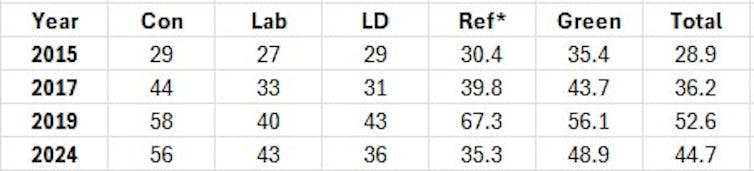
The party members project, run out of Queen Mary University of London and Sussex University, has been surveying party members about their activities after every election since 2015 and has just completed the 2024 exercise. And it appears that, following a decline in election campaigning in 2017 and 2019, there was a slight uptick overall this time round.
A simple way of looking at this is to note the proportion of respondents who told us they’d spent no time at all campaigning for their party (see Table 1). This rose considerably in 2017 and even more so in 2019 but dropped noticeably this year, suggesting the grassroots are getting a little more active, even if they’re still spending way less time campaigning for their parties than they were a decade ago.
Table 1: Percentage of party members saying they spent no time campaigning during the 2024 general election:
Party members who didn’t campaign. NB: Figures in the Reform column cover Reform in 2024, UKIP in 2015 and 2017 and the Brexit Party in 2019. Party Members Project, CC BY-ND
However, the uptick was due largely to the time put in by members of the smaller parties rather than by those belonging to the Conservatives or Labour – although it should be said that members almost certainly tend to overestimate the time they put in.
Indeed, worryingly for Keir Starmer, Labour members actually appear to have been no more active (and in some respects perhaps somewhat less active) than they were five years ago. This is possibly owing to the departure of many of those fired up by Jeremy Corbyn’s leadership in 2017 and 2019.
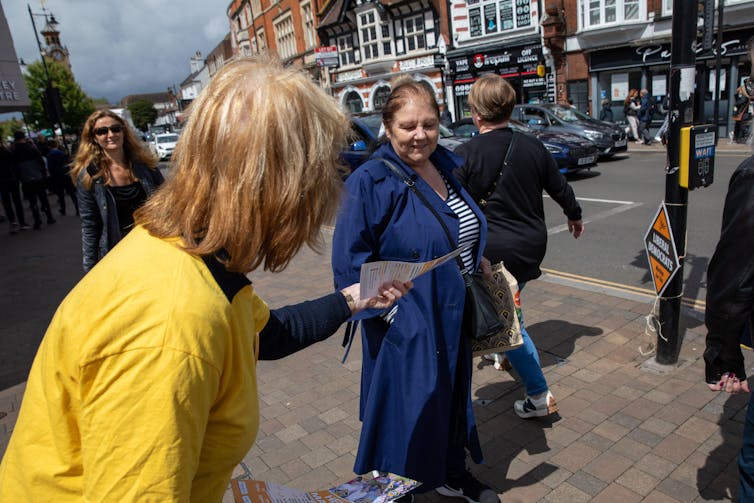
No one leaflets like a Lib Dem. Alamy
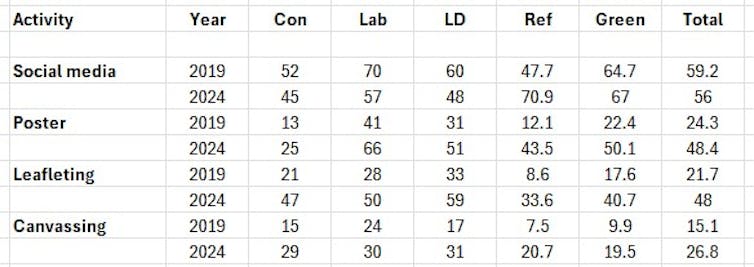
On the other hand, if we dig into the type of activities members got involved in, a slightly different picture emerges. Members of the smaller parties may be putting in the work, but they’re doing it from the comfort of their homes rather than pounding the pavements.
If we exclude the admittedly large number of party members who told us they either did nothing for their party or just hit “don’t know”, a whopping 71% of Reform members and 67% of Green members who were active said they spent time campaigning on social media in 2024. Just 45% of Conservative members who had done at least something for their party during the campaign said the same.
However, Reform and to some extent Green members too, were less likely than members of the Conservative, Labour and Liberal Democrat parties to do some of what, in the jargon, is known as high-intensity activity – the stuff that involves direct contact with voters (or at least their letterboxes).
Table 2: What active party members got up to in the 2024 election campaign (percentages):
What members got up to. Party Members Project, CC BY-ND
Interestingly, the members of the “old” parties appear to have done less on social media than they did in 2019. Instead they put their efforts into activities that, research suggests, do sometimes make a difference, such as leafleting. The Lib Dems (as ever) emerged as the champions when it came to this activity, with 59% of members who did something for the party during the election stuffing campaign literature through British households’ letterboxes. Whether it got read on its journey from front door to recycling bin, of course, is another matter.
But what also comes through strongly is that, worryingly for whoever takes over as leader from Rishi Sunak, Conservative members seem to be lagging further and further behind their main rivals – Labour and (especially) the Lib Dems – on campaign activities overall (see Table 3).
Table 3: Average number of activities (out of a total of nine) done by all members of each party during the 2024 general election campaign:
Lib Dems come out on top for average number of activities. Party Members Project, CC BY-ND
Now, nobody would argue, of course, that this was the main reason the Conservatives lost the election so badly. Nor should anyone imagine that simply recruiting and enthusing more members – something each of the candidates vying to become Tory leader has vowed to do – will rapidly reverse the epic defeat the party suffered this summer. But it certainly wouldn’t do it any harm in the long term.
After all, the Tories almost certainly have a very long and very hard road ahead of them in opposition. Persuading more people to join the party, and encouraging as many of those who do join to get out “on the doorstep” (or even just to go online if that’s all they feel up to), might not make that road much shorter. But it might make it feel just that little bit easier.




 Tim Bale's Blog