‘People want to have their cake and eat it’, Involve, 24 January 2019.

‘Jesus.  Never mind having their cake and eating it, too.  They want the flipping moon on a stick.’

Whether that’s how politicians and staffers will actually react to What People Want to see in Parties, I’ve no idea.  But I confess: that was my first response.

Not very politically correct, I’ll admit.  But look at the evidence that Kate Dommett and Luke Temple have assembled by conducting surveys and focus groups to explore the electorate’s feelings about organisations that – love them or loathe them (and many people do, indeed, seem to loathe them) – remain absolutely essential to democracy the world over.

People want parties to have principles but not necessarily to stick to them.  They want them to keep their policy promises, yet to compromise, too.  And they want MPs to exercise their best judgement at the same time as insisting they should do what their constituents tell them.

No wonder, then, that parties are held in such low esteem.  What human institution could possibly hope to satisfy such competing demands?  It’s so easy to say they’re not up to the job.  But maybe, in a more fragmented and more consumerist society – one increasingly used to getting what it wants when it wants, and how it wants – the job itself has become impossible.  Perhaps the fault, dear reader, is not in our parties but in ourselves.

Yet it’s hard to read the most popular pet peeves about parties without concluding that those who criticise them may nevertheless have a point. Unrepresentative? Check. Undemocratic? Check.  Divided? Check.  Self-serving? Check. Tribal? Check.  Perhaps, after all, parties are their own worst enemies.

But here’s the paradox.  If political parties really are so awful, then how come so many more people have joined them – or at least some of them – in recent years?

Ten years ago, the UK’s political parties, like most their continental counterparts, were drifting and dwindling downwards.  But look at them now: Labour can claim to be the biggest party in Europe – certainly on the centre-left; the SNP doesn’t seem to have declined significantly since the huge bounce it experienced after the Scottish Independence Referendum; the Lib Dems can plausibly claim to have nearly as many members as the Conservatives (the one obvious exception to the rule); and both the Greens and UKIP (before the EU Referendum anyway) have had their moments, too.

Arguably, then, the parties (collectively at least) don’t have that much to worry about.  Maybe, like the big energy companies most people seem somehow locked into using, they can be confident of survival in spite of their woefully poor reputations for both value for money and customer service?

I’m not so sure. The growth we’ve seen recently could eventually turn out to be a blip – for reasons that soon become evident the deeper one dips into What People Want.  Parties, it turns out, can bend over backwards to make it easier for folk to get involved in what they do; but they shouldn’t expect many of them to bother.

Why?  Because, although most of us say we’d like to see parties provide more opportunities for participation, it turns out we’re honest enough to admit that we wouldn’t bother taking advantage of those opportunities themselves.

There are probably as many reasons for this as there are individuals.  Research I’ve conducted with my colleagues on the ESRC-funded Party Members project suggests, for instance, that even people who are big fans of a particular party often don’t go so far as to join it because they worry (unnecessarily many existing members would say) about the amount of time it will take up.  But Dommett and Temple’s work also points to another important factor – namely the belief that members don’t really have much impact on what parties do and say anyway.

In some cases (and that’s true of many of the accusations flung at parties) that’s not really fair.  The Lib Dems and the Greens are actually pretty democratic organisations which allow members the final say on almost everything.  Moreover, one of the biggest ironies in British politics in the last couple of decade is that, at least when it comes to Europe, the members of the party who lack any formal power over policy – the Conservatives – can claim to have helped shift it most profoundly.

But there is one case – a test-case really – on which the future of mass participation in political parties, and therefore of parties themselves, may eventually come to rest.

Hundreds of thousands of people have joined the Labour Party since 2015, at least in part because they truly believed Jeremy Corbyn when he promised that it would henceforth be guided by the wishes of its members, not its leader.

Survey after survey has demonstrated that Labour members want to remain in Europe and, more recently, are overwhelmingly in favour of a referendum to help bring an end to Brexit.  If Labour’s leadership, in its anxiety not to upset Leave voters, continues to maintain its studied ambivalence on the issue, then it risks effectively proving the cynics correct, thereby ensuring that what many have hailed as a renaissance of grassroots participation party politics ends up as a nail in its coffin.

Originally published at https://www.involve.org.uk/resources/blog/opinion/people-want-have-their-cake-and-eat-it-tim-bale

Posted in Uncategorized | Leave a comment

‘Theresa May asks her MPs to ‘think about history’. She should do so too’, Evening Standard, 18 January 2019

As the smoke clears at the end of one hell of a week at Westminster, Theresa May has to choose between her party and her country. Either she decides to risk the UK crashing out of the EU without a deal on March 29 or she pivots to pursue a softer Brexit with the help of the Opposition, thereby risking the wrath, and perhaps even the departure, of some of her own MPs.

She could do worse than recall the very different fates of two of her predecessors who faced the same dilemma. Both put what they saw as the national interest first. But only one emerged — and only then, eventually — with their reputation enhanced.

In May 1846, Sir Robert Peel, founder of the Metropolitan police and prime minister since 1841, defied the dearest wishes of large numbers of his Conservative colleagues and, with the assistance of the Opposition, finally repealed a system of tariffs that had rendered desperately needed imports of grain prohibitively expensive.

The parliamentary response of those colleagues, led by the Boris Johnson of his age, Benjamin Disraeli, was swift and brutal. As one diarist recorded, “they screamed and hooted at him in the most brutal manner. When he vindicated himself, and talked of honour and conscience, they assailed him with shouts of derision and gestures of contempt … They hunt him like a fox, and they are eager to run him down and kill him in the open, and they are full of exultation at thinking they have nearly accomplished this object.”

Not surprisingly, a month or so later, Peel was forced to resign as PM and surrender the leadership. And although his party was by no means crushed at the next general election, it had effectively split into factions so irreconcilable that it took nearly three decades before it could convincingly claim to have returned to power. In the meantime, the Peelite faction had left the Tories to help form the Liberal Party, going on to supply it with probably its greatest ever prime minister, William Gladstone.

Yet, writing to a friend a year after he had lost office, Peel (who sadly died in 1850 after a fall from his horse) was clear-eyed about the choice he’d made and confident that he’d made the right call. “It was impossible,” he said, “to reconcile the repeal of the Corn Laws by me with the keeping together of the Conservative Party, and I had no hesitation in sacrificing the subordinate object, and with it my own political interests.”

Fast forward from the 19th to the 20th century and to 1931. This time, the politician faced with choosing between party and country was a Labour prime minister, Ramsay MacDonald. His minority Labour government, faced with Conservative demands that it cut welfare payments to the very poorest to preserve the public finances and the parity of the pound, saw the Cabinet split down the middle. Instead of resigning and telling the Tories to do their own dirty work, or perhaps precipitating a general election, MacDonald decided to form a National Government with (and, indeed, dominated by) the Conservatives.

Yet despite the fact that MacDonald would go on to lead that government as PM until 1935, enabled so to do by winning the largest Commons majority (500 seats) this country has ever seen, he — in marked contrast to Peel, to whom posterity has proved rather kind — has gone down British political history as a turncoat and a failure. Why? The difference in their respective fates surely comes down to whether the solutions they sought and the realignments they triggered made underlying sense — at least in hindsight.

Peel is seen to have done the right thing for the right reasons. Accurately or otherwise, his decision is linked both to a principled belief in free trade and a laudable desire to do something about Ireland’s Great Famine, which in the course of just two years saw more than a million people perish in a country, remember, that at the time was officially part of the UK. Nor could the Conservatives — as Disraeli himself eventually acknowledged — afford to stay stuck representing the agricultural and aristocratic interest in a country that was rapidly industrialising and already set on the road to democracy.

MacDonald, on the other, did the wrong thing for the wrong reasons. Always prey to the Establishment’s embrace, he was too easily persuaded (by the King, no less) of his own indispensability. The cuts he imposed managed to be both unfair and unconvincing: they hit the poorest hardest but failed in the end to convince the markets.

Moreover, the resulting realignment at Westminster proved paltry and short-lived. Hardly any Labour MPs joined MacDonald, and those who did were, like him, quickly expelled from the party. Those who stayed held together through the hard times and within 15 years won themselves a landslide majority over a Tory Party widely (if not always fairly) blamed for the “Hungry Thirties”.

Mrs May opened this week’s debate on the meaningful vote by begging MPs to think about “when the history books are written”. She should do so, too. By reaching out beyond her party she can secure an agreement that makes far more sense for the future of the country than the deal Parliament has so resoundingly rejected. If some Tory MPs, blinded by ideology and imperial nostalgia, cannot see that, then the PM should let them go. A truly 21st-century Conservative Party could very well be better off without them.

Originally published at https://www.standard.co.uk/comment/comment/mrs-may-asks-her-mps-to-think-about-history-she-should-do-so-too-a4042801.html

Posted in Uncategorized | Leave a comment

‘Would a Norway option break the Brexit stalemate? Here’s what new polling tells us’, The Conversation, 16 January 2019

The Labour politician Jim Callaghan famously remarked to his colleagues in 1970 that a referendum on Europe might end up being “a little rubber life raft” into which they all might one day have to climb. Just five years later they did so, holding a vote that ensured the UK remained a member of what was then the EEC for more than four decades.

The decision taken two-and-a-half years ago in the 2016 referendum reversed the verdict the public arrived at back in 1975. But so controversial has it become, and so difficult to implement, that many are calling for what would be a third “people’s vote”.

Opposition to another referendum is intense – and not just among those desperate to see the UK leave the EU. Many who would, in their heart of hearts, prefer to remain in the EU worry that seeking to overturn the 2016 result would send a damaging message to “the people”.

For some, the so-called Norway-plus option, which would see the UK remain in the customs union and the single market, is now the safest life raft available. Prime Minister Theresa May has lost the meaningful vote, and it is increasingly clear that parliament, by hook or by crook, is going to do its damnedest to prevent a no-deal departure. We can therefore expect to hear a lot more in the coming days about Norway-plus – and about the EEA, EFTA, “cross-party consensus”, and a so-called “soft” (or “softer”) Brexit.

Whether any of this is feasible – at least in the time available and with May still prime minister – who knows? But what we do know is that, if it is to stand any chance of working, then advocates of the Norway-plus option are going to have to work very hard and very fast to persuade both the public and the members of Britain’s two biggest political parties that it’s something worth trying. How much chance do they have?

Party members

Just before Christmas, Our ESRC-sponsored Party Members Project surveyed 1,034 Labour Party members and 1,215 Conservative Party members, together with a representative sample of 1,675 ordinary voters. We asked all three groups of respondents how they would feel if Britain “ended up leaving the European Union but remaining in the single market and customs union – an arrangement that is sometimes called Norway-plus”. Their answers suggest the latter won’t necessarily be an easy sell – but that it shouldn’t be written off.

Let’s take party members first. Perhaps predictably, given how keen they are on a hard Brexit, the Tory grassroots are going to take a heck of a lot of persuading. Norway-plus would leave 23% of grassroots Tories feeling “disappointed”, 11% “angry” and a whopping 38% feeling “betrayed”. And if you look at the three-quarters of Tory members who voted Leave back in 2016, those proportions rise to 21%, 13%, and an even more whopping 49%, respectively.

ESRC Party Members Project.Author provided

What about Labour members? Arguably their views should be taken seriously since Norway-plus will only really become an option if Labour MPs – the people Labour members help select – decide to support it. Our survey suggests that, if they do, then they might well be able to claim some grassroots sympathy if not outright support.

Recalling that some 82% of Labour’s rank and file said they’d feel “delighted”, “pleased” or “relieved” should the UK end up holding a second referendum and voting to remain in the EU, we shouldn’t expect them to be particularly gung-ho about Norway-plus since it would still mean the country leaving the European Union. However, only 24% of Labour members said such a second-best outcome would make them feel disappointed, angry, or betrayed, compared to 52% who said they’d feel relatively positive. That said, only 3% chose “delighted” as opposed to 12% saying “pleased” and 37% “relieved”.

ESRC Party Members Project.Author provided

The wider public

What about voters? Well, as one might expect, it rather depends on whether they voted Leave or Remain in 2016. Norway-plus would leave 43% of those who voted Remain feeling relatively positive (either delighted, pleased, or relieved) with 26% feeling relatively negative (disappointed, angry, or betrayed). For Leavers, however, it’s a very different story: only 20% would feel positive about such an outcome, compared to 45% who would feel negative.

ESRC Party Members Project.Author provided

That said, and possibly very significantly, the scale of disappointment (19%), anger (6%), and betrayal (20%) that Leave voters would feel in the event of a Norway-plus outcome comes nowhere near that which would be felt by paid-up Tory members. Nor, interestingly, would the disappointment (21%), anger (5%), and betrayal (17%) that would be felt by Tory voters rather than Tory members.

For their part, Labour voters, like Labour members, could probably live with Norway-plus. True, only 40% said they’d feel delighted, pleased, or relieved. But that’s considerably more than the 26% who picked disappointed, angry, or betrayed.

And, if we return, finally, to look at voters as a whole – this time irrespective of whether they voted Leave or Remain, Tory or Labour – then those who advocate Norway-plus might have at least some cause for optimism. Fewer than a third overall expressed negative feelings (17% disappointed, 4% angry, and 10% betrayed). And although that was more than the quarter or so of voters who expressed positive feelings (2% delighted, 10% pleased, and 17% relieved), we should note that some 16% of voters said they “wouldn’t mind either way” while some 21% said they didn’t know how they’d feel.

In other words, it looks as if possibly nearly two-thirds of voters, and almost certainly a majority of them, could probably live with Norway-plus. But before its advocates get too excited, they need to heed what may be one enormous, crucial caveat.

Our survey noted that Norway-plus involved staying in the customs union and the single market. However, it did not remind voters that the latter would mean continuing to allow EU citizens the unfettered right to live and work in the UK. Were it to be made clear to the public that Norway-plus did not mean they could “take back control” of Britain’s borders, their reaction might well be very, very different.

Originally published at https://theconversation.com/would-a-norway-option-break-the-brexit-stalemate-heres-what-new-polling-tells-us-109823 and https://www.newstatesman.com/politics/brexit/2019/01/would-norway-option-break-brexit-stalemate-here-s-what-polling-says

Posted in Uncategorized | Leave a comment

‘The opposite of enthusiasm: why do people support or oppose the Brexit deal?’, YouGov, 15 January 2019 (with Stephen Fisher and Eilidh Macfarlane).

We know – at least we think we know – that voters don’t think much of Theresa May’s deal.  But we don’t really know why – until now, perhaps.  A YouGov survey of 1754 adults in Britain conducted on 7-8th January helpfully asked them if they’d expand on their reasons for either opposing or supporting the government’s Brexit deal – and their write-in responses help us dig a little deeper into their reasoning.

But before we do that, some headline numbers.  Altogether, it looks as if only around a quarter (23%) of the electorate support the deal, while half (49%) oppose it. And, consistent with some previous analysis, people’s feelings about the deal seem to be more strongly linked to how they voted at the 2017 general election than how they voted in the 2016 EU referendum. While 39% of Conservative voters support the deal, that’s true of only 14% of Labour voters. Although partisan divisions are, if anything, more important than Leave/Remain divisions in explaining who supports and who opposes the deal, it turns out that the reasons people give for their support or their opposition depend mainly on whether they voted Leave or Remain.

Reasons for supporting the deal

If we turn first to those who support the deal, the single most popular reason they give, mentioned by 33% of deal supporters, is that the deal is simply the best on offer. Comments such as “I feel it’s the best we’re going to get” and “we need a deal and it could be worse” are hardly ringing endorsements for the Prime Minister’s deal.

toprreasons

The next most common reason for supporting the deal – mentioned by 27% of Leavers who support the deal (compared to just 8% of Remainers who do so) – is that it “delivers” Brexit. For many of these respondents, the primary concern appears to be quickly enacting Brexit, urging the government to “get on with it”.

The third most common justification for supporting the deal is yet another unenthusiastic reason, namely that it is “better than no deal”. Indicative of how subdued such responses are is one that says “purely because no deal would be so much worse”.

At best, just 5% of those who supported the deal were clearly positive about it. Not even all of these said it was good. Just one person, out of 404, said that they “like” it. Enthusiasm for the deal, even among its supporters, is in short supply.

Reasons for opposing the deal

What about the reasons given by people for their opposition to the deal?  Well, these are quite varied, with even the most popular (wanting the UK to remain in the EU) is mentioned by just 18% of deal opponents. Unsurprisingly this was far more commonly cited by Remain voters while attracting few (although not zero!) mentions by those who voted Leave in 2016. Most Remainers, are still convinced that, as one person put it, “the best deal is to stay in the EU”. Hardly anyone is opposing the deal because they’re hoping for the Norway option. Also, wanting a referendum was mentioned by very few people on either side of the divide – probably because most of those who want one are Remainers for whom it is primarily a way of getting what they most want, namely to stay in the EU.

treasons

Diametrically opposite is the second most popular reason for opposing the deal: a preference for a harder Brexit. Some were clear that they wanted a no-deal Brexit while others complained that the deal was not a “full” or “proper” Brexit. Some went further to remark that the deal “is not what we voted for” – “I voted out. I did not vote for a deal”.

The third most common reason for opposing the deal, and one expressed by 9% of both Leave and Remain voters who are against the deal, is a complaint about the quality of the deal. This category lacks specific reasons but includes descriptions such as “fudged”, “shambolic” and even “a load of rubbish”. Such blanket dismissals were more common among those who do not pay much attention to politics, as were complaints that the deal is confusing and unclear.

Concern about the UK still having to follow EU rules is the fourth most cited reason for opposing the deal. It is mentioned by some 8% of opponents, including 14% of those who are Leave voters. Sovereignty is the main substantive reason among Leavers for opposing the deal, in marked contrast to the paucity of deal supporters claiming sovereignty as a reason for accepting the deal. Less than two percent of those in favour of the deal explicitly mentioned any gain in sovereignty or control, including of immigration, as a reason for supporting it. Supporters of the deal might believe that it restores sovereignty to the UK, but if they do that virtue is not at the forefront of their minds.

Of the various other reasons for opposing the deal, 5% mention Ireland or the backstop, and 2% mention the divorce bill, but very few other features of the deal, or the possible consequences of the deal, are mentioned. In fact, the reasons given for opposing the deal tend towards the general rather than the particular. It’s also worth noting that one in twenty people admitted they didn’t really know why they opposed the bill; they just did.

What do reasons tell us?

Those who watched Benedict Cumberbatch play Dominic Cummings entreating Leave campaigners to ‘hit them with 350m quid and Turkey!’ in Brexit: the Uncivil War might be interested to note that literally no-one in this survey mentioned Turkey or £350m! And the two (yes only two out of 1305) respondents who mentioned the NHS did so to express concerns about the negative consequences of Brexit.

It seems, then, as if the supposedly powerful and very particular slogans from the 2016 Leave campaign have now been superseded by more immediate concerns – but those concerns centre around the general merits or otherwise of the deal negotiated and Brexit itself rather than a series of specific costs and benefits that might arise as a result of leaving the EU. Moreover, people’s views as to those merits or demerits seem in the main to be driven by what people voted back in 2016. The views expressed may have changed, but few have changed sides.

Those who oppose the deal say they do so mainly because they either never wanted Brexit in the first place or because they’re convinced it’s a bad deal, often because they feel it doesn’t deliver the hard Brexit they’d ideally like.  As for those who support it, few actually think it’s a good deal. The rest are prepared to live with it because at least it means we’re leaving or because it’s the best deal on offer – or because, ultimately, it’s better than no deal.

If, in the end, the deal does pass, it may be greeted with relief. But celebration? We doubt it.

Originally published at https://yougov.co.uk/topics/politics/articles-reports/2019/01/15/opposite-enthusiasm-why-do-people-support-or-oppos 

Posted in Uncategorized | Leave a comment

‘Why is the Brexit Deal so unpopular?’, What the UK Thinks, 11 January 2019 (with Stephen Fisher).

Ever since the EU withdrawal deal was published in November, Mrs May has been struggling to persuade MPs to back it. On Tuesday, we should learn whether she has eventually managed to win them over or not. Her attempts to do so have not been helped by the fact that voters have also proved to be doubtful about the deal. YouGov, for example, have consistently found that only around 25% back the deal, while some 45% or so are opposed, with around 30% saying they don’t know whether they support the deal or not.

It is not immediately obvious that the content of the deal should have received such an unenthusiastic response. Research on attitudes to Brexit suggests that most people want to continue to trade freely with the EU but also want the UK to have much more control over immigration. Under the Northern Ireland backstop that has been the subject of much criticism from MPs, Britain would continue to trade with the EU under single market rules while still being able to introduce controls on EU migration. This aspect of the draft Withdrawal Treaty thus apparently meets the public’s, and especially Leave voters’, main requirements.  Meanwhile, the accompanying Political Declaration offers the prospect, at least, of a close trading relationship in years to come, while recognising that the UK does not wish to maintain freedom of movement.

So how then can we account for the unpopularity of the Brexit deal? We try to answer this question using data from a survey of 1675 adults conducted by YouGov on 18th-19thDecember 2018 for the ESRC-funded Party Members Project. In this particular exercise, 23% said that they supported the deal, 49% that they were opposed, while 28% indicated that they didn’t know.

Perhaps the most immediately obvious explanation for the deal’s unpopularity is that it is strongly opposed by those who would prefer to remain in the EU. Remain voters are, indeed, unhappy with the deal – but not much more so than Leave supporters. In our survey, only 21% of those who voted Remain in 2016 said that they support the deal, while 56% indicated that they were opposed. Equally, however, only 29% of Leave supporters stated that they supported the deal, while 48% were opposed.

Similarly, only 5% of all voters say they would be “pleased” or “delighted” if the deal passed, while a further 13% would be “relieved”. At 9% and 14% respectively, the corresponding numbers among Leave voters are only marginally better.

Perhaps it is all a question of party politics? Maybe support for the deal is so low because it is being proposed by a Conservative government, and that consequently supporters of other parties are reluctant to accept it. Indeed, as the table below shows, support for the deal stands at just 11% among those who voted Labour in 2017, and is similarly low among Liberal Democrats and voters for other parties that support Remain such as the SNP and the Greens. Yet even among Conservative voters only two-fifths (40%) say they back it. The only group of voters among whom supporters of the deal outnumber opponents (by 48% to 27%) are those Conservatives who voted Remain in 2016, almost half of whom support the deal.


Perhaps these Conservative Remainers are more willing than their Leave counterparts to regard the deal as an acceptable compromise, in line with one of the arguments the government has been deploying in an attempt to win over support. Maybe, too, they are more supportive of Theresa May and thus are willing to follow her lead. Certainly, among those Conservative voters who think Mrs May is doing “well” as Prime Minister, as many as 58% support the deal, compared with just 14% among those who think she is doing “badly”. Maybe this difference, however, arises because those who like the deal are more likely to approve of Mrs May rather than vice-versa. In any event, Conservative Remainers are not particularly likely to think that the Prime Minster is performing well and so the pattern does not explain why they are more likely than Tory Leavers to support the deal.

Apart from presenting the deal as a compromise that contains something for both Remainers and Leavers, the Prime Minister’s other key tactic has been to warn of the consequences of rejecting the deal. First, she has been telling MPs that it might result in a “damaging” no-deal Brexit. Second, she and her ministers have argued that it might mean that Brexit does not happen at all.

Neither argument seems to have much traction in persuading voters to back the deal. Only 35% of all voters believe warnings that “Britain leaving the European Union without agreeing a deal could cause severe short term disruption, such as shortages of food and medicines.” True, those warnings are widely believed by supporters of parties other than the Conservatives, but as we have already seen they are least likely to support the deal! But even among Conservative voters, those who believe the warnings are realistic are only seven points more likely to support the deal than those who think the warnings exaggerated. It is a similar story when voters are asked about the medium and long-term economic consequences of leaving the EU without a deal. Those Conservatives who think that leaving without a deal would have a negative impact on the economy are only six points more likely than those who think it will have a positive effect to support what the Prime Minister has come up with.

So far as Brexit not happening at all is concerned, naturally Remain voters would be happy if “Britain ended up having a new referendum and voting to remain in the EU after all”, while some two-thirds of Leave voters, and a larger share of Conservative Leave voters, would feel “betrayed” or “angry”. However, these particularly staunch Tory Leavers are no more likely to support the deal than those Tory Leavers who are more relaxed about the prospect of Remain winning another referendum.

Perhaps, then, the reason for the deal’s unpopularity with the public is to be found (as is the case with many MPs) in attitudes towards the Northern Ireland backstop. Indeed, only 18% think that it “makes sense and should be part of the deal”, while even fewer Conservative voters (15%) and Leave supporters (11%) think that is the case. Conservative voters are more likely instead to take the view that the backstop is “a bad idea but it’s a price worth paying to secure a deal.” However, support for the deal among this latter group (72%) is actually slightly higherthan it is among those Conservatives who believe the deal makes sense (65%). So, disapproval of the backstop per sedoes not appear to be an essential barrier to supporting the deal.

Perhaps, then, we should step back and remind ourselves that, despite the intensity of the debate at Westminster, many voters still do not know whether they support the deal or not. Maybe this is indicative of a wider problem for the Prime Minister, namely that voters for whom politics is not a passion find the debate about the deal rather too complicated – and thus take the view that perhaps the deal itself must be too complicated as well?

As we might expect, people who pay more attention to politics are, indeed, far more likely to have an opinion on the deal. Only 8% of this group do not have a view compared with 53% of those who pay relatively little attention. However, sadly for Theresa May, they are also more likely to oppose the deal than they are to support it. True, among her own voters the balance of support and opposition is much the same among those who pay more attention to politics as it is among those who pay less attention. But among Labour voters, those who pay more attention to politics are on balance much more likely to oppose the government’s deal, perhaps because they are more aware that their party is against the deal and take their cue accordingly. In any event, to know the deal is not necessarily to love it.

This analysis makes rather grim reading for the government. The overall level of support for the deal is relatively low, and there is little sign that the main arguments the government has deployed have proved persuasive with many voters, not least among those who voted Leave. Moreover, in so far as those who have not yet formed an opinion might eventually do so, there is no reason to believe that they will necessarily swing in behind the deal – indeed, in the case of Labour voters the opposite would seem more likely. Meanwhile, given that two-thirds of Labour voters are already opposed to the deal, there is seemingly little immediate incentive for Labour MPs to respond to attempts by the government to try to win them over. It looks as though Mrs May has to hope that MPs are not taking too much notice of the polls when they vote on the deal on Tuesday.

Originally published at https://whatukthinks.org/eu/why-is-the-brexit-deal-so-unpopular/ 

Posted in Uncategorized | Leave a comment

‘Jeremy Corbyn’s successor may be more establishment than you expect’, New Statesman, 3 January, 2019.

Those who sign off their tweets with #JC4PM2019 may find it difficult to contemplate but sometime, somehow, their man will eventually have to give way to a successor. It may not happen soon. But it will happen. No one, least of all the leader of a political party, goes on forever. So who’s really in the running to replace Jeremy when he goes?

Some clues are provided by the ESRC-funded Party Members Project run out of Queen Mary University of London and Sussex University, which surveyed 1,034 Labour Party members between 17 and 21 December and a total of 1,675 voters between 18-19 December, 428 of whom who were intending to vote Labour.

Respondents were asked the following question: If Jeremy Corbyn were to stand down as Labour Party leader, who would you most like to see replace him as Labour Leader? Quite deliberately, so as to avoid closing down options, neither group was presented with a pre-determined list of candidates but was instead asked to write in a name, and they were of course free to say that they didn’t know or weren’t sure etc.

The table below gives the results based on the write-in responses of the 334 Labour voters and 959 Labour members who decided to answer the question. It leaves out all those names that received only a handful (or fewer) of mentions – unless, like Sadiq Khan or Tom Watson they are in supposedly high-profile jobs (Mayor of London and deputy leader) or, like Rebecca Long-Bailey and Clive Lewis, they are sometimes tipped as leadership contenders (or at least hopefuls).

Labour Voters

(%)

Labour Members

(%)

Keir Starmer 9 18
John McDonnell 5 15

Emily Thornberry 3 12
Don’t Know 56 11
Yvette Cooper 2 10
Chuka Umunna 3 4
Angela Rayner 1 3
Diane Abbott 1 2
Rebecca Long-Bailey <1 2
Tom Watson 2 1
Sadiq Khan <1 1
Clive Lewis <1 1

“High-profile” here has to be used in the broadest of senses – indeed, the low ratings of one or two of the shadow cabinet members included is in some ways testament to what some see as the paucity of big beasts around him. It is noticeable that both Chuka Umunna and Yvette Cooper, neither of whom serves under Corbyn, do better than many of those who do.

There are only three names that beat “Don’t Know” – still very much the odds-on favourite among Labour voters rather than Labour members. Nine out of ten of the latter at least felt able to name someone (or in a few cases tell us in no uncertain terms that JC must stay!).

Those who reckon that shadow foreign secretary Emily Thornberry stands a chance of becoming the party’s first elected female leader may not be entirely wrong, since it’s hard to imagine Labour’s very left-wing and socially-liberal membership plumping for Yvette Cooper, and shadow education Secretary Angela Rayner would need to make up a fair amount of ground (by no means impossible but still….).

Shadow chancellor, and all-round power-behind-the-throne, John McDonnell also looks to be in with a shout should his friend fall under the proverbial bus – even though our survey shows that many voters and members can’t quite get his surname right yet.

But the front-runner – if one can really be said to be a front-runner with the support of just shy of one in five Labour members – is Sir Keir Starmer. Presumably his pro-referendum (and, it is probably fair to assume, pro-Remain) stance, which was so much in evidence at Labour’s last conference in Liverpool, is earning him serious brownie points among a Labour membership that, our data shows, is very much singing from the same anti-Brexit hymn sheet.

Those who think, then, that Corbyn will automatically be replaced by someone in his own anti-establishment image may need to think again. If our survey is a straw in the wind, then Labour, post-Corbyn, may find itself led for the very first time, not by a woman or by an ethnic minority politician, but instead by a knight of the realm.

Originally published at https://www.newstatesman.com/politics/staggers/2019/01/jeremy-corbyn-s-successor-may-be-more-establishment-you-expect 

Posted in Uncategorized | Leave a comment

‘Theresa May and the Conservative Will to Power’, New York Times,12 December 2018.

So Prime Minister Theresa May lives to fight another day. She won Wednesday’s vote of no confidence: 200 members of her party stood by her; 117 did not. Indeed, under the Conservative Party’s rules, it will be another year before her opponents in the party can try to unseat her as leader.

But does her victory really resolve anything? There’s been speculation that the deep divisions and factional fighting between the hard-line Brexiteers and the Conservatives’ less Euroskeptic wing might do more than just unseat the prime minister; it might ultimately break the party apart, with some members coalescing around a nationalist, even populist, alternative while their less strident colleagues join a putative “centrist” party committed to a more moderate, more open style of politics. Aren’t we, then, looking at a truly existential threat to the world’s oldest, and arguably most successful, party?

Probably not. Of course, past performance is no guarantee of future performance, but the Conservative Party’s “will to power” has seen it through many crises in its 200-year history. Holding office, not doctrinal purity, has always been its No. 1 goal. It often bends but it rarely breaks. Even Brexit, however bad things seem, is unlikely to change that.

No one is saying, of course, that “Europe” doesn’t matter. Britain’s relationship with the Continent has long posed a problem for the party, not least because the economic advantages it seems to offer involve a trade-off with national sovereignty, something Conservatives care about deeply. This has been the case since the 1970s, when Edward Heath, the prime minister at the time, had to rely on Labour votes in Parliament in order to bring Britain into the European Economic Community, the European Union’s predecessor.

Most of Mrs. May’s problems since she took office in the wake of the 2016 Brexit referendum stem from her dogged determination to secure an exit from the European Union that simultaneously restores Britain’s control over migration, but without tanking the economy and necessitating a hard border in Ireland. (Indeed, she’s done little else in her tenure.)

Those problems don’t look likely to go away just because she won Wednesday’s no-confidence vote. The Brexit process remains up in the air, and Mrs. May’s deal with the European Union is still unpopular with many in her party. It’s entirely possible that to break Britain out of the Brexit logjam, she may have to agree to a “softer” Brexit than she would have liked, or perhaps even to a second referendum. Neither of these would be popular among Conservatives — particularly if the latter resulted in a vote to remain. But even then, the party would almost certainly manage to pull itself together rather than fall apart, focusing on what its factions, despite everything, can still agree on.

That’s because even more than the Conservatives care about their divisions over Brexit, they care about what they share in common: a conservative agenda and a determination to keep a left-wing Labour Party from gaining a parliamentary majority.

Believe it or not, most Conservatives are in broad agreement. When it comes to the economy and the role of the state, they are all pretty much Thatcherites now. True, there are a few Conservative members of Parliament who would like to see a little more public spending and investment, a more compassionate attitude to those on welfare, and some slightly tougher regulation of business. But the differences between them and the rest of their colleagues (most of whom want to keep spending, taxes and regulation as low as possible without setting off an overwhelming electoral backlash) are largely differences of degree, not of kind.

That means that there is a post-Brexit agenda that the Conservatives can unite around: free trade with as many countries that will do deals with “global Britain,” cutting red tape that supposedly suffocates small business, overcoming the obstacles that have stymied the growth of homeownership under a party that has long lauded its commitment to a “property-owning democracy,” and health and education provisions lean enough to ensure that tax-funded spending on public services doesn’t crowd out the private sector. Time and time again, after fights that might have broken other parties — the vicious arguments over free trade in the 1920s is perhaps the most apposite example — the Tories have prevented seemingly permanent splits from becoming fatal.

Clearly, it’s proving incredibly hard right now to fulfill the decision to leave the European Union. But because there’s still more that unites the Conservative Party than divides it — particularly when it comes to keeping taxes and regulation low, keeping capital flowing, and keeping a socialist Labour Party out of power — even Brexit, in the end, is unlikely to tear it apart.

And who knows. With the clock ticking louder and louder, and with Mrs. May now apparently safe, this underlying agreement might still combine with the party’s traditional will to power to allow her, after all, to oversee a smooth departure from the European Union next March.

Originally published at https://www.nytimes.com/2018/12/12/opinion/theresa-may-conservatives-confidence-vote.html


Posted in Uncategorized | Leave a comment

‘Don’t underestimate Rees-Mogg’s ‘phantom army’ of Brexit fanatics’, Guardian, 21 November 2018

Blackmail,” as countless on-screen villains have observed over the decades, “is such an ugly word.” And, if you want to understand how an ostensibly small group of Tory Euro-fanatics has exercised such a hold over their leaders for so long, it’s probably not the most accurate one. Extortion – getting what you want, not by threatening to reveal something about someone but by threatening to hurt them in some way – is more accurate.

Sometimes that threat is as obvious as it’s effective, namely to deny a Conservative prime minister in possession of a small or non-existent parliamentary majority the votes he or she needs to get something through the House of Commons. Theresa May is hardly first of her ilk to know how that feels.

John Major might have snatched victory from the jaws of defeat at the 1992 general election. But his overall majority fell to just 21. That proved nowhere near enough to outweigh the admittedly small minority of backbenchers who’d convinced themselves, first, that Margaret Thatcher had been stabbed in the back by a cabinet cabal of Europhiles in 1990 and, second, that the UK’s ignominious exit from the ERM two years later was proof positive that nothing good could come out of Europe, either for the country or the party.

Other times, the threat is as much extra-parliamentary as it is legislative – namely, the suggestion that, without the support of the Euro-fanatics, a would-be leader won’t make it to the top in the first place. Back in 2016, May clearly felt, as a remainer (albeit a very reluctant one), she had to do everything she could to match the zeal of the leave campaigners she needed to beat. But, again, that was nothing new.

David Cameron may have been Michael Howard’s choice as his successor in 2005 after he’d presided over the party’s third election defeat on the trot, but Cameron wasn’t the starting favourite. And he was well aware that, four years previously, the candidate who should have won hands-down (Ken Clarke) was beaten by a total inadequate (Iain Duncan Smith) solely because one was Eurosceptic and the other wasn’t. So when Liam Fox promised to pull Tory MEPs out of the European People’s party-European Democrats (EPP-ED) group in the European parliament, Cameron (unlike, note, David Davis) positively (but almost certainly unnecessarily) rushed to follow suit.

Once that initial dependence is established, it then becomes impossible, both psychologically and practically, to throw off. May must know this now – but Cameron’s experience could have told her from the get-go. His fear of the party’s Euro-fanatics grew with every passing year, especially once he was forced, after the Lisbon treaty was ratified, to abandon his “cast-iron” pledge to put it to a people’s vote – not a good look, particularly when Ukip could plausibly claim to have denied the Tories a far more convincing win at the 2009 European parliament elections.

In opposition, Cameron’s fearful dependence led to his promising the repatriation of policies and a “referendum lock” on further transfers of power to Brussels. True, along with Nigel Farage giving up the leadership so as to focus on yet another doomed attempt to win a Commons seat, as well as the inexorable logic of our first-past-the-post electoral system, that promise may have helped put Ukip temporarily back in its box at the 2010 general election. But not firmly enough to prevent the myth taking hold among Tory activists, candidates and MPs that Ukip, by winning more votes than the margin of victory obtained by Labour and Liberal Democrat MPs in some constituencies, had denied the Conservatives an outright victory.

In the government, and in the light of more than 20 Tory rebellions against the Lib-Con coalition on Europe (including one in October 2011 in which as many as 81 Conservative MPs voted for a full-blown in-out referendum), that same fearful dependence then led Cameron to veto the EU’s treaty-based response to the eurozone crisis – a move that, after gaining him a hero’s welcome back in the Commons, soon backfired when it became obvious that the other member states could go ahead anyway.

And then, of course, came Cameron’s fateful promise, in his Bloomberg speech in January 2013, to hold a vote on the UK’s EU membership – a move intended, perhaps paradoxically, to face down the party’s Euro-fanatics in the long-term by appeasing them in the short, as well as to supposedly shoot Ukip’s fox. Sadly, and some would say predictably, it failed miserably – just as the attempts of the then home secretary, May, to bang on about immigration failed miserably, too. The rest, as they say, is history.

No one, then, should allow the recent failure of Messrs Rees-Mogg and Baker to muster the famous 48 letters required to trigger a no-confidence vote in May to fool them into thinking that Conservative Euro-fanatics are and always have been merely a phantom army. Sure, maybe once upon a time that was the case, and maybe they’ve never been quite as numerous as they, and their equally obsessive media cheerleaders, have liked to suggest. But, with the Tory press (and indeed ConHome) on their side, with Ukip waiting in the wings, with constituency associations and even their less fanatical parliamentary colleagues growing ever more hostile to the EU, and – most importantly – with the maths as tight as it’s often been, they haven’t really needed to be. And that remains as true right now as it has been in the past.

Originally published at https://www.theguardian.com/commentisfree/2018/nov/21/rees-mogg-phantom-army-brexit-no-confidence-tory-eurosceptics

Posted in Uncategorized | Leave a comment

‘Corbynism is a populism within Labour – but Brexit risks its internal appeal’ (with Jake Watts), LabourList, 20 November 2018

When we think of populism in recent years, we tend to think of the Ukips of the right and the Syrizas of the left. These political forces are united by their binary politics, in which they look out and see a ‘pure’ people downtrodden or ignored by a ‘corrupt’ political elite. Jeremy Corbyn’s Labour has never squarely fitted this populist mould. Instead of looking beyond the party, Corbynism’s populism looks inwards within the party itself, with potentially damaging implications for the link between the party’s MPs and their constituents.

The populism of Corbyn and his allies comes not through the way they view the wider world, but of how they conceive of the internal life of Labour. In this vein, the ‘Corbynista’ populist binary has been shaped around the relationship between the party grassroots and the parliamentary party, rather than Labour and the British political landscape at large.

As discussed in our recent research article (subscription required), this has been most obvious during times of crisis, when Corbynism appears to teeter on the brink. Since Corbyn’s election to the leadership in 2015, it has hardly been plain sailing. Internal conflict has been public and frequent, placing significant strain on relations inside the party. In the face of calls to resign, votes of no confidence and a leadership challenge, Corbyn and his closest supporters were keen to stress that party members were being ignored and usurped by the ‘collusive’ elites of the parliamentary party. At some points, this thinking drew on conspiracy theories about Blairite think tanks; the propensity to draw on conspiracy theories is another common feature of populist politics. Together, these elements form a classic populist binary, albeit within the confines of Labour’s own internal politics.

Like many populists, the remedy Corbyn and his supporters proposed to this malady was ‘democracy’. ‘Democratising’ the party, giving Labour members greater power over platform and policy, and a firmer grip of the reins of Labour MPs through reselection, would be key to remedying the apparent injustice they saw in the subjugation of the party faithful. This is the logical resolution to the populist frame: reconnecting the downtrodden with the levers of power.

However, within a party, and in a system that depends upon parliamentary representation, this has potentially harmful consequences for the link between MPs and constituents. Labour’s recent democracy review did not represent the all-out member empowerment that some might have hoped for, and have been led to expect. However, the transformation of the party in this populist image, at any stage, and the fostering of expectations about the need for it, present problems for parliamentary politics. Ultimately, the democracy of Labour is nested within the wider political system. Greater power for party members, at the expense of parliamentary representatives, risks creating a group of dues-payers with greater influence over the PLP than the constituents that MPs exist to represent.

Whether this populist dynamic will be a permanent feature of Labour’s internal politics is difficult to determine. There is little reason to think that the populism of Corbyn and his allies has waned in recent months, and the centrality of populism to the ideology of Corbynism was no doubt reinforced by its effectiveness in beating off parliamentary rebellions.

However, the Labour leadership’s Brexit stance might risk the appeal of this populist reasoning to party members going forward. As Corbyn doubles down on his commitment to a ‘jobs first Brexit’, the distance between the party’s direction on the UK’s relationship with Europe and what members want is widening. At the same time, the gap between the membership and the parliamentary party has narrowed, as the vast majority of both groups have vocalised their opposition to Brexit and Theresa May’s deal.

With these developments, the potential for internal conflict is rising. Should tensions flare up over the question of the UK’s relationship with Europe, the ability of Corbyn and his allies to use their populism to their advantage may well be severely dampened if they are not perceived to be on the side of party members on the biggest political issue of the day.

Originally published at https://labourlist.org/2018/11/corbynism-is-a-populism-within-labour-but-brexit-risks-its-internal-appeal/

Posted in Uncategorized | Leave a comment

‘Conservative conference: a party surprisingly united on Brexit, just divided from the rest of the world’, The Conversation, 2 October 2018

In his big speech to the Conservative Party conference in Birmingham on Monday, Brexit secretry Dominic Raab urged fellow Tories to “come together”. I’m not sure he needed to bother. Here in Birmingham the issue’s already one big circle jerk.

After all, the fringes are full to bursting with Brexiteers strutting their stuff in front of adoring audiences who are utterly convinced – as Theresa May still insists she, too, is convinced – that “no-deal is better than a bad deal”.

There are Remainers and Second-Referendumers around, of course. But unless they’re high-profile members of the Resistance, like Anna Soubry or Justine Greening or Philip Lee – who managed to attract quite a crowd at a People’s Vote meeting rather tellingly held outside “the secure zone” – they tend to huddle together for warmth and comfort, hoping against hope that reality might dawn on their colleagues before it’s too late.

So while people often refer to the “conference bubble”, really we’re talking about a whole bunch of bubbles. It’s easier than ever to float around in these sealed spheres thanks to the now-notorious conference apps almost everyone seems to have on their smartphones. Installing them allows those attending to plan their day so rigidly that they never need find themselves in a situation where they and their opinions are in a minority. As a result, those opinions are reinforced rather than challenged, meaning they’ll return home more convinced than ever, not just that they’re right but that pretty much everyone thinks the way they do.

In some ways, of course, that’s the whole point of party conferences. Sure, they’re about showcasing a slew of new (or at least recycled) policies to the public, even if research suggests that the public isn’t paying much attention. Sure, especially when you’re in government, they’re a chance to milk some much-needed cash out of lobbyists and exhibitors. And sure, they’re an opportunity – especially this year – for leadership contenders to try, like Raab, to more or less transparently pitch for the top job in front of those who will ultimately decide who gets it. But essentially these annual get-togethers are rallies for the faithful, designed to make them feel part of something and to gee them up so that they’re more likely to get out on the doorstep for the party at election time.

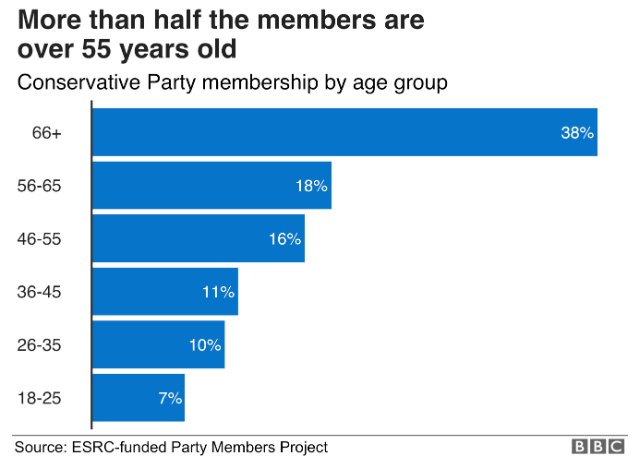
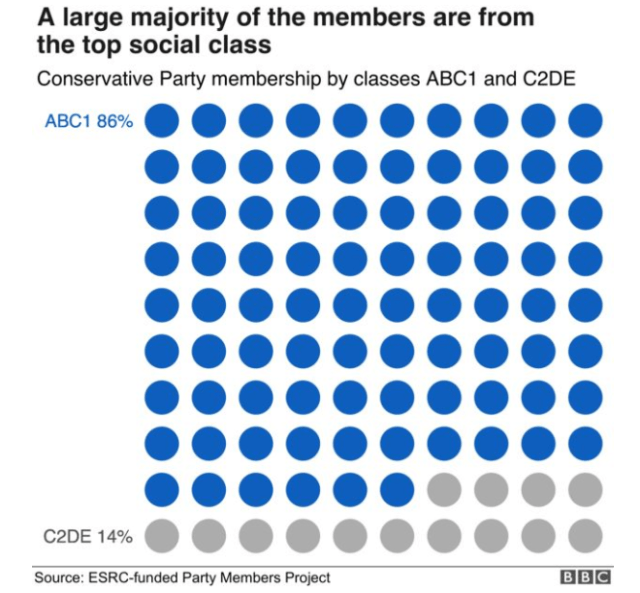
As to who the faithful are, that’s an interesting question. Some would say that, if you strip out all the (overtired) media people, the (always-on) Conservative Campaign HQ and parliamentary staffers, the “come to our event” think-tankers, the slightly-handsomer-and-more-beautiful lobbyists, and of course the MPs, you’re left with a fair few 50-something men – often small businessmen – in blue suits, a fair few celebrity-spotting ladies of a certain age queuing to see “Boris” or “Jacob” or “Dominic” (first-name terms apparently), and a smattering of mainly male, 20-something, brylcreamed wannabees equally keen on getting a selfie with their heroes. However, as someone who’s conducted extensive academic research on the membership, I couldn’t possibly comment.

What I can say, however, is that anyone walking through the building site that is Central Birmingham at the moment to get to the ICC for an 8am fringe event, could very, very easily tell the difference between the conference-goers and the morning commuters – a sure sign, perhaps, of a party that’s still struggling to look and sound like the 21st-century country it claims to govern.

Originally published at https://theconversation.com/conservative-conference-a-party-surprisingly-united-on-brexit-just-divided-from-the-rest-of-the-world-104218

Posted in Uncategorized | Leave a comment