‘Northern Research Group: faction or tendency?’, UK in a Changing Europe, 28 October 2020

‘You’re joking. Not another one!’ – not just Brenda from Bristol in the spring of 2017, reacting to Theresa May calling a snap election, but also Tim Bale (whose dad was from Bristol) in the autumn of 2020 on hearing the news that some 55 Conservative parliamentarians had set up something called the Northern Research Group.

The NRG (note: not a sports drink) joins the Eurosceptic European Research Group (ERG) and the Sinosceptic China Research Group (CRG) in bringing together likeminded Tory MPs with the aim of pulling the party’s leadership round to their way of thinking or at least making it keep its manifesto promises.

So does that mean it’s now finally time for political scientists to forget the longstanding idea that, while Labour is a party of factions, the Conservative Party is merely a party of tendencies.

It’s a long time now – 56 years to be exact – since the legendary Richard Rose first made the distinction between different types of intra-party grouping. But it made such intuitive sense for so long that we’d almost taken it for granted – until, that is, the Tories began to tear themselves apart over Europe from the mid-1990s onwards.

Cue, at that point, much talk of ‘a party within a party’. Yet one could, in fact, continue to argue, then at least, that, according to Rose’s schema, Conservative Eurosceptics – bastards or otherwise – did not yet constitute a fully-fledged faction.

To qualify as a faction, according to Rose, an intra-party group has to display four characteristics. First, it should be self-conscious.

Second, it must persist through time, so that it’s more than just an ad hoc combination of politicians in agreement on a particular issue at a particular moment.

Third, it should seek to further a broad range of policies, which again distinguishes it from a single-issue coalition.

Implicit in this account is the fourth, and in some ways most crucial, characteristic – the presence of a significant organizational infrastructure which ensures that faction members identify strongly with their faction, and act with a measure of discipline and cohesion over time, thereby ensuring they ‘transfer old enmities to new issues.’

A tendency, by contrast, is a significantly less organized and cohesive body than a faction – more ‘a stable set of attitudes’ than ‘a stable set of politicians’. A tendency, then, is based upon a more or less coherent ideological position but it does not display the discipline, consciousness, organization and behavioural cohesion of a true faction.

Looking at those definitions and then looking at each of the two main parties, it is easy to see why academics could (and indeed can) agree that Labour was the true home of faction, riven as it has been by the conflict between centrist social democrats and Bevanite socialists on the left in the fifties, between hard left and soft left in the eighties, between Blairites and Brownites at the turn of the century and, most recently, between Corbynites and the rest.

As for the Conservatives, yes, there were Thatcherites and there were Wets.

But the former soon came to colonise the party almost completely, while the latter, whether in the shape of the Tory Reform Group or under some other (usually more evanescent) label, could never really get itself together sufficiently to resist and ultimately to survive.

As for One Nation, like the concept itself it means everything and nothing and so has always been amusingly heterodox.

Meanwhile, more obviously right-wing groups like No Turning Back and the 92 Group were rather more permeable and rather less institutionalised than some journalists, keen to lend a rent-a-quote source a little more gravitas than he or she really deserved, made them seem.

Nevertheless those two groups were surely harbingers of what was to come. Indeed it was one of their ilk – the initially less high-profile ERG – that, nearly a quarter of century after it was first set up by Michael Spicer (no, not that one), arguably leapt the species barrier between tendency and faction.

Under the chairmanship of Steve Baker – not just a committed ideologue but also a gifted organiser – it was soon acting collectively in parliamentary votes and in communications with the media, and only intensified its efforts as the Brexit saga dragged on, ensuring the defeat of Theresa May’s three Meaningful Votes and, in so doing, her eventual downfall.

Of course, exactly how many members it has or the precise nature extent of its finances, we may never know: the group isn’t required to publish that information, although we have some idea of who belongs to it since its full-time researcher is paid for by numerous Tory MPs putting a slice of their annual office expenses towards his salary.

Whether MPs belonging to the recently established CRG and the even more recently established NRG will do the same, and whether they, too, will be able to credibly claim the ‘party within in party’ mantle or to have anything like the same influence as their big brother remains to be seen.

But even if they were to, would they really count as full-blown factions in the true sense of the term? Indeed, in the end, does even the ERG make the cut?

Clearly it thinks of itself as a tight-knit group. Equally clearly it has persisted over time and is pretty well organised even if, unlike Labour’s left-wing factions, it appears to lack an extra-parliamentary infrastructure.

Yet, ultimately, doesn’t the ERG, with its gimlet-eyed focus on Europe, continue to revolve round what is essentially a single issue – again unlike Labour’s left-wing factions, many of which can convincingly lay claim to a worldview encompassing a whole host of political issues and policies?

At the moment, the answer to that last crucial question would appear to be yes.

But, but, but…. A few prescient observers have already noted that there’s a fair degree of crossover between Brexiters and libertarians who are particularly exercised about what they see as the government’s excessively draconian Covid-19 restrictions.

If that crossover begins to take in Tory MPs as well – and there are signs that it might – then watch this space.

Originally published at https://ukandeu.ac.uk/northern-research-group-faction-or-tendency/
Posted in Uncategorized | Leave a comment

‘Tory Party conference and the missing B-word’, UK in a Changing Europe, 9 October 2020 (with Alan Wager)

This year’s party conference season has lacked the usual magic ingredients. No warm white wine or cold coffee. No free gifts from the Government of Gibraltar or the Royal Mail or one of the other random corporate giants who’ve paid through the nose for a stall outside the main auditorium. No media vox-pops of party members wandering between those stalls to pocket those freebies. And no popping into fringe events on the off-chance of spotting a political celebrity and wolfing down yet another chicken goujon.

Yet if you are one of those who tried to replicate the real thing on your laptop (guilty as charged), there might have been a nagging feeling that something else was missing – something that you couldn’t quite put your finger on. Yes, that’s right: the B-word.

Brexit has become so familiar as to be part of the party conference furniture in the last half decade. Anyone attending the Conservative Party’s annual bashes in recent years, will be familiar with with endless queues for fringe events giving besuited teenage boys and equally well-turned-out retirees a chance to cheer on assorted members of the ERG.

This year, however, Brexit barely seemed to feature – and not just on the fringes but, even more obviously, in the main conference hall itself. This accords with rumours that Tory MPs have been told not to use B-word anymore.

But what do the numbers say? And what might they tell us about, firstly, the government’s overall political strategy and, secondly, about one particular politician’s personal ambitions?

First, the overall figures.

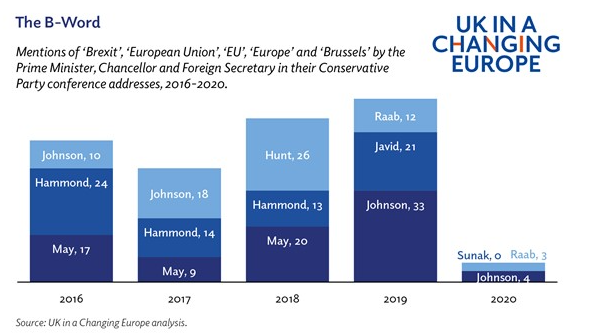
Mentions of Brexit as a buzzword dipped in 2017, as Theresa May – after struggling on the campaign trail, and while struggling on stage – attempted to construct a plausible governing vision to fight a newly-bolstered Jeremy Corbyn in a hung Parliament.

But mentions peaked last year, as the Tory Party geared up to fight a ‘Brexit election.’ Boris Johnson used the B-word 16 times and made eight mentions of ‘the EU’, seven of ‘Europe’ and managed to include a couple of swipes at ‘Brussels’.

While not entirely banned – the Prime Minister did, after all, say the B-word four times this year – talk of Brexit and the EU from the conference floor has fallen by a staggering 89% in a year.

Just as significantly, perhaps, Rishi Sunak became the first occupant of one of the three big offices of state since the EU referendum not to mention Brexit, the European Union, Europe or Brussels in his (short) conference address.

This tells us the government has other priorities and issues – the coronavirus pandemic, of course, has dominated. It tells us something about the strength of its urge to pocket the win from Brexit and move on. But it might also be telling us something about the brand that the Chancellor wishes to promote.

Take Jeremy Hunt’s speech as Foreign Secretary in 2018. The writing was not yet on the wall for Theresa May, but it was clear which way the wind was blowing. And while it was not then clear that Johnson would win, he was near-certain to stand as ‘Mr Brexit’.

In response, Hunt took the opportunity to scatter his speech with talk of Brexit, with the key takeaway that we should ‘never mistake British politeness for British weakness’ – a clear attempt to address his own weakness ahead of an internal Tory party contest.

Compare that to Rishi Sunak. As a Leaver, he has no such concerns. Should the Brexit coalition that Boris Johnson built at last year’s general election collapse in on itself, triggering a premature end to his premiership, the Chancellor will be able to portray himself – to voters and members alike – as a truly post-Brexit Tory leader.

Originally published at https://ukandeu.ac.uk/tory-party-conference-and-the-missing-b-word/

Posted in Uncategorized | 2 Comments

‘How patriotic Labour could crush Boris’, Unherd, 21 September 2020

There’s an uphill struggle, and then there’s a mountain to climb. The task of winning back the so-called Red Wall seats that Labour lost to the Tories at last year’s general election probably falls somewhere between the two, depending in part on which constituencies you are looking at.

It’s hardly surprising then, that those hoping for a Labour government might be looking elsewhere — searching for an alternative route to power that runs not through former mining and industrial seats, but instead through the quote-unquote leafier suburbs of Britain’s big cities and some of its commuter belts. Think Guildford, not Gedling. Think also, for instance, Chingford, Uxbridge & South Ruislip, and Wycombe — places where Labour’s vote has increased substantially since 2005 and where it’s now over 25%.

Are those doing the hoping right? Well sort of. Talk to some of the Tory-inclined analysts of the UK’s electoral dynamics and geography, including those whose work first alerted the Conservative Party to the potential gains on offer in the Midlands and the North, and they will freely acknowledge the flipside.

As values and culture become as important to British voters as valence and competence, then there are seats in southern (but not exclusively in southern) England full of well-heeled, increasingly well-educated voters which could eventually fall to the centre-Left. Canterbury as canary in the coalmine, if you like.

But ‘eventually’ is an awfully long time in politics — and, with a few exceptions, probably too long for any Labour supporters hoping to turn things around in just four years. The term ‘centre-Left’ points to an important caveat, too. Not all of what we might call the leafy liberal seats, if they do flip in the future, will flip to Labour. For instance, constituencies such as Wimbledon, Esher and Walton, and actually Guildford itself, are far more likely to turn orange than red.

That needn’t, of course, be a deal-breaker — indeed, it could turn out to be a deal-maker. The chances of Labour making it into office in 2024 on its own and without the support of other parties are, frankly, slim — since even a small overall majority would require a swing of the size last seen in 1945 and 1997, elections which back then delivered the kind of monster majorities that not even the most optimistic of optimists working for Keir Starmer can possibly hope for — especially now Scotland is all but lost.

If the best, then, that Labour can do in four years’ time is to become the largest party in parliament, it will (even if there are still Scottish seats in the Westminster parliament) have to depend on the Lib Dems capturing or recapturing at least the 13 seats that Ed Davey (presuming he’s still leader by then, too) stands to snatch from the Tories on, say, a 5% swing.

On the upside — for both of England’s ‘progressive’ parties — there is now next to no electoral competition between them. There are now just nine seats in the entire country where the Lib Dems are the key challengers to Labour, down from 76 in 2010. And none of the 11 Lib Dem MPs currently sitting in Westminster faces a credible threat from a Labour challenger.

In fact, a division of labour between Labour and the Lib Dems may, some might argue, be no bad thing since it would theoretically allow Starmer to leave the socially-liberal, pro-European stuff to Davey, while he beats a more patriotic, even authoritarian drum in order to win back the seats the party has lost since 2005.

But there’s a problem with that horses-for-courses, red-orange strategy. Not all the leafy liberal seats that might swing away from the Tories — especially if they really do decide to wage the kind of ‘culture war’ that some Conservative MPs clearly see as their best bet — are winnable by the Lib Dems.

The hard truth is that Labour will have to try to win a whole bunch of seats outside the Red Wall by itself, whether they be leafy liberal or, perhaps more promisingly, some of the socially-heterogeneous seats in home counties towns that it managed to win in 1997. And doing so almost certainly rules out a transparently desperate (and as such probably ultimately unconvincing and internally divisive) attempt to embrace cultural conservatism in order to close the yawning ‘values gap’ between Labour and the voters who switched from it to the Tories in 2019.

That doesn’t mean, however, that Labour need give up on most, all or even any of the seats in which those switchers live.

In part, that’s because those more culturally conservative, provincially-minded voters are not the be-all-and-end-all of those seats. Some of those constituencies contain significant proportions of ethnic minority voters still inclined to vote Labour. And even those that don’t are not, believe it or not, like those small towns in a sci-fi movie where all the kids, the teenagers, and the young adults have mysteriously disappeared. Moreover, you wouldn’t know it to read some media commentary, but some people living in them — yes really — have even been to university. And even some of those that haven’t share the broadly ‘progressive’ views of the majority who have.

In any case it’s a common misconception that, when it comes to elections (and referendums) demography is somehow destiny. Of course it matters that many of those seats have (or can certainly be caricatured as having) large number of older, less educated, white working class voters who were repelled by Labour’s London-Left-liberalism — especially when it appeared to accelerate under Corbyn. But that doesn’t mean that at least some of them can’t be brought back into the fold by a palpable change of direction or at least an emphasis under a Labour leader savvy enough to steer clear of the supposed excesses of identity politics and away from any suggestion that Brexit can be unwound.

It’s an equally common misconception that all or nearly all of the northern seats that switched had never before elected a Tory MP — many of them (Barrow-in-Furness, Bury North and Bury South and Bolton North to name but the ‘b’s) did so in the 1980s before going back to Labour again in the late nineties and early noughties. In other words, a fair few of the seats that Labour needs to win back are seats that the party has lost (and often lost quite badly) in before but won back, sometimes with seemingly stonking majorities.

Nor should we discount the economic shocks resulting from both Covid and Brexit, deal or no deal. By the time the next election rolls around, the UK might not be firing on all cylinders, let alone have been ‘levelled-up’. As a result, there is really no earthly reason why Labour — decently led and with a little bit of luck — can’t snatch back many of the seats Boris Johnson captured back in 2019, in addition to winning a bunch of home counties and leafy-liberal constituencies further (but not always: think Rushcliffe and Altringham and Sale) south.

Keir Starmer would doubtless deny being a Blairite. But he is going to have to pull off basically the same trick as the man who only a small minority of his grassroots membership still regard with much, if any, residual fondness and respect.

For all the inevitable calls for him to define himself this week, in the months and weeks to come, Labour’s new leader would be far better off becoming, like Blair, a protean politician onto whom a bewildering variety of voters can project their own aspirations and concerns — and so see in him both the radicalism and reassurance they simultaneously crave.

Originally published at https://unherd.com/2020/09/how-patriotic-labour-could-crush-boris/

Posted in Uncategorized | Leave a comment

‘Boris Johnson’s First Year’, UK in a Changing Europe, 22 July 2020

As a classicist, Boris Johnson hardly needs reminding that hubris can lead to nemesis. But hubris must have been hard to avoid. After all, his first six months as Britain’s eighteenth Conservative prime minister were, frankly, little short of miraculous.

To grasp the sheer scale of Johnson’s achievements between July 2019 and January 2020, just recall for a moment quite how bad things had become for the Tories under Theresa May.

Clearly, the snap election of 2017 was a shambles. But things didn’t turn truly catastrophic for the Conservatives until it became clear that May couldn’t persuade Parliament to pass her Withdrawal Agreement.

As a result, Brexit had to be postponed, at which point the party’s poll ratings fell off the proverbial cliff – with the word made flesh in elections to the European Parliament that saw the Conservative vote share dip below ten percent for effectively the first time ever.

By promising that he would do whatever it took to get the UK out of the EU, Johnson’s first impressive feat was to convince a whole bunch of Tory MPs and grassroots members who had grave doubts, not just about his character but also his competence, to vote for him as leader.

Johnson’s crushing victory in that contest saw the party’s poll ratings begin to climb steeply – an upward trend that his decision to play hardball with Parliament, however much it enraged his opponents and displeased the Supreme Court, did nothing to arrest and may even have accelerated.

Likewise his summary removal of the whip from MPs who insisted on blocking a no-deal Brexit – some of them high-profile parliamentarians who had served their party and in government with distinction – only served to strengthen his hand and his hold over his front and backbenches.

Moreover, Johnson then had the absolute chutzpah to secure a last-gasp Withdrawal Agreement with the EU that involved drawing a border down the Irish Sea – something that Theresa May had sworn no UK prime minister could ever agree to and which broke all her promises to the DUP into the bargain.

More than that, Johnson was able to get his own Brexiteer ultras not just to vote for it but to join him in trumpeting the whole thing as some sort of diplomatic masterstroke.

As if that weren’t enough, Johnson then managed to entrap the opposition parties, via a combination of rational self-interest (the SNP), inflated expectations (the Lib Dems), and appearances’ sake (Labour) into granting him an early general election fought on his terms, not theirs.

He then proceeded to win by a landslide, primarily by successfully framing the contest as the chance for an exhausted and frustrated nation to ‘Get Brexit Done’ so they could move on to the stuff that matters much more to most people, like schools, hospitals and law and order, on which he promised to spend up large – although not as large as a Labour Party he found it all-too-easy to portray as a profligate shambles led by a Marxist throwback who couldn’t even make his mind up on the main question of the day.

And he did all that, remember, with questions about his ‘colourful’ personal life, about Russian interference, about dim-witted and dodgy candidates, about his relationship with Donald Trump, and about his running away from media scrutiny, hanging over him throughout.

All that remained, after what must have been quite a Christmas, was to speed through the passage of the Withdrawal Bill in the New Year and (the sad absence of Big Ben bongs notwithstanding) to celebrate the UK’s great escape from the supposed shackles of Brussels. Oh, yes, and to replace a Chancellor who refused to do whatever he wanted with one who apparently would.

Except, of course, that it wasn’t all that remained. Because soon after that, everything – well, almost everything – began to go very badly wrong. The coronavirus struck, chaos reigned and has arguably reigned ever since.

Hampered first by his libertarian instincts and managerial inadequacies, and then by his physical incapacity, Johnson took the country too slowly into both lockdown and the test-trace-isolate strategy that might have offered a more rapid (and less economically damaging) route out of it, not least for families unable to send their kids back to school.

True, an initial rally-round-the-flag effect, combined with understandable human sympathy for a prime minister suffering from the self-same virus that was beginning to kill tens of thousands of their fellow citizens, staved off public criticism of the handling of the pandemic for a while.

So, too, did the swift response of a Chancellor who quickly proved himself more just a pretty face. Likewise – at least for the half of the country still positively bursting with Brexit pride – Johnson’s insistence that, come what may, we would be leaving the customs union and single market at the end of the year.

But doubts soon began to creep in, followed in fairly short order by outrage (amplified even by normally-supportive media outlets) both at the mess that the government seemed to be making of its response to the pandemic and to the fact that, when it came to lockdown itself, it looked awfully like there was one rule for them and one rule for the rest of us – always a potential Achilles heel for the Tory (if not necessarily for the Boris) brand.

Whether that injury will heal, allowing the Conservatives to win a fifth consecutive term in 2024 will depend in large part on the economy.

And then there’s the outcome of the post-mortem on the pandemic Johnson has now promised to hold, as well as the fact that the public already seem to have decided that Labour’s new leader, Keir Starmer, unlike his frankly hopeless predecessor, may actually be capable of running the country.

Nemesis, then? Well, not exactly – and not yet, anyway. Boris Johnson’s first year may have been very much a year of two halves – the first a triumph, the second something close to disastrous.

But, for all that, the government retains the support of clear plurality of British voters. And while it does so, Boris – his Teflon coating scratched but still essentially intact – seemingly sails on regardless.

Originally published at https://ukandeu.ac.uk/boris-johnsons-first-year/

Posted in Uncategorized | Leave a comment

‘Boris Johnson could win a war on woke’, Unherd, 29 June 2020

Is Downing Street preparing a ‘war on woke’? If you believe the reports, then just such a strategy is being urged upon Boris Johnson by some of his senior advisors — among them one of the authors of the 2019 manifesto and Head of the Number Ten Policy Unit, Munira Mirza who is routinely portrayed as a polarising, Right-wing culture-warrior.

Such an approach would actually make sense — and not just because it’s all of a piece with the hegemonic war of manoeuvre recommended by Michael Gove’s newest best friend, Antonio Gramsci. According to research published today, it is underlying socio and cultural (as opposed to economic) values that keep the Conservative Party and its electoral coalition together and give it the best chance of connecting with the voters it will need to win again in 2024.

Political scientists often make use of two sets of questions to measure people’s economic and social values. They’re designed to tap into underlying, stable, long-term ideological attitudes rather than ephemeral, short-term policy preferences.

The first set covers economic values: the distribution of wealth and income, big business, fairness, etc. The second covers socio-cultural values and includes question on things like law and order, the purpose of education, respect for traditional values, and censorship.

Essentially, this is a recognition that politics can’t just be understood as a contest between Left and Right – between state and market. We also have to take into account whether people are socially liberal or social conservative.

Most of the time, those questions are only asked of voters – for instance by the gold standard British Election Study. But in this new study they were also asked of MPs and grassroots party members from both the Conservative and the Labour parties.

Their responses give us a sense, not just of how united or divided the parties are, but of how out of touch they are with voters – and not just voters in general but even those voters who supported them at last year’s general election.

Covid-19 is going to do some serious damage to the economy. And one only has to look back to events like Black Wednesday in 1992 and the financial crash of 2008 to see how easily that sort of setback can swiftly shred a party’s hard-won reputation for economic competence. If (some would even say when) that happens to the Tories in the months and years to come, then, the research suggests, they’re going to have to rely heavily on social and cultural conservativism to see them safely through the next election.

That’s because, when it comes to economic values, the Conservatives a) are less likely to see eye-to-eye with one another than their Labour counterparts and b) are further away, if not from the average voter, then from the voters that helped them win so comfortably in 2019. Indeed, those voters’ underlying values on the economy mean they have more in common with the Labour Party at all levels than they do with Conservative members, activists and MPs.

True, on social and cultural values, the Tories are not altogether united either.  But they are much closer to voters – especially the ones they really need to keep hold of if they are to repeat their 2019 win in four years’ time.

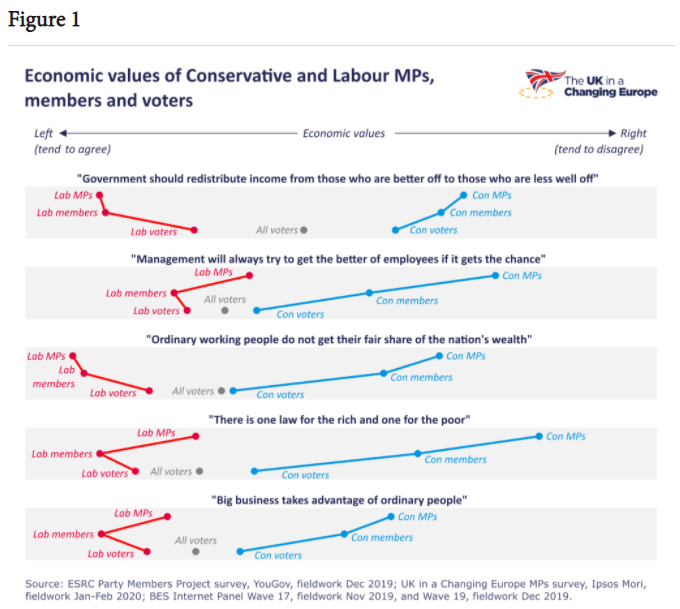
Let’s look, first, at economic values.  Figure 1 shows that on every question used to tap into those values apart from the first one on redistribution, the differences between what the Conservative Party’s MPs, grassroots members and voters are much bigger than they are between Labour’s people.

It also shows, incidentally, that, if Labour can overcome the economic competence deficit that has cost it so dear since 2010, and then get voters to realise just how differently Tory MPs think about the economy than they themselves do, then the Government could find itself in serious trouble.

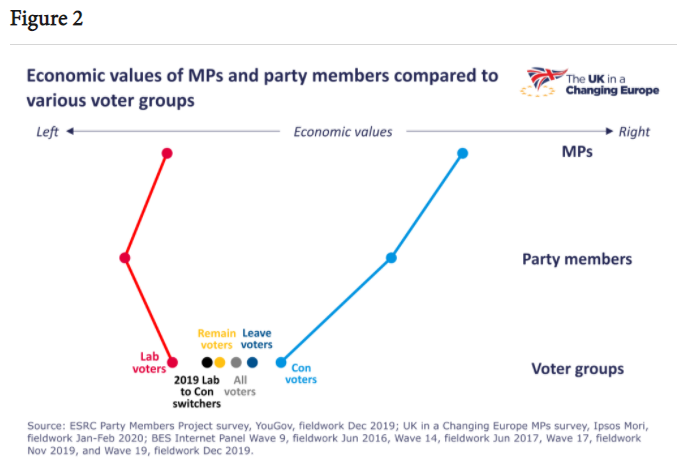
Figure 2 hammers home that warning. On every economic values question, the average voter who made the journey from Labour in 2017 to Conservative in 2019 (represented by the black dot) is more Left-wing than the average member of the public, as well as noticeably to the Left of the average individual who voted Conservative in 2019.

Moreover, these 2019 Labour-to-Conservative switchers are far, far closer to Labour when it comes to underlying economic values than they are to the Conservatives. For instance, a full 81% of those switchers think that big business takes advantage of ordinary people – very much in line with 83% of Labour MPs and 92% of Labour members, but very much out of line with Tory members and Tory MPs, only 34% and 18% of whom, respectively, think the same way. And on whether “there is one law for the rich and one law for the poor” the 84% of Labour-to-Conservative switchers who agree are far closer to the 92% of Labour members and the 71% of Labour MPs who say the same than they are to the 22% of Tory members and 5% of Tory MPs who think so too.

Keir Starmer might have sacked Rebecca Long Bailey last week but he’s no neoliberal, and nor is his Shadow Chancellor Anneliese Dodds.  They will be perfectly comfortable putting forward an economic recovery plan that reflects those switchers’ values. Boris Johnson and Rishi Sunak? Not so much. Any conversion to socialism brought on by the current emergency will, one suspects, be short-lived, leaving the party — on the economy at least — stranded way to the right of many of the voters they need to hold onto.

But when it comes to social and cultural values, it’s a whole different story – and a story with what could well be a happier ending for the Conservatives.

For one thing, as Figure 3 shows, generally speaking (the exception being the death penalty), the Conservative Party’s MPs, members and voters are more united than their Labour counterparts and, as a whole, tend to be a little closer to the average British voter.

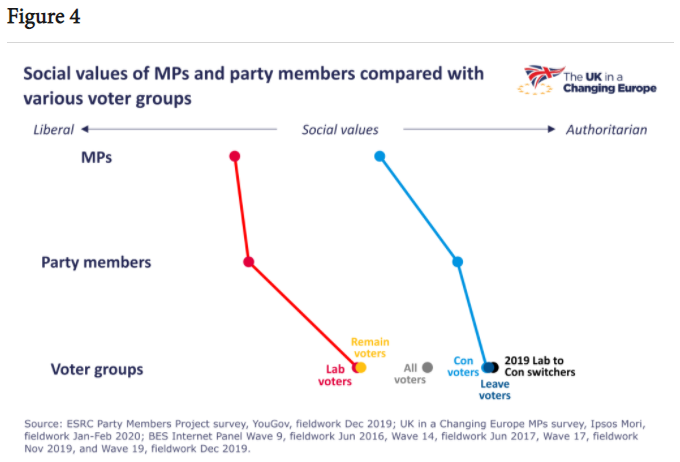
For another, when we look at different groups of voters, as we do in Figure 4, we can see that — in what is essentially a mirror image of the picture on economic values — 2019 Labour-to-Conservative switchers (again represented by the black dot) are much, much closer to the Conservatives when it comes to underlying social/cultural values than they are to Labour. In fact, those switchers even sit to the right of Conservative members and Conservative MPs.

Ultimately, though, it is the yawning gap between the 2019 switchers and the Labour Party they abandoned that is most striking. Just 17% of Labour members and 9% of Labour MPs think that “young people don’t have enough respect for traditional British values” — a view held by 88% of Labour-to-Conservative switchers. The idea that schools should teach children to obey authority is supported by 81% of those swing voters, against just 29% of members and 41% of Labour MPs. Stiffer sentences are supported by 85% of switchers — again way more than is the case for Labour members (25%) and Labour MPs (24%).

It is also striking, again from Figure 4, but this time looking solely at parliamentarians (who are, after all, the most visible representatives of their respective parties as far as voters are concerned), that Tory MPs are far closer not just to their voters but to all voters, than are Labour MPs. That’s because, much as it pains liberals to admit it and even if things may gradually be shifting their way through generational change, Brits remain a pretty authoritarian bunch.

Given all this, some kind of culture war, however damaging and polarising some fear it would be, is arguably a perfectly rational strategic choice for the Conservatives in the years to come. It would build on — but, just as crucially now that Brexit is nearly done, allow them to build out of — the Leave-Remain identities established, to their obvious recent advantage, since 2016.

Pushing back against supposed attempts by the liberal elite to make Brits ashamed of their history and downplaying structural and institutional racism are only the more obvious aspects of such a strategy. Clamping down on illegal immigration — especially now that Nigel Farage is back punching that particular bruise — will also loom large. Even apparently trivial interventions, such as Gavin Williamson’s call for schools to insist pupils face the front and pay attention to the teacher rather than each other play a part.

There are, however, just a couple of crucial caveats.

First, it takes two to tango: while there may be plenty of socially liberal Labour MPs who might easily be tempted to fall into a Tory trap on this score, for example by allowing it to look like they were lecturing Home Secretary, Priti Patel, on racism. Keir Starmer and most of his Shadow Cabinet, whatever their true feelings, seem far less likely to take the bait.

Second, but no less important, the figures above suggest that Conservative MPs are not only more socially liberal than Conservative grassroots members and Conservative voters but more liberal than most voters – and on some issues are even more liberal than Labour voters. To win a culture war, like any other war, a general not only needs all his troops behind him but they all have to be up for the fight.

So if Boris Johnson is genuinely serious about ‘levelling up’ — and indeed about ‘fucking business’ — then this new research strongly suggests that he risks a good deal of unhappiness on the benches behind him from those overwhelmingly Thatcherite backbenchers who joined the Conservative Party to promote, not mitigate the free market.

It also suggests that, on social and cultural values, those MPs have rather more in common with the old Boris, the live-and-let-live liberal mayor of London, than with the ersatz Trump some of his advisors seem to want him to become. The electoral logic, however, points strongly to him listening to those advisors rather than worrying too much about the misgivings of his parliamentary colleagues.

Originally published at https://unherd.com/2020/06/how-out-of-touch-is-the-tory-party/

Posted in Uncategorized | Leave a comment

What is Keir Starmer up to over a Brexit extension?, New Statesman, 8 June 2020

Nobody, outside the ranks of Britain’s Brexiteer ultras, thinks that ending our transition out of the European Union’s single market and customs union without having secured some kind of trade deal is a good idea. Indeed, it’s becoming increasingly obvious that business – whether we’re talking about outfits like the CBI or individual firms such as Nissan – is beginning to panic about the possibility.

The obvious way for the government to calm these nerves, especially since so little progress seems to have been made so far in negotiations with Brussels, would be to agree an extension with the EU. But this presents it with two problems.

First, any extension has to be agreed by the end of this month. The idea that it can easily be done at a later date should talks over the summer fail to break the logjam is, as the Institute for Government clearly shows in its latest report, for the birds. It’s pretty much now or never.

Second, when the government passed the Withdrawal Act earlier this year, it decided – both to reassure Leavers and to persuade the EU it was prepared to play hardball – to make it difficult, if not impossible, to agree an extension without passing primary legislation.  Obliging it to perform a volte-face would therefore require an enormous amount of pressure.

And yet no such pressure is forthcoming – not at least from Her Majesty’s Opposition. The Mayor of London, Labour’s Sadiq Khan, may have written to the Prime Minister calling on him, in terms, to agree an extension. But the Labour leader, Keir Starmer, has conspicuously not chosen to join him. 

In so doing, Starmer seems determined to stick with the strategy that first became apparent in early May, when, after he was asked by LBC’s Nick Ferrari whether he would ‘press pause’, he simply reminded listeners that ‘the government says it’s going to get [a deal] done by the end of the year. So let’s see how they get on.’ Ferrari tackled Starmer again on the issue during the first Call Keir show; but, as well as reiterating that ‘the Leave-Remain divide is over’, he resolutely refused to call for an extension to transition.

In some respects, Starmer’s seeming lack of urgency is surprising – shocking even. This, after all, is the man who thought Brexit was such a bad idea that, with the help of Labour’s overwhelmingly Europhile membership, he dragged a clearly reluctant Jeremy Corbyn sullenly towards a second referendum. And this is a politician who, while urging Remainers to accept that the UK has now left the EU, is fully aware of the severe damage and disruption that leaving it without a trade deal could do – especially on top of the economic destruction wrought by Covid-19.

Surely, then, Starmer should demanding Boris Johnson do everything in his power to minimise even the slightest risk of that happening – a demand that, logically anyway, should see him campaigning hard for an extension?

But Starmer is also a politician who, perhaps owing to his legal experience, thinks very carefully before he opens his mouth – someone who neither speaks nor holds his peace without good reason. And as soon as you start to think about it, there are plenty of good reasons for Starmer to keep schtum on the question of an extension.

Most obviously, what would calling for one gain? It’s not as if it’s likely to make it happen. For one thing, Johnson, Frost (and presumably Cummings) seem if anything to have doubled down lately on their promise not to ask for more time. For another, a government that’s already earned itself an embarrassing reputation for U-turning in response to pressure from the new leader of the opposition is even less likely to want to do so again – not on something this huge anyway.

Moreover, it’s not as if Starmer would, by calling for an extension, be putting himself at the head of a furious and fast-growing campaign for one on the part of the public or crucial pressure groups. True, there is a petition to extend out there. But, with fewer than 80,000 signatures, it hasn’t even reached the threshold for parliamentary debate and is a long, long way off the six million-plus garnered by last year’s petition to revoke article 50 and remain in the EU.

True, too, polling suggests a majority (albeit one made up mainly though not exclusively of Remain and non-Tory voters) for an extension in the face of Covid-19. But as always there’s a big difference between what people say they agree with when asked by a pollster and what they urgently, desperately want to happen.

It’s also noticeable that, while both individual firms and the organisations that represent businesses are very worried about leaving without a trade deal, they aren’t exactly clamouring for an extension either. Nor, it seems, are the trade unions – presumably because they don’t believe they’ll get one.

Assuming they’re right, and presuming their worst fears are realised and no trade deal can be done before December, the only advantage that would accrue to Starmer for having called for an extension now would be the right later on to say “I told you so” – never really the most persuasive argument in politics.

Meanwhile, Starmer would spend the next six months being labelled not just a Remoaner but someone who preferred to retain free movement rather than see the government bring in its much-trumpeted (and overwhelmingly popular) ‘Australian-style points based system.’

In the end, then, Starmer may well be wise to keep his counsel. There’s not much he can do to prevent the government pursuing the course it has set, and trying would only see him run into trouble. Sure, that course could end in tears – both for Britain and Boris Johnson. But, as a cynic might say, taking inspiration from a certain Monsieur Bonaparte, why on earth interrupt your enemy when he is making a mistake?

Originally published at https://www.newstatesman.com/politics/staggers/2020/06/what-keir-starmer-over-brexit-extension

Posted in Uncategorized | Leave a comment

‘The virus is changing politics, but there are opportunities as well as risks’, Times, 13 May 2020.

It’s an ill wind, they say, that blows nobody any good. And the coronavirus crisis is no exception. It’s too early to tell how – or how much – it will change UK politics in the long term. But we can at least make some educated guesses about the short- to medium-term opportunities and threats it presents to the Conservative government and to its Labour opposition.

Both the Brexit referendum and the 2019 general election proved that Boris Johnson is a phenomenally gifted campaigner. But doubts remained – even among his colleagues – about his capacity to handle the infinitely harder task of actually running the country.

Covid-19 provides him with the chance to put an end to those doubts once and for all – and to show a sceptical electorate that he’s not just someone they can’t help but like but someone they can trust as well.

More broadly, the crisis provides the chance for the Conservatives to convince people that the NHS really is safe in their hands – something they’ve had an awful lot of trouble doing since it was created by Labour nearly three-quarters of a century ago.

Then there is the opportunity that the crisis gives the Conservatives to hit the reset button on a relationship with the BBC that was rapidly becoming poisonous, as well as on plans to reform immigration which looked set to cause major disruption to the labour market – especially in low-paid but crucial sectors like social care.

And talking of social care, the coronavirus crisis presents the government with the perfect opportunity to grasp a nettle that it might otherwise have shied away from.

Truly profound changes in the UK often come about not as the result of cross-party initiatives but as a result of one or other of the two main parties making the running, leaving the other with nothing else to do but to play catch-up.

If they can do it, knitting together health and social care could pay as big an electoral dividend for the Conservatives as creating the NHS has always done for Labour.

Finally, the obvious need to repair the public finances after the crisis has passed presents the Conservative Party with another opportunity – the chance to shed its reputation as the party of austerity by raising (and just as importantly reforming) taxation instead of hitting the poorest hardest with yet more, largely counterproductive spending cuts.

None of this is to say, of course, that Covid-19 doesn’t present a serious threat to the party. For one thing, any post-mortem that takes place could end up revealing that its leader really was as reckless, as lazy and as uninterested in the detailed business of government as his critics feared.

And it could end up reminding voters big-time that, during a decade in power, the Conservatives spent far too little on the NHS.

There is also a clear and present danger that the party’s fixation with getting Brexit done could see the UK refuse to extend transition and, just as it’s struggling to get back on its feet again, effectively crash out of the single market and customs union without having secured some sort of deal with the EU.

Nor is there any guarantee that the Conservatives will eschew austerity as a means of balancing the books in the post-Covid-19 era, so blowing whatever opportunity they might have had to make a reality of their promise to level up Britain.

By the same token, they could easily fall back into banging on about immigration and BBC bias. Old habits, after all, die hard.

The same, of course, goes for Labour. Just as many in the party assumed, after the financial crash and then after nearly a decade of austerity, that the facts of life were socialist, the party could all too easily place too much faith in the idea that the public, having now seen what an active and high spending state can do, will want it to do more in perpetuity.

It is also entirely possible that any public enquiries into the UK’s handling of Covid-19 don’t end up doing the Conservatives as much damage as some suppose they will.

It remains entirely possible that voters, having decided for now that the government is making a reasonable fist of a very challenging situation, don’t change their mind, allowing Johnson and his colleagues a relatively easy ride back into office in 2024.

The coronavirus crisis also presents Labour with a more immediate threat, namely that very few voters are listening to what it has to say at precisely the time – just after a change of leader – that it might have been hoping to garner a little more of their attention.

That said, the crisis nevertheless presents Labour with some opportunities – and they go beyond distracting the electorate from what might otherwise have been a seriously damaging renewal of factional infighting following the leak of a deeply embarrassing internal report a couple of weeks ago.

Most obviously, assuming that report can indeed be made to go away, everything prior to Covid-19 will seem like a very distant memory.

That includes not just the Corbyn era but many of those faces associated with it. Meanwhile, their successors in the shadow cabinet will have more than enough time, given how little legislation is likely to be passing through parliament any time soon, to read themselves properly into their portfolios.

And while, as we have noted, there is a danger of Labour presuming too much about the state spending and intervention occasioned by the virus inevitably creating a more benign environment for a social democratic party, it still remains possible, at the very least.

Finally, there is the fact that the crisis could put more of a premium on competence than on charisma – which should suit Labour’s new leader.

Keir Starmer’s constructive, measured and forensic style might well make him a formidable opponent not just in the weeks and months but also in the years to come.

Given the double-digit swing he needs to win an overall majority, his colleagues will be hoping and praying that’s the case.

Originally published at https://www.thetimes.co.uk/article/the-virus-is-changing-politics-but-there-are-opportunities-as-well-as-risks-kg9trpxj8

Posted in Uncategorized | Leave a comment

‘Does Boris Johnson have the Conservative Party’s permission to extend transition?’, with Hovid Minasyan, 30 April, UK in a Changing Europe.

A new survey from Deltapoll has confirmed what others have already pointed to – namely that a majority of the public, given the outbreak of Covid-19, are now in favour of extending the UK’s transition out of the EU’s single market and customs union.

True, there is a big difference on the issue between Remain and Leave voters, but even 39% of those who voted to quit the EU in 2016 and voted for the Conservatives in 2019 agree.

So although his chief Brexit negotiator continues to insist he won’t be doing so, Boris Johnson has the general public’s permission to extend transition. But does he have permission from a group to which he’s likely to pay just as much attention – Parliament and, in particular, his own MPs?

That’s a question that’s difficult to answer directly. But we can make an educated guess by looking in more depth at the parliamentary Conservative Party returned to the Commons in 2019.

The 2016 referendum saw almost every front- and back-bencher then sitting in Parliament, as well as many destined to join them, adopt a position on the issue. A substantial minority, particularly in the Conservative Party, plumped for Leave, but the majority went for Remain.

The public’s vote to leave the EU, therefore, meant that a lot of folk at Westminster had, in effect, picked the wrong team.

Some of them stuck to their guns – particularly if they represented opposition parties. Others – particularly if they were Conservative MPs – very quickly decided to get with the programme.

A new dataset, compiled at Yale University, allows us to see how things shook out.

The dataset looks at the stance that MPs elected in the 2019 election cycle took on Brexit in 2016, regardless of whether or not they were MPs during the referendum. It uses a combination of social media, MPs’ personal websites, newspaper interviews, and media reports.

Some MPs remain a mystery but not many: the dataset captured 354 of the 365 Conservative MPs elected in 2019, for instance.

So what of the trends? The most obvious is that, although Parliament became significantly more pro-Leave by 2019, this was entirely due to a massive shift within the parliamentary Conservative Party.

Almost all Conservative MPs who were pro-Remain in 2016 left Parliament in 2017 or 2019 or – in the case of nearly all of the 129 Conservative Remainers who were elected to the Commons in 2019 – had shifted to either vocally or tacitly supporting Brexit.

Some 98% of current Labour MPs qualify as Remainers, as the ten Labour MPs who had supported leaving in 2016 dwindled to just three: four chose not to stand and three lost their seats.

All MPs representing the smaller parties were Remainers in 2016, while all DUP MPs were Leavers. On the other hand, only 36% of current Conservative MPs were Remainers back in 2016 – a 21 percentage point drop on the figure for those elected in 2015 and a similarly big change even from those elected in 2017.As to what caused that drop, the numbers tell several stories.

Firstly, the Conservatives won 59 seats from other parties, most of which were previously represented by MPs who had supported Remain in 2016. Pro-leave Conservatives also won 43 seats from pro-Remain Conservatives.

In large part, however, this process of replacement wasn’t needed to effect the change that a party leadership now committed to Brexit at apparently any cost required.

That’s because, according to the Yale dataset, nearly all of those Conservative MPs (96% to be exact) who were elected in 2019 but who supported Remain in 2016 changed their tune and decided to toe the party line and support Brexit.

Why they decided to do so is open to debate. Maybe they came to believe that to do anything else in the light of the referendum result – albeit a result that went against them – would have been anti-democratic.

Maybe, having listened to the arguments that raged in the two-and-a-half years following the referendum, they finally found themselves persuaded that Brexit would be best for Britain.

Or maybe they simply and swiftly realised which way their bread was buttered. After all, success in politics requires a dash of idealism but an even bigger dollop of realism.

That realism, however, may also extend to sympathy for the idea that, in the face of the coronavirus crisis, the UK and the EU cannot hope to come to a satisfactory deal by the end of this year.

So let us assume, for the sake of argument, that all of the 129 Conservative MPs currently sitting in the Commons who, according to the Yale dataset, originally supported Remain would, irrespective of their post-referendum conversion to Brexit, nevertheless vote to extend transition.

Let’s also assume that the proportion of the 225 Conservative MPs who, according to the Yale dataset, voted Leave in 2016 but might now be prepared to support extending transition matches the 39% of their Conservative and Leave voting counterparts in the general public.

Add the resulting total of 88 MPs to the 129 and ‘extend’ beats ‘don’t extend’ by 217 to 137.

Good news for Johnson? Hardly: 137 potential rebels is a very worrying figure indeed, dwarfing the government’s effective working majority of 87.

That said, it might be an overestimate: using another recent attempt to calculate the Leave-Remain balance on the Conservative benches would put the figure nearer 120 than 140.

Moreover, if Johnson does ultimately opt to extend, and assuming he goes down the legislative route to do so, then he would whip his MPs hard to support him.

That, and the fact that some of the potential rebels will be part of the payroll vote, might reduce that worrying figure still further.

And ultimately, were the PM to change his mind about extending transition, he would also be able to rely on the support of opposition MPs who, as the Yale dataset confirms, are (or at least were) Remainers almost to a man and woman.

In short, Johnson will be able to get permission to extend from Parliament – and from the majority of his Conservative colleagues – as well as the public. The $64,000 question now is will he seek it?

Originally published at https://ukandeu.ac.uk/does-boris-johnson-have-the-conservative-partys-permission-to-extend-transition/

Posted in Uncategorized | Leave a comment

‘A Brexit extension would face serious opposition even during coronavirus’, Financial Times, 11 April 2020

More often than not, the burden of proof for a major shift in policy lies with those advocating change rather than with those resisting it. But what if the arguments in favour of that shift seem so self-evident to its advocates that they don’t bother to anticipate the arguments that will be mounted against them?

Forewarned, they say, is forearmed. So for those who believe that, in the light of Covid-19, the UK should ask for an extension to its transition out of the EU — pushing off the end of December deadline for a deal on the future relationship — what are the arguments Brexiters are likely to deploy against them?

Some sense of those arguments can be obtained by responses to an invitation I issued online last week for objectors to explain why transition shouldn’t be extended — a thought experiment that effectively reverses the burden of proof by transferring it from those advocating change to those resisting it.

My invitation elicited hundreds of responses.

Perhaps inevitably, some purported to detect what they saw as yet another example of Remainers’ inability to come to terms with the fact of Britain leaving the EU — a variant of a more widely-held suspicion that any extension of transition represents yet another attempt by those opposed to Brexit to try to block it.

The aim here is not to squash or even critique those suspicions.

That, after all, is for advocates of extension, who will need to take on objections rather than assuming that what they see as the logic of their position will ultimately prevail. That would be to risk repeating the mistake made by those backing Remain in the 2016 referendum.

On Thursday the government offered an official response to a petition to extend that appeared to give no ground: “We will be recovering economic and political independence at the end of the year, which the British people voted for,” said the statement from the Cabinet Office.

And while some high-profile Brexit supporters have begun to accept the idea, others have not.

One common argument against extending transition is that there is still plenty of time to conduct negotiations with the EU.

While face-to-face meetings are clearly impossible during the coronavirus pandemic, talks can, they claim, be conducted just as well by videoconferencing — especially since the civil servants participating in them, are not, they say, also involved in the battle against coronavirus.

There also appears to be a widespread belief among Brexiters that, rather than proving a distraction, the coronavirus crisis could even concentrate the minds of the two sides.

In any case, they claim, since any agreement with the EU is bound to be made at the last minute, what on earth is the point of putting off that last minute for a year or two?

Many are convinced, too, that the coronavirus crisis has left the EU distracted, divided and weakened, meaning that now is exactly the right time for the UK to secure a good deal.

There are plenty of Brexiters, of course, who don’t want a deal at all (and/or think the EU will grant one only on punitive terms), and believe that keeping to the current timetable will make their preferred departure on World Trade Organization terms all but inevitable.

They also argue that, since the UK economy will be on its knees in the wake of the coronavirus crisis, it would be pointless to try to rebuild it within the single market and the customs union only to then have to rebuild it again once any extended transition comes to an end.

Better, they say, to rip the dressing off the wound, end any damaging uncertainty, and free the British economy from EU regulations (for example on state aid) and the burden of further payments to Brussels so that the country can start enjoying what they see as the full benefits of Brexit sooner rather than later.

Related to this is an argument that, since the entire British (and EU) economy will have ground to a halt by the end of the year anyway, any economic shocks and logistical disruption caused by an abrupt UK departure from transition will supposedly be less noticeable and less costly now than they might have been prior to the coronavirus crisis.

And then there is the pervasive belief that the current crisis has shown quite how dysfunctional, disorganised, and even downright malign the EU really is.

This not only confirms Brexiters’ belief that the UK was right to leave but leads them to worry that, unless transition ends in 2020, the British government will be liable to hand over additional funds to bail out the eurozone or member states particularly badly hit by Covid-19.

In any case, they stress, ending the transition at the end of 2020 was a Conservative manifesto promise and any breach would erode public trust in the government at a time when that trust is vital to see off Covid-19. Such a betrayal would also be tantamount to an admission that the UK is unable to go it alone.

Indeed, for some Brexiters, this crisis is a reminder that the UK needs to reduce or even end its reliance on other countries to provide it with food, manufactures and pharmaceuticals.

Polling now shows that two-thirds of the public support extending the transition period beyond the end of this year, although there is disagreement about how long, with 29 per cent favouring a year or less, and 38 per cent willing to wait as long as it takes. But be in no doubt, such a decision is not inevitable.

People like the new Labour party leader Keir Starmer, if they believe an extension may well prove necessary, need to come up with some effective arguments — and since the real deadline is at the end of June, the last moment when a change to the timetable can be legally agreed, they need to do so soon.


Originally published at https://www.ft.com/content/97d9d574-78e9-11ea-bd25-7fd923850377 


Posted in Uncategorized | Leave a comment

‘Covid-19 and the transition period’, UK in a Changing Europe, 19 March 2020.

Last year, some six million people signed a petition on Parliament’s website calling for the revocation of Article 50 and for the UK to remain in the European Union.

But right now, as the covid-19 crisis threatens to overwhelm the country’s capacity to cope on all sorts of levels and yet the government continues (at least officially) to rule out extending the transition period beyond the end of this year, fewer than twelve thousand (at the time of writing) have gone on to the same website to sign a petition calling on them to do just that.

By way of comparison, that’s less than number who’ve signed one calling on the government to ‘make pet theft crime a specific offence with custodial sentences.’

What – apart, of course, from the fact that we’re supposedly a nation of animal lovers – might account for that difference?

The answer’s not immediately obvious. After all – and a YouGov poll supports this – it seems intuitively reasonable to assume that the so-called Remoaners who wanted to stop Brexit last year would be particularly keen to avoid an unduly abrupt end to transition.

As former Chancellor Alistair Darling (someone who knows a thing or two about preventing a crisis turning into a catastrophe) put it, ‘it’s madness to contemplate shooting yourself in the foot on an entirely man-made political decision at a time when you don’t need to do that’. Who knows, even some Leavers may concede he has a point?

Thinking a little harder about why so few people, and particularly so few ardent Remainers, have signed the petition, a number of explanations spring to mind. Most obviously, when it comes to the two petitions we’re admittedly talking about a difference not of degree but of kind.

For Remainers, anyway, last year’s petition was existential – in or out, all or nothing. This year’s can do little more than postpone the inevitable. As such, it’s clearly less likely to ignite the passion of your average Europhile.

And then there’s the fact that last year’s petition ultimately made no difference. ‘If the government didn’t allow over six million signatures to change its mind’, some will ask, ‘then what’s the point’?

Sure, after any petition gathers over one hundred thousand signatures it is considered for a debate in parliament. But that debate happened, and made no difference.

The petition to delay transition reached ten thousand signatures on the night of 17/18 March, which means that, while it has a way to go to reach the threshold for debate, it does at least require a response from government – one that should (in normal times anyway) come within 21 days.

But as the Hansard Society’s Brigid Fowler has pointed out, there is nothing to stop said response saying anything more than ‘s.33 EU (WA) Act 2020 makes UK government agreement to a transition extension unlawful.’

Most people won’t have a clue about that of course. But they probably don’t have to in order to be sceptical as to whether a government response will achieve much in the way of concrete action.

Another possibility is that people reckon that said extension is going to happen anyway. It makes such obvious sense in the circumstances – and, if they’re fans of the always impeccably well-informed Peter Foster  – they may have read that some in the government are strongly hinting at just that.

Persuasive? Not totally – and not just because the entire population don’t read Peter’s tweets, even when they so obviously should do. After all, the same air of inevitability surrounded the government’s decision on 18 March to close schools.

Of course, few if any of those who signed that petition were likely to have worried that it might spark a counter-reaction – something that could perhaps be a concern among those who’d like to see the transition extended but fear that actively campaigning for it might mobilize Brexiteer opinion against it.

All a bit reminiscent of a victim of coercive control treading on egg-shells lest they set off their angry other-half, but similarly understandable perhaps.

The same consideration might be preventing high-profile, pro-European politicians supporting the postpone petition, as they did on the Article 50/Remain one last year, and therefore failing to provide an important cue for ordinary folk to go sign it.

And those same politicians might also be (equally understandably) worried that adding their voice to the cause might see them accused of politicising the covid-19 crisis – an accusation that no sensible person in public life wants to have to face right now.

But, in the end, perhaps, none of the above explanations trump the most obvious one – namely that none of us right now can really think of anything much else than the immediate threat posed by covid-19.

As a result, the end of transition (assuming we’re aware in the first place that Brexit’s not really ‘done’ without it ending) seems – quite wrongly of course – a very long way away indeed.

An earlier version of this post was published at https://ukandeu.ac.uk/covid-19-and-the-transition-period/


Posted in Uncategorized | Leave a comment