‘The PM we shouldn’t write off’, Unherd, 19 July 2019.

The current Tory leadership contest is sheer agony – especially for those of us able to call to mind the calibre of some of those who have steered the party and the country in times gone by. There’s one man, in particular, whose influence on Britain and the wider word was – and continues to be – immense. And yet his name isn’t lauded like say, Churchill or de Gaulle. History seems rather to have written him off. But without him, our lives might have been very different. I’m thinking of Harold Macmillan.

Let’s begin with his more trivial achievements – well, relatively trivial. In 1956, Macmillan, as Chancellor of the Exchequer, was looking for ways to dampen down inflation by cutting consumption. In that year’s budget, he introduced a government-backed savings vehicle which paid out no interest but instead offered investors the chance to win a tax-free prize every month. Sixty or so years later, over 20 million people in the UK own well in excess of £30 billion worth of Premium Bonds.

A fair few of those people will also live in a house originally built in the years following the war. Some of those buildings, of course, went up during the pioneering Labour government that led Britain between 1945 and 1951. But even more of them were constructed under the Conservative government that followed it – and which ran the country for 13 years until 1964.

That government’s first Minister of Housing – the man to whom many believed Churchill had given a poisoned chalice by asking him to achieve the seemingly impossible target of 300,000 properties a year – was (yes, you’ve guessed it) Harold Macmillan. Via some judicious deregulation, he not only helped the construction sector reach the target but helped it do so far earlier than expected.

Before that success, many of his colleagues had written Macmillan off, regarding him, indeed, as something of a political oddity and a personal failure (his impressive military record in WWI and diplomatic role in WWII notwithstanding).

Westminster’s worst kept secret was that his wife had been conducting an affair with his Conservative colleague, Bob Boothby, since the 1930s. And during that decade, Macmillan himself had earned a reputation as a disturbingly unconventional thinker on economic and social policy, writing volumes such as The State and Industry (1932)Reconstruction: A Plea for a National Unity (1933)The Next Five Years (1935), and, perhaps most famously, The Middle Way (1938). All of them championed the idea that governments should take greater responsibility for the economy as well as, more generally, the welfare of the population as a whole.

Meanwhile, Macmillan’s family business, in which he played an active role, was publishing John Maynard Keynes’ General Theory – probably the most influential book on economics of the 20th century. It is credited with helping to convince post-war policy makers that, via the management of demand by fiscal and monetary means, they could prevent a return to the unemployment which blighted Britain (and other countries) in the thirties.

It became increasingly clear after 1945, that the Conservative Party was going to have to reconcile itself to the public’s demand for a more activist state – one that would provide both economic growth and increased social security. And so Macmillan’s long-held beliefs looked rather more prescient. So, too, did his opposition to appeasement, which, along with that of Churchill, Eden and others, later helped to avert the charge that the entire Conservative Party had effectively given Hitler what he wanted.

As a result, and given his successful ministerial record under Churchill, it came as no surprise that, in April 1955, Eden having finally managed to winkle the grand old man out of Number 10, Macmillan was named Foreign Secretary. Later that year, he became Chancellor of the Exchequer.

Macmillan’s elevation to the Premiership just over a year later in January 1957, however, did come as something of a shock to those not in the know. It had a great deal to do with an event that is often quoted nowadays (in the same breath as Brexit) as one of the most disastrous and humiliating episodes for a British government in recent memory – the 1956 Suez crisis.

It might be going too far to assert that, without Macmillan, Eden would never have gone with the idea that Israel should invade Egypt in order to provide a pretext for Britain and France to snatch back the Suez Canal. But Macmillan’s enthusiasm for the plan, and his misplaced confidence that US President Dwight Eisenhower (whom he had got to know well during the war) would tolerate the operation, certainly did nothing to dissuade his colleagues from going ahead with it.

It is undoubtedly true, though, that it was Macmillan’s rapid realisation that the otherwise relatively successful intervention would have to be called off, not least in order to prevent a diplomatic disaster turning into economic chaos, which convinced those same colleagues to stop it in its tracks.

It was also Macmillan who, unlike, his rival Rab Butler, was able to convince his furious fellow Conservative MPs that the government could recover from the affair – one of the main reasons the party turned to him rather than Butler when Eden resigned.

Supermac – as he came to be dubbed – turned out to be right. Not only did he manage to repair relations with the US, later striking up a friendship with the much younger Jack Kennedy, but at the 1959 election – one unusual for being fought in the autumn rather than the spring or summer – he increased the Conservative Party’s overall majority to over 100.

This he did by persuading voters (who he famously said “had never had it so good”) that it was the architect and guarantor of their burgeoning consumer affluence, establishing the template later used to similarly devastating electoral effect by Margaret Thatcher in the loadsamoney 1980s. But he also did it by refusing to countenance the public spending constraints demanded by his supposedly proto-Thatcherite Treasury team, whose resulting resignation in January 1958, Macmillan, with his characteristic ‘unflappability’, dismissed as “a little local difficulty”.

In hindsight, this may have been unwise – though not nearly as unwise as his fateful decision in 1960 to commission Dr Beeching to write his report which resulted in the closure of a third of Britain’s rail network, cutting off hundreds of towns and villages from one of the most environmentally-friendly (if costly) forms of transport.

But it was surely in defence and foreign affairs that Macmillan made his biggest and most lasting contribution. He played a role in Cold War efforts to ban the testing of nuclear weapons but also secured the Polaris weapons system for the UK’s independent nuclear deterrent. He effectively admitted that Britain’s imperial game was up and then set a course firmly for decolonisation with his ‘Winds of change’ speech in February 1960.

And, of course, after trying to establish the European Free Trade Association (EFTA) as a counter to the EEC, Macmillan swiftly came to the realisation that the UK had no alternative but to join the bigger bloc, initiating its first of three eventually successful accession applications to what is now the EU.

Whether that 40-plus years of membership is about to end – and end in tears – who knows? What we do know, however, is that without Harold Macmillan, Britain and the world might well have looked very different.

Originally published at https://unherd.com/2019/07/the-pm-we-shouldnt-write-off/
Posted in Uncategorized | Leave a comment

‘Tory leadership contest: What’s on the minds of party members?’, BBC, 5 July 2019.

To read this, click here.

Posted in Uncategorized | Leave a comment

‘How the Tories became a Brexit death cult in thrall to Boris Johnson’, Independent, 27 June 2019.

Has the Conservative Party become a death cult? A few years ago that would not have been a question that it would have occurred to anyone even to ask. But after the publication of YouGov’s most recent polling of its grassroots members, it’s one that’s hard to ignore.

Some 61 per cent were willing to countenance significant economic damage to the British economy in order to leave the EU. And 63 per cent and 59 per cent of members were apparently content to see Scotland or Northern Ireland leaving the UK if that is what it took to get Brexit.

In some ways, even more shockingly, just over half of rank-and-file Tories (54 per cent) thought the destruction of their own party would be a price worth paying for Brexit, with only just over a third (36 per cent) feeling that, at that point, the game would no longer be worth the candle.

So what just happened? How on earth has the membership of an organization traditionally dedicated to the preservation of the Union – and, presumably, the preservation of itself – come to believe that nothing (well, almost nothing: a net 12 per cent thought Jeremy Corby becoming PM would be worse than not getting Brexit) trumped quitting the EU?

Obviously, this hasn’t come out of nowhere. It was in the early 1990s that the Conservative Party first began seriously experimenting with hard Euroscepticism (the idea that we’d have to leave the EU because reform would never deliver what we needed), and after that it began to need more and more of the stuff in order to feed what soon became an increasingly debilitating and expensive habit.

But to go from that to full-on junkie status – to so crave the hit you not only want but need to the point where you no longer really care whether you live or die – is quite something, and has only happened more recently.

That’s even more clearly the case if you recall the summer of 2015. Back then, alongside my colleagues Paul Webb and Monica Poletti, we surveyed Conservative Party members as part of an ESRC-funded research project (that will be published in September as a book called Footsoldiers: Political Party Membership in the 21st Century).

At that moment in time, two-thirds of members told us that they’d wait to see what their then leader (and prime minister) David Cameron came back with from Brussels before making up their minds how to vote in the upcoming EU referendum.

Fast forward to now and two-thirds of Tory members say they want not only Brexit and not only a hard Brexit (where we leave the customs union and the single market) but a no deal Brexit.

There are, of course, myriad reasons that might account for such a change of heart.

One obvious explanation is that Cameron’s renegotiation turned out to be such a damp squib that it proved once and for all to an already pretty hostile party that soft Euroscepticism (the idea that we could get reform from within and opt out of what we didn’t like) wasn’t really going to cut it.

Another is the rise and fall of Ukip, which under Nigel Farage’s breathtakingly brilliant leadership, managed to permanently fuse Euroscepticism and anti-immigration sentiment and, in so doing, represent a serious threat to the Conservative Party’s hitherto unchallenged hegemony over the country’s right-wing voters. It was a threat that the Tories responded to by essentially co-opting the insurgency’s agenda.

That co-option, of course, went on – more or less officially – before, during and after the referendum campaign, accelerating under Theresa May, who literally told members that “no deal was better than a bad deal”.

That notion was then given rocket-boosters by their celebrity-politician favourites like Jacob Rees Mogg and, of course, Boris Johnson, as well as by their favourite newspapers: don’t forget that a third of rank-and-file Tories read the Telegraph and just under a fifth read the Mail. The triumph of the Brexit Party at the European Parliament elections – a triumph no doubt assisted in part not only by Conservative voters but Conservative members – has only served to up the ante even further.

And then, finally, there’s what some insist on calling “entryism” – the promotion of the idea that Brexiteers, and especially former Ukip members, should join the Conservative Party to influence its policies, its choice of candidates and its choice of leader.

Surveys can’t confirm whether this so-called Blukip phenomenon is as real as some of the self-styled victims of it, such as Anna Soubry, have alleged. But what they do seem to show is that well over a third of the current Conservative Party membership joined after the 2016 referendum, which some will take as at least circumstantial evidence and may explain why they care more about Brexit than their party’s long-term survival.

What they also show is that, while no deal wins the support of “only” 60 per cent of those members who had already joined the party by the 2015 election, that figure rises to 70 per cent for those who joined after the 2016 referendum, and to an astonishing 77 per cent of those who became Conservative Party members after the 2017 general election.

In short, attitudes on Europe have hardened among rank-and-file Tories; but part of that hardening is due to the fact that some of those with less strident views on the issue may have left the party only to be replaced by Brexiteer-ultras. That, of course, is democracy. But it’s also bloody good news for Boris Johnson – at least until he risks, as prime minister, having to disillusion and disappoint them.

Originally published at https://www.independent.co.uk/voices/brexit-boris-johnson-tory-leadership-party-conservative-no-deal-ukip-nigel-farage-a8977716.html

Posted in Uncategorized | Leave a comment

‘People are unpredictable at predicting what they will do’ (with Phil Cowley), Times, 27 June 2019.

How good are you at predicting what you’ll do in the future? Or even remembering what you’ve recently done – particularly when it comes to politics? Not always that good, if our research is anything to go by.

Prior to Donald Trump’s state visit to the UK, we surveyed Londoners on their attitudes to the visit. This was the latest in a series of polls, conducted by YouGov, which Queen Mary University of London’s Mile End Institute has been running on the politics of London.

More than half of respondents (54 per cent) said they opposed the US president coming to the UK, compared with just 24 per cent who were supportive. We also asked people whether or not they were intending to go to any of the organised protests against his visit. Some 13 per cent said that they were likely to take part – of whom 4 per cent said “very likely” and 9 per cent said “fairly likely”.

If all of those saying their participation was likely had turned up, attendance at the anti-Trump protests would have involved close to a million Londoners (916,000), in addition to anyone who might have travelled in from outside the capital.

Nobody – apart from Mr Trump himself perhaps – is denying that those protests went ahead in June but almost a million Londoners? Hardly.

While crowd sizes are always difficult to estimate, even the organisers of the main London rally – who have an incentive to accentuate the positive – claimed a figure of about 75,000 people and some news organisations were sceptical it was this high. Yet even 75,000 is a lot less than 916,000.

What explains this gap? It is worth noting that the survey didn’t ask people if they were definitely going, only if they were “very” or “fairly” likely to do so, and we wouldn’t expect every single one of these people to turn up. Yet even if we discount entirely all of those who said they were “fairly” likely to attend, even the figure for those who claimed they were “very likely” to take part in the demo would have yielded a crowd of more than a quarter of a million London adults, plus any out of towners.

This is, then, yet further proof that people can be pretty hopeless at predicting their own behaviour – especially those who say they’re going to something rather than nothing. Some people may have been genuinely keen to go, only for something – work, childcare, whatever – to prevent them.

Some may have a very low bar for what “very” or “fairly” likely may mean. Some may be using the question more to signify that they did not approve of the trip rather than actually indicating they intended to go, whether they knew this or not.

So in a subsequent survey, this month and again with YouGov, we asked Londoners if they had been on the demo, asking them, in other words, not to predict what they might do, but what they actually had done. Only 2 per cent claimed they’d protested against Mr Trump. This compares with 94 per cent who said they did not go, along with 4 per cent who – for reasons we can only guess at – said they were “not sure”.

That 2 per cent would still, however, mean that 140,000 Londoners joined the protests – roughly double the number that did take part, even assuming that not a single participant came from outside of London. So even this figure is way too high.

Again, there are various possible reasons for this. All surveys have an element of sampling error (of about plus or minus 3 percentage points on any one figure), so it is possible that all of those who responded to the survey by saying they attended did in fact do so. Yet equally we do know that people lie about these sort of things. Some of us – whisper it softly – tell fibs that fit with our self-image as right-on and radical.

One study of voter recall found that people both claimed to have voted when they did not and vice versa, but the former was more likely and it was especially common among those who thought voting was important. As the study’s author, Paul Whiteley, noted: “People only mislead when it matters.”

One clue that this might be going on here can be found in those who said they were “not sure”. While there may be genuine reasons why you could be unsure whether you went on a demonstration (perhaps you go on so many demos you can no longer tell which is which?) the “not sure” figure was as high as 10 per cent among those aged 18-24, which was exactly the same age group who had said they were most likely to attend in the first place. Even anonymously, and as part of an online survey, some people just can’t bring themselves to admit they have fallen short.

Originally published at https://www.thetimes.co.uk/article/people-are-hopeless-at-predicting-what-they-ll-do-in-the-future-l2fg7lk6q

Posted in Uncategorized | Leave a comment

‘Tory leadership: Who gets to choose the UK’s next prime minister?’, BBC, 23 June 2019.

To read this one, click here.

Posted in Uncategorized | Leave a comment

‘The Surreal Contest to Succeed Theresa May’, Foreign Affairs, 17 June 2019

To read this one, click here.

Posted in Uncategorized | Leave a comment

‘Boris Johnson supporters want no-deal Brexit and less talk of climate change – new survey of party members reveals’, The Conversation (with Paul Webb), 11 June 2019.

By the end of July the UK will have a new prime minister. They will be chosen not by the electorate but by a group of around 160,000 members of the Conservative Party. This selectorate gets to choose between the two candidates who finish first and second in a series of votes held among Conservative MPs.

There has, perhaps not surprisingly, been a degree of disquiet expressed about this situation. Members of political parties are, generally speaking, more zealous than members of the public. Some argue that it might be better to leave the choice of the country’s PM up to MPs. They, at least, have a direct mandate from voters. And, since governments in parliamentary systems must retain the confidence of the legislature in order to stay in office, allowing MPs to choose would at least guarantee a chain of democratic accountability from executive to electorate. That is bypassed completely when party members alone make the decision.

Such concerns are surely all the more pressing because, as our research has already shown, grassroots Conservatives can hardly be said to be representative of the country as a whole, either demographically or ideologically. There are far more men among them than there are women; most of them live in the southern half of the country; they are generally pretty well-off; they are relatively old (although not quite as ancient as often suggested); they are very, very white; and they are also significantly more right wing than the average voter – whether we’re talking about their economic or social attitudes.

Our new analysis, however, using data from a recent survey of Conservative Party members that was kindly provided to us by Chris Curtis of YouGov, reveals something that is possibly even more worrying for critics of the process. The party members who support the clear front runner, Boris Johnson, are even more ideologically unrepresentative of British voters than are the bulk of their counterparts.

Indeed, compared to the kind of members drawn to the two contenders who, currently seem to stand the best chance of grabbing the crucial runner up spot – the environment secretary, Michael Gove, and the foreign secretary, Jeremy Hunt – Johnson’s supporters look anything but moderate.

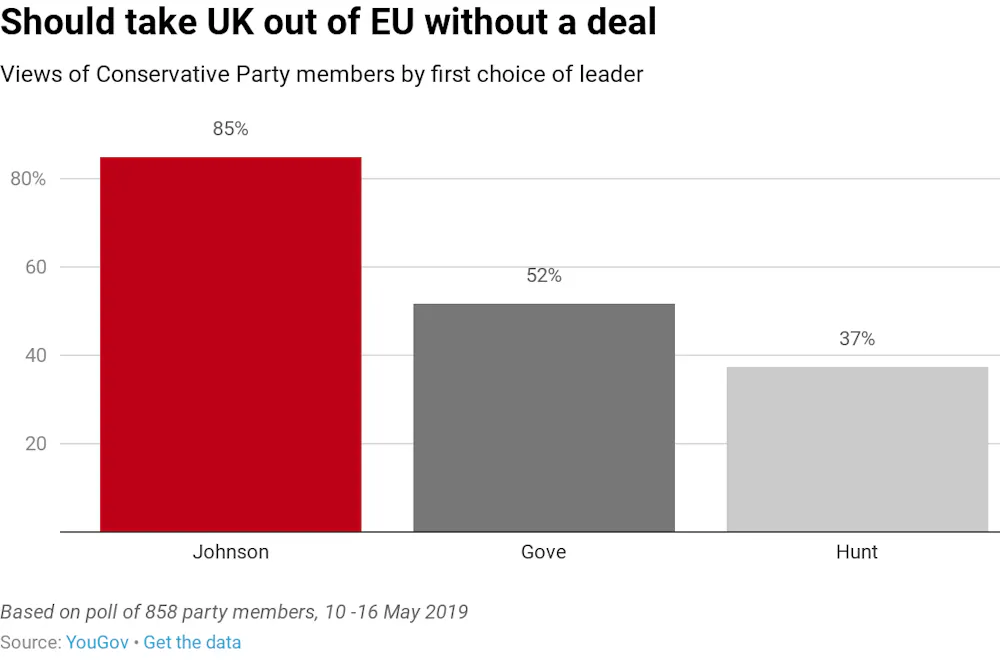
While only around a quarter of the wider British public support leaving the EU without a Brexit deal, an amazing 85% of Johnson’s supporters within the party are keen on a no-deal departure.

Can’t wait for that no-deal feeling. YouGov

Some two thirds (66%) of the nearly 900 Conservative rank-and-file members who responded to the survey said the UK should leave without a deal, so Johnson supporters are extreme even by that standard. “Only” 37% of Hunt supporters would be happy with a no-deal Brexit.

Even Gove supporters are less enthusiastic about no-deal than Johnson supporters. Their man was a leading figure in the Leave campaign but only 52% of them want to leave without a deal.

Right-wing base

It’s clear that, when it comes to the 39% of the Conservative grassroots who are in Johnson’s camp, what the party’s critics would no doubt label their extremism isn’t just confined to Brexit.

Asked to locate themselves ideologically, some 42% of members overall said they were on the right – not just of British politics, but of the Conservative Party itself, making Gove’s supporters (39% of whom said the same) about average. Just 15% of Hunt’s grassroots supporters (who make up just 8% of the membership overall) located themselves in that space.

Party members assess where they sit on the left/right spectrum. YouGov

Johnson’s supporters had no such problem: well over half of them (56%) said they belonged on the right wing of their party, with about the same proportion (58%) of them styling themselves as “fairly or very right wing”.

The impression that Johnson’s supporters are very much a sub-set of a sub-set is only reinforced when we dig into the specifics.

For instance, Tory members in general are more inclined than the general public to want to cut tax and spending, so it comes as no surprise that 34% of them supported that option – one that only around a fifth of voters right now would go for. But those members backing Johnson, 40% of whom supported cuts, were twice as enthusiastic about them as those backing Gove (20.5%) and Hunt (22%). This may well solve the mystery of why Johnson’s only big domestic policy so far has been his promise to cut taxes – the front runner is mobilising his base.

Johnson’s base is also relatively socially-conservative. A majority (although, at 59%, hardly an overwhelming majority) of Tory members think that David Cameron’s government was right to allow same sex marriage. Those supporting Gove – who has always been seen as socially-liberal and will be seen as even more so after recent revelations about his cocaine use – are slightly more likely (at 63%) than most members to agree. Supporters of Johnson and Hunt are slightly less likely (at 54% and 55%) to do so.

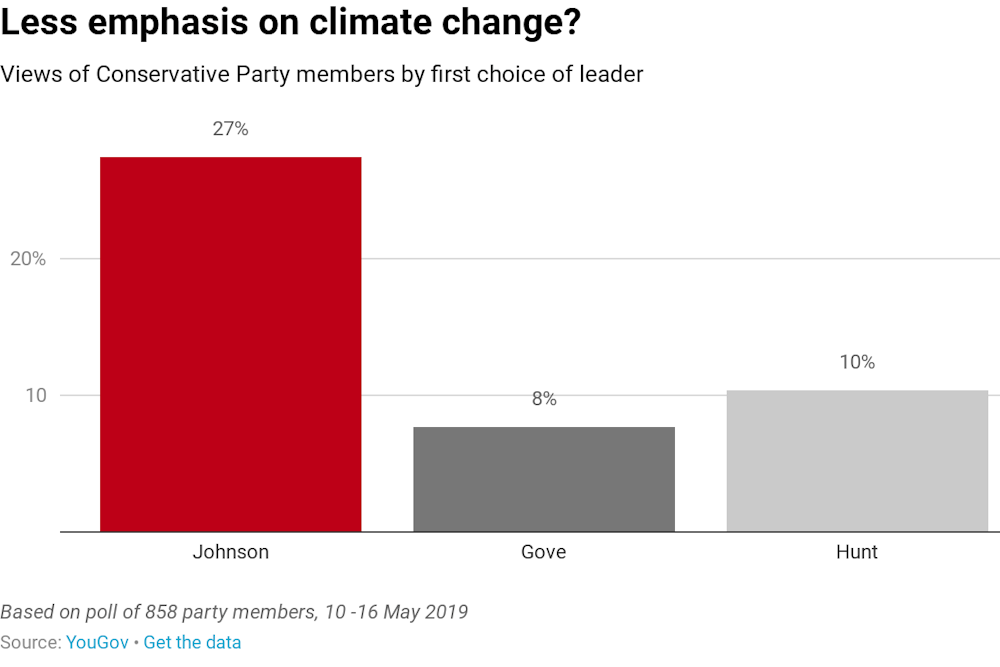
However, it’s probably climate change where we see the most striking attitudinal differences between those who support Johnson and those who support the others. Rather worryingly for those who regard the issue as a priority, one in five Tory rank-and-file members would like to see less emphasis on climate change. But that rises to one in four among Johnson supporters. Just under one in ten Gove supporters feels the same way, and just over one in ten Hunt supporters.

A worrying finding about climate change. YouGovAuthor provided

Why the difference?

Why that might be – and why Johnson’s supporters seem to be so generally right wing as well as so keen on a no-deal Brexit – can perhaps be explained, not by demographics (supporters of all three candidates actually look pretty similar in that respect), but by looking at when the members who responded to the survey said they’d joined the party.

Nearly half (44.5%) of all the members surveyed said they’d become party members sometime after the 2016 referendum. Hunt’s backers, 41% of whom had done the same, are therefore about average. In contrast, only a third (34%) of Gove’s grassroots backers joined the party after the referendum. That suggests he draws a slightly bigger proportion of his support from those who have stuck by the party through thick and thin. Over half of those rank-and-file Tory members who are backing Johnson, however, joined the party after the EU referendum three years ago.

Signs of a UKIP influx? YouGov

We can only guess as to how many of Johnson’s supporters were former UKIP sympathisers switching to the Tories; but it certainly seems possible. And, who knows, given that one doesn’t have to renounce one’s membership of the Conservative Party to become a registered supporter of the Brexit Party, perhaps some of them hold a candle for Nigel Farage as well as Johnson.

Whether the country will be as pleased as they will be if Johnson does end up making it all the way to Number 10, however, remains to be seen.

Originally published at https://theconversation.com/boris-johnson-supporters-want-no-deal-brexit-and-less-talk-of-climate-change-new-survey-of-party-members-reveals-118633

Posted in Uncategorized | Leave a comment

‘How Farage took control’, Unherd, 7 June 2019.

Politics is like poker. You don’t always need that strong a hand in order to win. You just have to convince your opponents that you do.

The influence of Europe’s – and in particular Britain’s – populist radical Right parties is a case in point.

Although we’ve been hearing about their rising support for years now, few of them have actually won sufficient seats in parliament to force their way into national office. And, as we’ve seen in Peterborough, some of them can’t even win high profile by-elections.

Yet – often with the help (if not necessarily the support) of a media that understandably craves conflict and novelty – they’ve managed to shift the centre of gravity strongly in their direction, particularly when it comes to questions of migration and multiculturalism.

For decades, many centre-Right parties either didn’t have to think very much about those questions (because the numbers coming to their country were so small) or, like the Conservative Party here, they had established a reputation in the minds of voters for being the tougher of the two main governing alternatives on such issues.

Once numbers began to increase, however, those centre-Right parties, already losing support as voters lost faith in their ability to produce the economic goods, were in a bind.

On the one hand, as market-friendly parties supported by business, they could see the case for maintaining a reasonably relaxed attitude: no point, after all, in cutting off a useful source of often cheap, hard-working and flexible labour. On the other, as self-appointed guardians both of their country’s traditional values and its sovereignty, they understood and sympathised with the cultural anxieties felt by many of their ‘natural voters’ – anxieties which more extreme alternatives on their right flanks were more than happy to exploit.

Social democratic parties on the Left, meanwhile, were losing support, particularly among the shrinking ranks of the traditional working class. And they were desperately casting around for reasons why. Rising support for the populist radical Right provided an easy, off-the-shelf explanation that avoided their having to ask whether the truth lay elsewhere – such as with their third-way embrace of less redistributive, less interventionist economic and social policies, and in the seemingly remorseless displacement of authentic working class voices by well-heeled, well-educated, and more professional politicians.

The evidence suggests that the centre-Left has always been significantly less likely to lose voters directly to the populist radical Right than its centre-right opponents. Take Denmark, which is much in the news at the moment. Yes, the Social Democrats, who’d considerably tightened up their already pretty restrictive immigration and integration policies, did well in this week’s general election. And yes, the populist radical Right Danish People’s Party did badly. But the one doesn’t necessarily explain the other – not when flow-of-the-vote calculations suggest that less than 10% of the former’s vote was made up of people who’d previously voted for the latter.

Yet, predisposed as they are to add two and two to make five, Labour and social democratic politicians all over Europe have been no less obsessed than conservative, Christian democratic and even liberal parties with trying to work out how to respond to a threat that can easily appear bigger than it is. What else explains Ed Miliband’s famous immigration mug, or Jeremy Corbyn’s desire to limit free movement not just of goods, services and capital but of people, too?

The mainstream’s first response is often to try to change the subject by talking about almost anything else other than immigration and integration. That’s not altogether impossible: after all, people still care about the economy and public services. But it’s very difficult to do when voters clearly are concerned about such things and, especially when there are plenty of politicians and journalists who know that ‘floods’ of migrants, their apparent ‘failure’ to ‘fit in’, and the supposed ‘strain’ they place on the welfare state make for such arresting headlines.

The mainstream’s response at that point is to try to fight fire with facts – which, as anyone who has tried it will attest, is normally about as effective as fighting with one hand tied behind your back, especially when not everyone in the mainstream (particularly on the centre-right, it has to be said) is averse to peddling some now-familiar myths themselves.

As a result, the most obvious recourse for both centre-Left and centre-Right parties is to claim ‘We’re listening’ and to start adopting – albeit in dilute form and couched in less inflammatory rhetoric – some of the diagnoses and the policy prescriptions of their more radical opponents. The hope, of course, is that voters, realising that their concerns (many of which revolve around the sheer rapidity of cultural change that they never explicitly consented to) are now apparently being taken seriously, will end their flirtation with the extreme and gratefully return to the mainstream.

Except it doesn’t always work like that. By ‘banging on’ about the urgent need to control migration and insisting that migrants mustn’t live separate lives, as well as about (to pick two not-so-random examples) net migration targets and the big bad EU, mainstream parties only serve to up the salience of such issues. And so, rather than undermining the populist radical Right, they actually do it a favour – not least because it can always trump any restrictive (or Eurosceptic) policy that a mainstream party can dream up with something much bigger and better.

Nigel Farage will no doubt be peeved by the Brexit Party’s failure to pull off a win in Peterborough. But it won’t wipe the smile off his face permanently. Farage knows from his days as UKIP leader that all he has to do to get what he wants (which, whatever he might say about taking over at Westminster, remains, in the end, a no-deal Brexit) is to score highly enough in polls and in European and by-elections to make sitting MPs believe that his candidates are capable of stealing enough of ‘their’ voters to gift their seats to their main opponent.

Right now, then, Farage has got both Labour and the Conservatives exactly where he wants them: living in fear and promising the undeliverable.

Originally published at https://unherd.com/2019/06/how-farage-took-control/

Posted in Uncategorized | Leave a comment

‘Britain has never been more European’, Politico, 28 May 2019.

Britain, welcome to Europe.

Nigel Farage’s upstart Brexit Party — which ran away with 32 percent of the vote and is set to gain 28 seats in the European Parliament — has blown the United Kingdom’s political system to pieces. And paradoxically, it’s made it more “European” in the process.

With the Conservatives and Labour Party bleeding support, and big gains for Farage, the Liberal Democrats and the Greens, the two-party system looks like it might be on its last legs — replaced by the multiparty pluralism that drives politics in much of Europe.

As hard as it may be to concede for those determined to buy into the myth of British exceptionalism, the U.K. is following in its neighbors’ footsteps.

Austria, Estonia and Germany — to name just three — have all reckoned with the rise of an extremist party in national politics. And across the EU, traditional catch-all parties of the center right and center left have also seen massive drops in support. New cleavages that cut across class divides have boosted the popularity of political startups on their flanks — be they populist far-rightists, radical centrists (à la Macron), radical leftists (como Podemos), Green parties, or even separatists.

Welcome to fragmentation, polarization, volatility and the erosion of traditional party loyalties.

This is not the first time, of course, that a populist, radical-right, British insurgency led by Farage has topped a European poll and sent a big bunch of MEPs to make as much mischief (and as much money) as possible in Brussels and Strasbourg: In 2014, the U.K. Independence Party (may it rest in peace) won 27 percent of the vote.

Despite Farage’s win this weekend, he is arguably no closer to holding office back home. As the former UKIP leader knows from experience, it’s by no means easy to turn what is effectively a protest vehicle (albeit a much flashier and better engineered one this time) into an all-singing, all-dancing outfit that people — even the people who play a starring role in every populist’s wet dreams — reckon is ready for government.

The more immediate implications of this European election for the U.K. is the collapse of its two big mainstream parties. If UKIP’s win five years ago sent tremors through British politics, this year’s Brexit Party upset is more like a full-scale earthquake.

Five years ago, the big two — let’s carry on calling them that for the sake of argument — performed woefully, but were still relatively close on UKIP’s heels (with 24 percent for Labour and 23 percent for the Tories). Together, they could claim to have the support of nearly half the country. That argument can’t be made this time around: Support for the two parties amounts to barely more than a quarter of the vote.

Labour’s share, at 14 percent, is its worst at a nationwide election in 100 years, and has already prompted calls for the party to pivot toward calling for a second referendum in order to stop the resurgent Liberal Democrats (on 20 percent), Greens (12 percent), and Scottish National Party (38 percent in Scotland) in their tracks.

But it’s the Conservatives’ share, at only 9 percent, that’s truly catastrophic. Perhaps most disastrously for the country, the result all but guarantees that they will now order the full English Brexit — namely a promise to leave the EU with or without a deal on October 31, cooked for our delectation by a charismatic leader like former Foreign Secretary Boris Johnson.

Sure, the Tories have almost certainly lost some votes in Remain regions to the Lib Dems. But neither the Tory MPs nor the grassroots Tory members who will vote to replace Prime Minister Theresa May as party leader are going to be listening to that particular still small voice.

Tory thinking (if you can call it that) goes something like this: By calling for Brexit to happen by Halloween, deal or no deal, the party can claw back most of the support it’s clearly lost to Farage by the next general election. After all, the argument goes, a year after UKIP’s 2014 triumph, David Cameron won an overall majority for the Conservatives.

This time, however, the Tories have even more reason to be worried. Cameron’s victory was the result of Britain’s first-past-the-post system, which favors large parties over small ones. But should the Brexit Party manage to maintain its lead over the Conservatives, then there’s no telling to which party that advantage will accrue.

We’ve been slowly moving away from two-party politics in the U.K. for decades now. The European election results might be the moment when we finally kiss it goodbye.

Posted in Uncategorized | Leave a comment

‘May’s Fatal Flaw’, UnHerd, 24 May, 2019.

After the initial surge of sympathy provoked in my sentimental old soul by Theresa May’s tears at the end of her speech in Downing Street, all I could think of were Oscar Wilde’s words on Charles Dickens’ The Old Curiosity Shop: “One must have a heart of stone,” Wilde wrote, “to read the death of little Nell without laughing.”

It was a speech of epic self-delusion and self-justification, followed by a veritable flood of hypocrisy from many of those who had made her life – indeed, all our lives – a misery for the last two years. Ultimately, though, they aren’t to blame for the mess the country and the Conservative Party is in today. She is. Where, then, did it all go so terribly wrong?

It was as soon as she stepped through the door of Number Ten Downing Street. Instead of turning round and telling people, particularly in her own party, the truth – namely that the referendum was a close run thing, that people had voted Leave for a myriad of different reasons, that the Irish border was bound to prove problematic, and that, more generally, the EU-27 weren’t going to allow the UK to have its cake and eat it – she decided to present herself as Brexitier-than-thou.

Quite why we can only guess. There are a number of possibilities, even leaving aside the temptation to cast her erstwhile adviser, Nick Timothy as the serpent.

Perhaps it was pure partisan opportunism – the thought of the Tories pulling off Brexit and pulling in many of the four million voters who had supported UKIP in 2015. Perhaps it was the need to prove her personal bona fides after playing the role of reluctant Remainer in the referendum campaign. Perhaps it was her tendency, after five years as Home Secretary, to see everything through the prism of immigration: Vote Leave stressed it; therefore the referendum was won on it; therefore free movement must end; therefore hard Brexit.

From that initial decision everything else flowed.

Originally published at https://unherd.com/2019/05/what-was-mays-fatal-flaw/

Posted in Uncategorized | Leave a comment